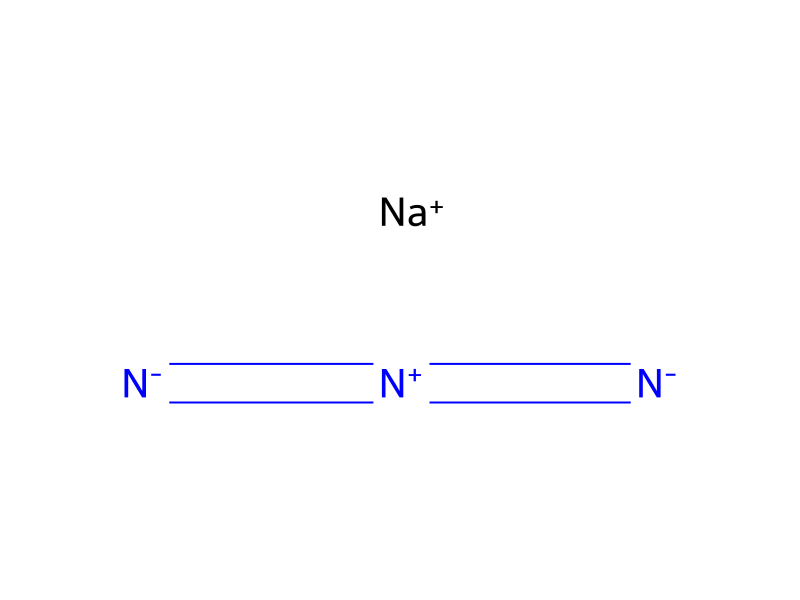
Cl[C:2]1[CH:11]=[N:10][C:9]2[C:4](=[CH:5][CH:6]=[CH:7][CH:8]=2)[N+:3]=1[O-:12].[N-:13]=[N+:14]=[N-:15].[Na+]>CC(C)=O.O>[N:13]([C:2]1[CH:11]=[N:10][C:9]2[C:4](=[CH:5][CH:6]=[CH:7][CH:8]=2)[N+:3]=1[O-:12])=[N+:14]=[N-:15]In this example 0.500 grams (0.0028 mol) of 2-chloroquinoxaline 1-oxide and 0.500 grams (0.0080 mol) of sodium azide were added to and dissolved in 35 ml of acetone and 35 ml of water. The solution was stirred at 25° C for 60 hours. The acetone was evaporated in vacuo and the resulting aqueous solution was extracted with methylene chloride. The organic phase was introduced onto a basic alumina column. Elution with chloroform gave 2 azidoquinoxaline-oxide in a yield of 0.080 grams or 16% of theory which was immediately decomposed in boiling benzene for 1 hour. Evaporation of the solvent gave 2-cyanobenzimidazole N-oxide which is tautomeric with N-hydroxy-2-cyanobenzimidazole in a yield of 0.020 grams or 30% of theory having a melting point of 236° C to 238° C with decomposition.