Hunig's Base (65 μL, 0.37 mmol) was added to a stirring solution of HATU (56 mg, 0.15 mmol), 3-(2-(4-fluorophenyl)-3-(methoxycarbonyl)furo[2,3-b]pyridin-5-yl)-4-methylbenzoic acid (50 mg, 0.12 mmol), 1-(pyridin-2-yl)cyclopropanamine dihydrochloride (31 mg, 0.15 mmol) in DMF (1.2 mL) at room temperature. It was allowed to stir for 30 min. The mixture was diluted with ethyl acetate and washed with sat NaHCO3, 1M NaOH, and sat NaCl. The organic phase was dried over Na2SO4, filtered and concentrated to give methyl 2-(4-fluorophenyl)-5-(2-methyl-5-(1-(pyridin-2-yl)cyclopropylcarbamoyl)phenyl)furo[2,3-b]pyridine-3-carboxylate. The crude residue was diluted with MeoH (2 mL) and treated with NaOH (0.617 μL, 0.617 mmol, 1M aq). The mixture was allowed to stir at 60° C. for 1 hour. The mixture was diluted with EtOAc and washed with 1M HCl, and sat NaCl. The organic phase was dried over Na2SO4, filtered and concentrated to give 2-(4-fluorophenyl)-5-(2-methyl-5-(1-(pyridin-2-yl)cyclopropylcarbamoyl)phenyl)furo[2,3-b]pyridine-3-carboxylic acid. The residue was diluted with DMF (1.2 mL) and treated with HATU (56 mg, 0.15 mmol), methanamine (308 mL, 0.617 mmol, 2M in THF), followed by Hunig's Base (65 mL, 0.37 mmol). The reaction was allowed to stir for 1 hour. The mixture was diluted with EtOAc and washed with sat NaHCO3, and sat NaCl. The organic phase was dried over Na2SO4, filtered and concentrated and was purified on silica gel (Biotage, EtOAc/hexanes gradient, fraction collection at λ=254 nm) to give 2-(4-fluorophenyl)-N-methyl-5-(2-methyl-5-(1-(pyridin-2-yl)cyclopropylcarbamoyl)phenyl)furo[2,3-b]pyridine-3-carboxamide (19 mg, 0.035 mmol, 29% yield) consistent by LCMS and NMR. 1H NMR (400 MHz, DMSO-d6) δ ppm 9.27 (1H, s), 8.48-8.54 (1H, m), 8.46 (1H, d, J=4.02 Hz), 8.42 (1H, d, J=2.01 Hz), 8.13 (1H, d, J=2.26 Hz), 8.05-8.11 (2H, m), 7.90-7.95 (2H, m), 7.68 (1H, td, J=7.78, 1.76 Hz), 7.51 (1H, d, J=8.78 Hz), 7.41-7.47 (2H, m), 7.36 (1H, d, J=8.03 Hz), 7.16 (1H, dd, J=7.03, 5.27 Hz), 2.85 (3H, d, J=4.52 Hz), 2.35 (3H, s), 1.53-1.59 (2H, m), 1.25-1.30 (2H, m). LC-MS retention time: 1.34 min; m/z (MH+): 521. LC data was recorded on a Shimadzu LC-10AS liquid chromatograph equipped with a Waters Xterra MS 7u C18 3.0×50 mm column using a SPD-10AV UV-Vis detector at a detector wave length of 220 nM. The elution conditions employed a flow rate of 5 ml/min, a gradient of 100% solvent A/0% solvent B to 0% solvent A/100% solvent B, a gradient time of 2 min, a hold time of 1 min, and an analysis time of 3 min where solvent A was 10% MeOH/90% H2O/0.1% trifluoroacetic acid and solvent B was 10% H2O/90% MeOH/0.1% trifluoroacetic acid. MS data was determined using a Micromass Platform for LC in electrospray mode. Additional HPLC method: Solvent A=5% MeOH/95% H2O/10 mM ammonium bicarbonate, Solvent B=95% MeOH/5% H2O/10 mM ammonium bicarbonate, Start % B=10, Final % B=100, Gradient time=15 min, Stop time=18 min, Flow Rate=1 ml/min. Column: Phenomenex Gemini C1 C-18, 4.6×150 mm, 3 mm, Rt=13.32 min, purity=97%; Column: Waters Xbridge Phenyl column 4 6×150 mm, 3.5 mm, Rt=13.90 min, purity=97%.

 HCID 81531Diisopropylethylamine
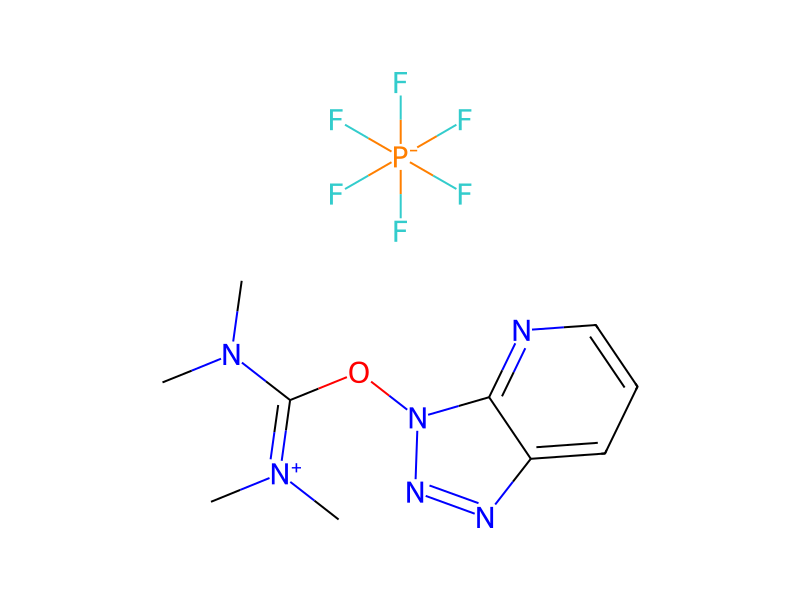 HCID 9886157Methanaminium, N-((dimethylamino)(3H-1,2,3-triazolo(4,5-b)pyridin-3-yloxy)methylene)-N-methyl-, hexafluorophosphate(1-) (1:1)
 HCID 533931811-(2-Pyridyl)cyclopropylamine Dihydrochloride
 HCID 672175563-(2-(4-Fluorophenyl)-3-(methoxycarbonyl)furo[2,3-b]pyridin-5-yl)-4-methylbenzoic acid


