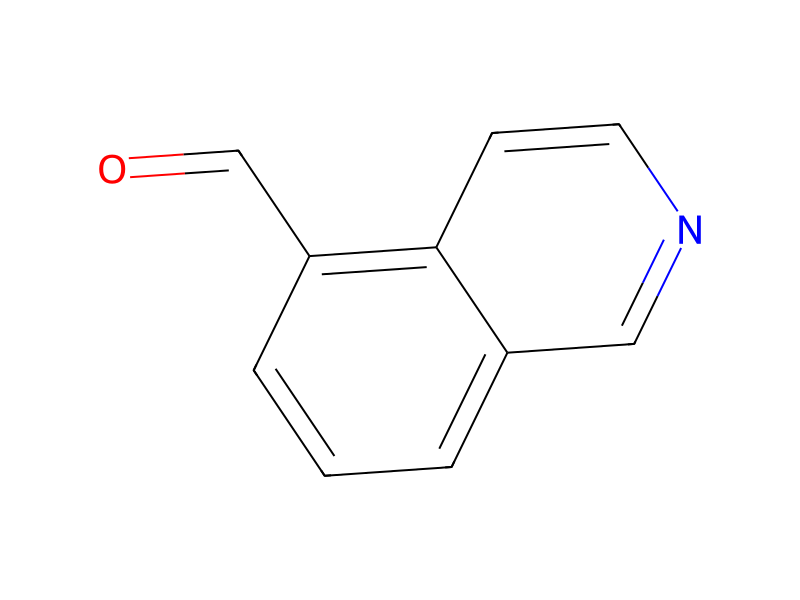
[C:1]([C:5]1[CH:10]=[CH:9][C:8]([CH:11]2[CH2:13][CH:12]2[C:14]([NH:16][NH2:17])=[O:15])=[CH:7][CH:6]=1)([CH3:4])([CH3:3])[CH3:2].[CH:18]1[C:27]2[CH:26]=[CH:25][CH:24]=[C:23]([CH:28]=O)[C:22]=2[CH:21]=[CH:20][N:19]=1.CC(O)=O>C(O)C>[C:1]([C:5]1[CH:10]=[CH:9][C:8]([CH:11]2[CH2:13][CH:12]2[C:14]([NH:16]/[N:17]=[CH:28]/[C:23]2[CH:24]=[CH:25][CH:26]=[C:27]3[C:22]=2[CH:21]=[CH:20][N:19]=[CH:18]3)=[O:15])=[CH:7][CH:6]=1)([CH3:4])([CH3:2])[CH3:3]To a room temperature solution of 2-(4-tert-butylphenyl)cyclopropanecarbohydrazide (200 mg, 0.86 mmol) in ethanol (10 mL) were added isoquinoline-5-carbaldehyde (162 mg, 1.0 mmol) and a catalytic amount of glacial AcOH (0.4 mL) under an inert atmosphere. The reaction mixture was then stirred at 90° C. for 4 h, concentrated in vacuo, and the residue was then dissolved in DCM (50 mL). The organic layer was washed with saturated NaHCO3 solution (15 mL) and brine (15 mL). The organic layer was then separated, dried over anhydrous Na2SO4, filtered and evaporated in vacuo to obtain the crude product. The crude material was purified via silica gel column chromatography eluting with 1% MeOH in dichloromethane to afford (E)-2-(4-tert-butylphenyl)-N′-(isoquinolin-5-ylmethylene) cyclopropanecarbohydrazide (160 mg, 50%) as a white solid. 1H NMR (500 MHz, d6-DMSO): δ 11.60 (s, 1H), 9.38 (s, 1H), 8.71-8.56 (m, 2H), 8.25-8.12 (m, 2H), 8.11-7.99 (m, 2H), 7.39-7.29 (m, 2H), 7.19-7.06 (m, 2H), 2.41-2.33 (m, 1H), 1.95-1.90 (m, 1H), 1.42-1.34 (m, 2H), 1.25 (s, 9H). MS: M m/z=372.2 HPLC: 96%, (Condition-A).
Wird geladen…