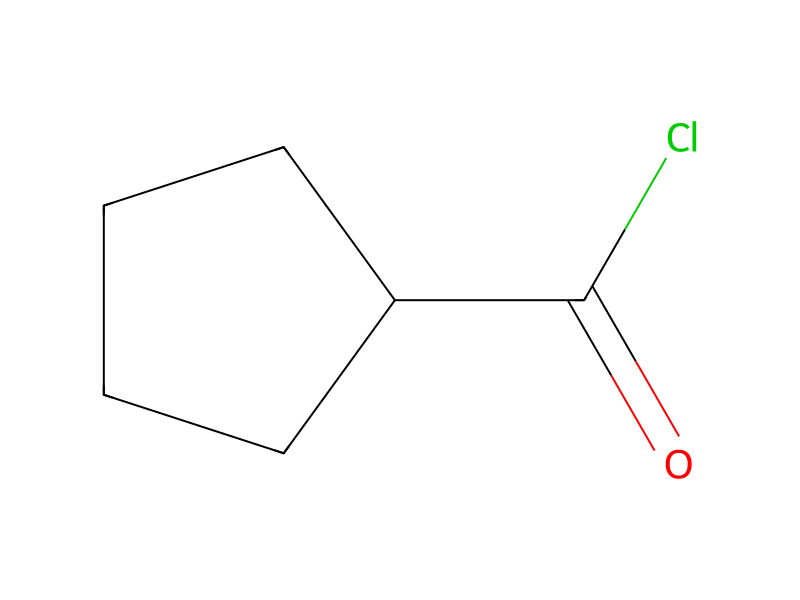
Cyclopentanecarbonyl chloride → (2Z)-2-(3-butyl-4,5-dimethyl-1,3-thiazol-2(3H)-ylidene)-1-cyclopentylethanone
Reaktionsgleichung

[I-].[CH2:2]([N+:6]1[C:10]([CH3:11])=[C:9]([CH3:12])[S:8][C:7]=1[CH3:13])[CH2:3][CH2:4][CH3:5].[CH:14]1([C:19](Cl)=[O:20])[CH2:18][CH2:17][CH2:16][CH2:15]1>CN(C1C=CN=CC=1)C>[CH2:2]([N:6]1[C:10]([CH3:11])=[C:9]([CH3:12])[S:8]/[C:7]/1=[CH:13]\[C:19]([CH:14]1[CH2:18][CH2:17][CH2:16][CH2:15]1)=[O:20])[CH2:3][CH2:4][CH3:5]Komponenten
Edukt 2

Produkt 1

Reagenzien, Katalysatoren, Lösungsmittel 1

Versuchsvorschrift
In a 20 mL vial 3-butyl-2,4,5-trimethylthiazol-3-ium iodide (48 mg in 0.5 mL DMA, 0.16 mmol, 1 equiv.) was added, followed by TEA (38 mg in 0.5 mL DMA, 0.37 mmol, 2.4 equiv.) and the solution went black. DMAP (2 mg in 0.5 mL DMA, 0.016 mmol, 0.1 equiv) was added next, followed by cyclopentanecarbonyl chloride (0.9 mL of 0.2M in DMA, 1.2 equiv). The mixture was shaken overnight at room temperature and then concentrated in vacuo. The resulting residue was taken up in 1:1 DMSO/MeOH and purified by reverse phase HPLC using a method analogous to that described in Example 53 to provide the title compound. 1H NMR (500 MHz, DMSO-d6/D2O) δ ppm 0.88-0.97 (m, 3 H) 1.30-1.39 (m, 2 H) 1.51-1.62 (m, 4 H) 1.62-1.70 (m, 3 H) 1.77-1.87 (m, 2 H) 2.16-2.26 (m, 5 H) 2.73-2.86 (m, 1 H) 3.71-3.83 (m, 4 H) 5.84-5.94 (m, 1 H); MS (ESI) m/z 280 (M+H)+.
Aufarbeitung
- concentrationconcentrated in vacuo
- custompurified by reverse phase HPLC
Quellen und Nachweise
- ORD-Eintrag
- ord-f4b71200f4094190830905d60b361090
- Quelldatensatz
- uspto-grants-2013_07
- Patentnummer
- US08481574B2
Notizen zur Reaktion
Wird geladen…