Tetrahydrofuran → HCID 59410166, Verbindung
HRID 452229
Reaktionsgleichung

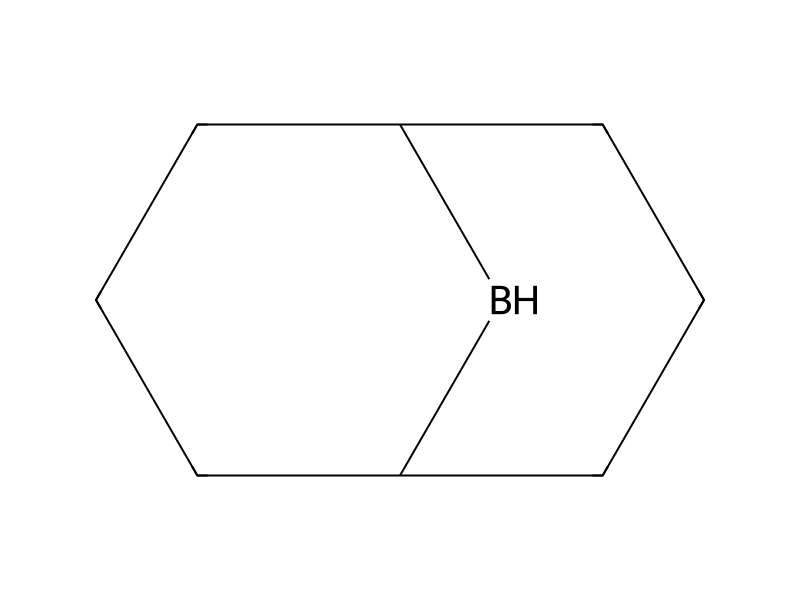
[CH3:1][O:2][CH2:3][C:4]1[CH:9]=[C:8]([N+:10]([O-:12])=[O:11])[CH:7]=[CH:6][C:5]=1[N:13]1[CH:18]=[CH:17][CH:16]=[C:15]([CH:19]=[CH2:20])[C:14]1=[O:21].C12BC(CCC1)CCC2.[O:31]1CCCC1>>[OH:31][CH2:20][CH2:19][C:15]1[C:14](=[O:21])[N:13]([C:5]2[CH:6]=[CH:7][C:8]([N+:10]([O-:12])=[O:11])=[CH:9][C:4]=2[CH2:3][O:2][CH3:1])[CH:18]=[CH:17][CH:16]=1Komponenten
4



Reaktionsbedingungen
- Temperatur
- 5 °C
Versuchsvorschrift
23 g (80 mmol) of the compound from Example 37A are dissolved in 80 ml of anhydrous tetrahydrofuran and cooled to 5° C. Over a period of 15 min, 21 g (176 mmol) of 9-borabicyclo[3.3.1]nonane (0.5M solution in tetrahydrofuran) are added. Cooling is removed, and the mixture is stirred at room temperature for another 2 h. The mixture is then again cooled to 5° C., and 400 ml of 1N aqueous sodium hydroxide solution are added. After the addition has ended, 81 ml of 30% strength hydrogen peroxide solution are added a little at a time at this temperature. After dilution with 500 ml of ethyl acetate, the mixture is washed with 32 ml of 40% strength sodium bisulphite solution to destroy the peroxides. The organic phase is separated off, and the aqueous phase is extracted four times with ethyl acetate. The combined organic phases are washed with saturated sodium chloride solution, dried over magnesium sulphate and, after filtration, concentrated to dryness under reduced pressure. The residue is chromatographed on silica gel using a gradient of cyclohexane and ethyl acetate. The product-containing fractions are combined and concentrated to dryness under reduced pressure. This gives 20 g (77% of theory) of the desired product.