Reaktionsgleichung
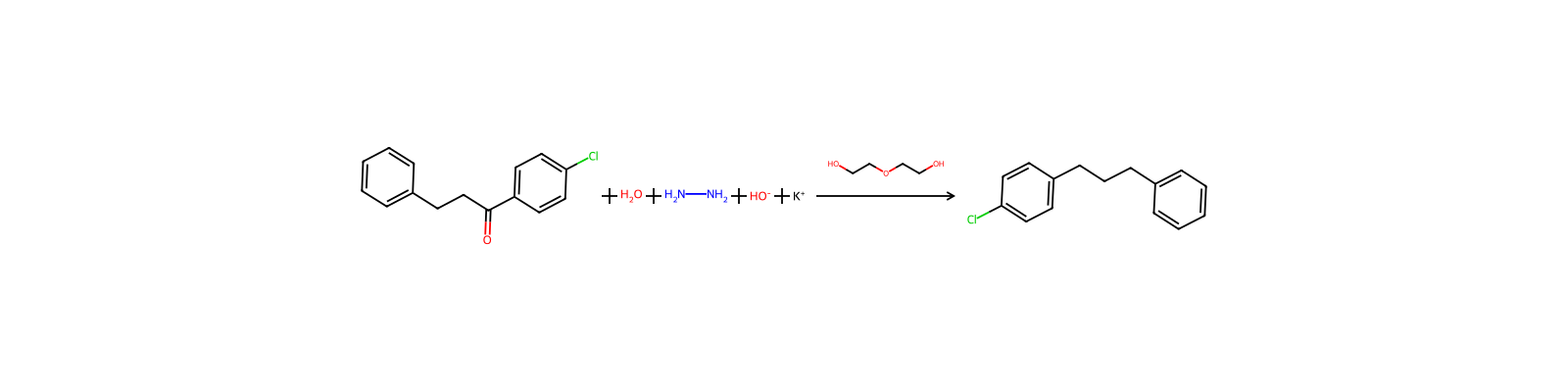
[C:1]1([CH2:7][CH2:8][C:9]([C:11]2[CH:16]=[CH:15][C:14]([Cl:17])=[CH:13][CH:12]=2)=O)[CH:6]=[CH:5][CH:4]=[CH:3][CH:2]=1.O.NN.[OH-].[K+]>C(O)COCCO>[Cl:17][C:14]1[CH:13]=[CH:12][C:11]([CH2:9][CH2:8][CH2:7][C:1]2[CH:2]=[CH:3][CH:4]=[CH:5][CH:6]=2)=[CH:16][CH:15]=1Komponenten
5
Edukt 3



Produkt 1

Reagenzien, Katalysatoren, Lösungsmittel 1

Versuchsvorschrift
p-chlorophenyl phenylethyl ketone (25 g) was refluxed with hydrazine hydrate (13 g) and potassium hydroxide (18 g) in Digol (diethylene glycol) for one hour. The mixture was then distilled until the solution temperature in the still reached 175°. The mixture was then refluxed for 3 hours, cooled, poured into water and extracted with petroleum ether (Bpt 40°-60°). Evaporation of the extracts gave 1-(4-chlorophenyl)-3-phenylpropane Bbt. 110°/10-3 mm.
Aufarbeitung
- distillationThe mixture was then distilled until the solution temperature in the still reached 175°
- temperatureThe mixture was then refluxed for 3 hours
- temperaturecooled
- additionpoured into water
- extractionextracted with petroleum ether (Bpt 40°-60°)
- customEvaporation of the extracts
Quellen und Nachweise
- ORD-Eintrag
- ord-3ea19a854acc474080cbdd3124680918
- Quelldatensatz
- uspto-grants-1985_05
- Patentnummer
- US04520007
Verknüpfte Notizen
Wird geladen…