StartseiteMCPWorkbenchSkills
StartseiteWorkbenchBenachrichtigungenMein Bereich
llms.txt · MCP-AnleitungDatenschutz · Nutzungsbedingungen · Supportv1.8.3
  1. Startseite
  2. /Reaktion

Dimethylformamide → 5-Fluoro-2-pyridazin-4-yl-4-(trifluoromethyl)phenol

HRID 46398
Drucken

Reaktionsgleichung

Reaktionsgleichung von HRID 46398
[F-].[Cs+].[F:3][C:4]1[C:5]([C:12]([F:15])([F:14])[F:13])=[CH:6][C:7](I)=[C:8]([OH:10])[CH:9]=1.C([Sn](CCCC)(CCCC)[C:21]1[CH:26]=[CH:25][N:24]=[N:23][CH:22]=1)CCC.CN(C)C=O>C1C=CC([P]([Pd]([P](C2C=CC=CC=2)(C2C=CC=CC=2)C2C=CC=CC=2)([P](C2C=CC=CC=2)(C2C=CC=CC=2)C2C=CC=CC=2)[P](C2C=CC=CC=2)(C2C=CC=CC=2)C2C=CC=CC=2)(C2C=CC=CC=2)C2C=CC=CC=2)=CC=1.[Cu]I>[F:3][C:4]1[C:5]([C:12]([F:15])([F:14])[F:13])=[CH:6][C:7]([C:21]2[CH:26]=[CH:25][N:24]=[N:23][CH:22]=2)=[C:8]([OH:10])[CH:9]=1
KomponentenReaktionsbedingungenVersuchsvorschriftAufarbeitungQuellen und NachweiseNotizen zur Reaktion

Komponenten

7

Edukt 4

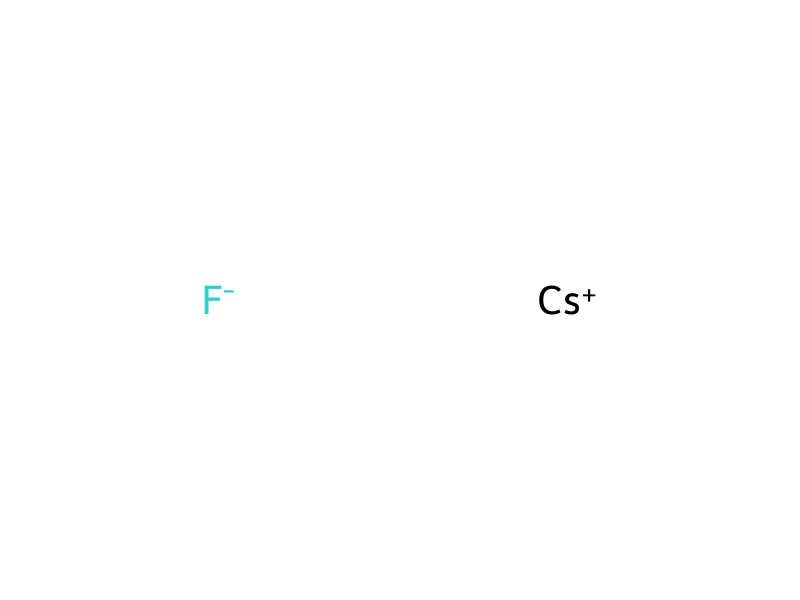
HCID 6228Dimethylformamide2×HCID 25953Cesium fluorideHCID 64097334-(Tributylstannyl)pyridazineHCID 594364965-Fluoro-2-iodo-4-(trifluoromethyl)phenol

Produkt 1

HCID 1360636295-Fluoro-2-pyridazin-4-yl-4-(trifluoromethyl)phenolAusbeute 62,5 %

Reagenzien, Katalysatoren, Lösungsmittel 2

HCID 24350Copper(1+) iodide; Copper(I) iodide; Cuprous iodide; Cuprous iodide (CuI)KatalysatorHCID 178418397HCID 178418397, VerbindungKatalysator

Reaktionsbedingungen

Temperatur
45 °C

Versuchsvorschrift

Cesium fluoride (570 mg, 3.8 mmol), tetrakis(triphenylphosphine)palladium(0) (220 mg, 0.19 mmol), and copper(I) iodide (72 mg, 0.38 mmol) were added to a solution of 5-fluoro-2-iodo-4-(trifluoromethyl)phenol (Preparation 885, 579 mg, 1.89 mmol) and 4-(tributylstannyl)pyridazine (770 mg, 2.1 mmol) in N,N-dimethylformamide (4 mL, 50 mmol). The sides of the flask were washed down with N,N-dimethylformamide (3 mL, 40 mmol). The flask was capped with a septum then evacuated and back-filled with argon (5 cycles). The reaction mixture was heated at 45° C. After 90 min, the reaction mixture was cooled to ambient temperature, diluted with ethyl acetate and water, and filtered through diatomaceous earth. The solids were washed with additional ethyl acetate. The layers were separated, and the organic layer was washed successively with water, aqueous lithium chloride, and brine. The organic layer was then dried over sodium sulfate, filtered, and concentrated in vacuo. The residue was taken up in methylene chloride, concentrated onto diatomaceous earth, and purified by automated flash chromatography (24 g SiO2, methylene chloride to 9:1 methylene chloride-methanol) to afford the product as a tan solid (305 mg, 62%).


Aufarbeitung

  1. customThe flask was capped with a septum
  2. customthen evacuated
  3. additionback-filled with argon (5 cycles)
  4. temperaturethe reaction mixture was cooled to ambient temperature
  5. additiondiluted with ethyl acetate and water
  6. filtrationfiltered through diatomaceous earth
  7. washThe solids were washed with additional ethyl acetate
  8. customThe layers were separated
  9. washthe organic layer was washed successively with water, aqueous lithium chloride, and brine
  10. dry with materialThe organic layer was then dried over sodium sulfate
  11. filtrationfiltered
  12. concentrationconcentrated in vacuo
  13. concentrationconcentrated onto diatomaceous earth
  14. custompurified by automated flash chromatography (24 g SiO2, methylene chloride to 9:1 methylene chloride-methanol)

Quellen und Nachweise

ORD-Eintrag
ord-a7a0f6a2d59a4b3aa5a72d666cf85236
Quelldatensatz
uspto-grants-2013_09
DOI
10.6084/m9.figshare.5104873.v1
Patentnummer
US08541588B2

Notizen zur Reaktion

Auf dieser SeiteKomponentenReaktionsbedingungenVersuchsvorschriftAufarbeitungQuellen und NachweiseNotizen zur Reaktion