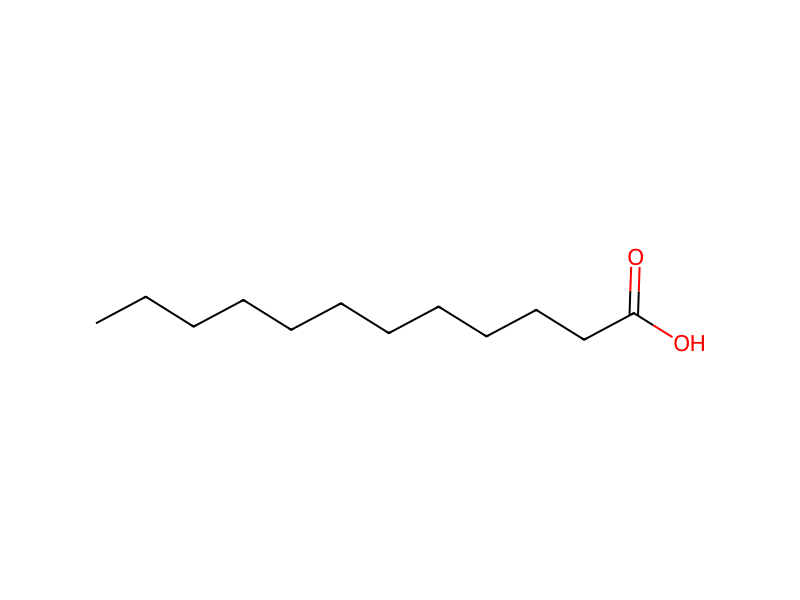
[C:1]([OH:14])(=[O:13])[CH2:2][CH2:3][CH2:4][CH2:5][CH2:6][CH2:7][CH2:8][CH2:9][CH2:10][CH2:11][CH3:12].[CH3:15][C:16]([CH:20]=O)([CH2:18][OH:19])[CH3:17].C1(C)C=CC=CC=1.O.C1(C)C=CC(S(O)(=O)=O)=CC=1>O>[C:1]([O:14][CH2:15][C:16]([CH3:20])([CH3:17])[CH:18]=[O:19])(=[O:13])[CH2:2][CH2:3][CH2:4][CH2:5][CH2:6][CH2:7][CH2:8][CH2:9][CH2:10][CH2:11][CH3:12]To a hot (80° C.) solution of lauric acid (70 g., 0.35 mole), and hydroxypivaldehyde (30.6 g., 0.3 mole) in 120 g. of toluene was added 1.75 g. of p-toluenesulfonic acid monohydrate (0.009 mole). The mixture was then heated at total reflux for 1.5 hrs. and water generated in the reaction mixture was removed by azeotropic distillation. The reaction mixture was cooled, washed with saturated aqueous sodium bicarbonate and brine, then dried over magnesium sulfate, filtered, and evaporated in vacuo. GLC analysis of the product showed that it contained 90% of the desired laurate ester. Fractional distillation of the crude sample gave a product cut, b.p. 180° C./4.0 mm, of 95% purity (GLC, area %). NMR (CDCL3): 9.73 (s, 1H,--CHO), 4.2 (s, 2H, --CO2CH2 --), 2.3 (t, 2H, --CH2CO2 --), 0.9-1.9 (m, 23H, CH2 (CH2)10CH2CO 2 --), and 1.17 (s, 6H, --C(CH2)2.