Hydrochloric Acid → AN-651/40768841
HRID 482719
Reaktionsgleichung

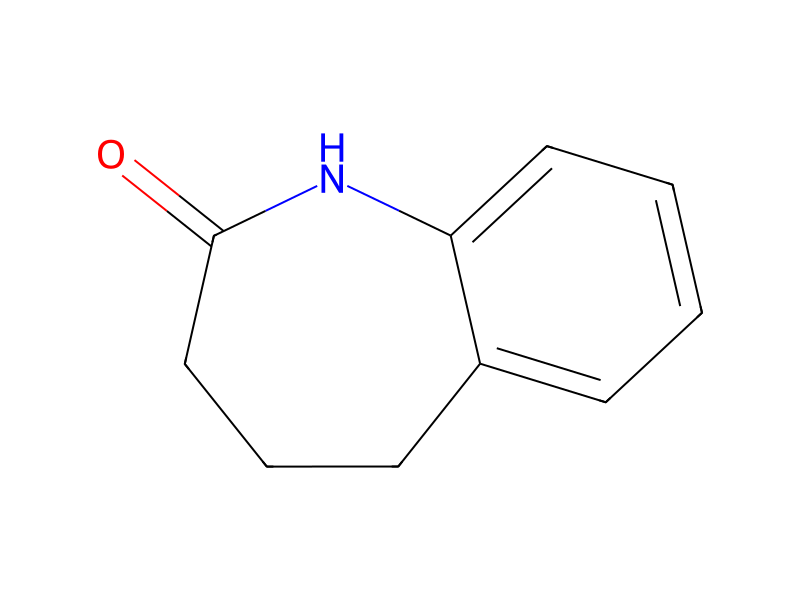
[NH:1]1[C:7]2[CH:8]=[CH:9][CH:10]=[CH:11][C:6]=2[CH2:5][CH2:4][CH2:3][C:2]1=[O:12].P(Cl)(Cl)(Cl)(Cl)[Cl:14].[ClH:19]>C1(C)C(C)=CC=CC=1>[Cl:19][C:3]1([Cl:14])[CH2:4][CH2:5][C:6]2[CH:11]=[CH:10][CH:9]=[CH:8][C:7]=2[NH:1][C:2]1=[O:12]Komponenten
5
Edukt 3


Produkt 1

Reagenzien, Katalysatoren, Lösungsmittel 1

Versuchsvorschrift
A mixture of 2,3,4,5-tetrahydro-1H-[1]benzazepin-2-one (48.3 g, see Briggs et al., J. Chem. Soc. 1937, 456), phosphorus pentachloride (188 g), and xylene (1300 ml) was heated with stirring under an atmosphere of nitrogen to 90° (oil bath temperature) during 30 min with pauses at 30° (to allow the phosphorus pentachloride to dissolve) and at 50°. There was a copious evolution of hydrogen chloride. The temperature was maintained at 90° for 30 minutes. The reaction mixture was filtered while hot to remove a small amount of suspended solid, and the filtrate was evaporated under reduced pressure until all the solvent was removed. The residue was added with stirring to saturated aqueous sodium carbonate (100 ml). The product was filtered after the solidification process was complete, then slurried in ethanol (150 ml), filtered, washed with ethanol (50 ml) and ether (50 ml) and dried to give 3,3-dichloro-2,3,4,5-tetrahydro-1H-[1]benzazepin-2-one, m.p. 185°-187°.