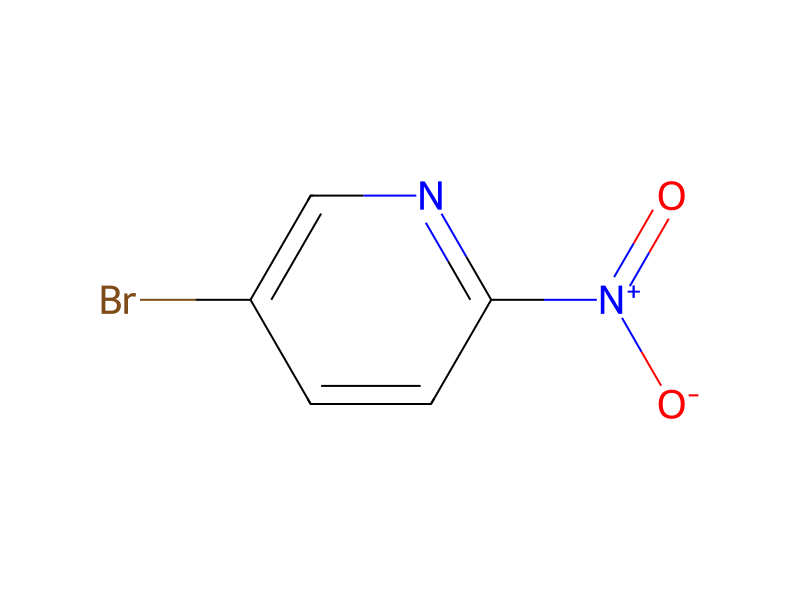
[N+:1]([C:4]1[CH:9]=[CH:8][C:7](Br)=[CH:6][N:5]=1)([O-:3])=[O:2].[C:11]([N:18]1[CH2:23][CH2:22][NH:21][CH2:20][CH2:19]1)([O:13][C:14]([CH3:17])([CH3:16])[CH3:15])=[O:12].C(=O)([O-])[O-].[K+].[K+].O>CN(C)C=O>[N+:1]([C:4]1[N:5]=[CH:6][C:7]([N:21]2[CH2:20][CH2:19][N:18]([C:11]([O:13][C:14]([CH3:17])([CH3:16])[CH3:15])=[O:12])[CH2:23][CH2:22]2)=[CH:8][CH:9]=1)([O-:3])=[O:2]A solution is prepared of 1 g (4.9 mM) of 2-nitro-5-bromopyridine and 917 mg (4.9 mM) of N-Boc-piperazine in 10 ml of dimethylformamide and 1.02 g (7.4 mM) of potassium carbonate are added. The reaction mixture is agitated at 120° C. for 36 hours and then cooled. 50 ml of water are then added and extraction is carried out with ethyl acetate. The organic phase obtained is washed with water, dried and concentrated under reduced pressure. The crude product is purified by silica gel chromatography in eluting with the aid of a toluene/isopropanol mixture (98/2; v/v). The product sought after is thus obtained as a yellow solid (yield=33%).