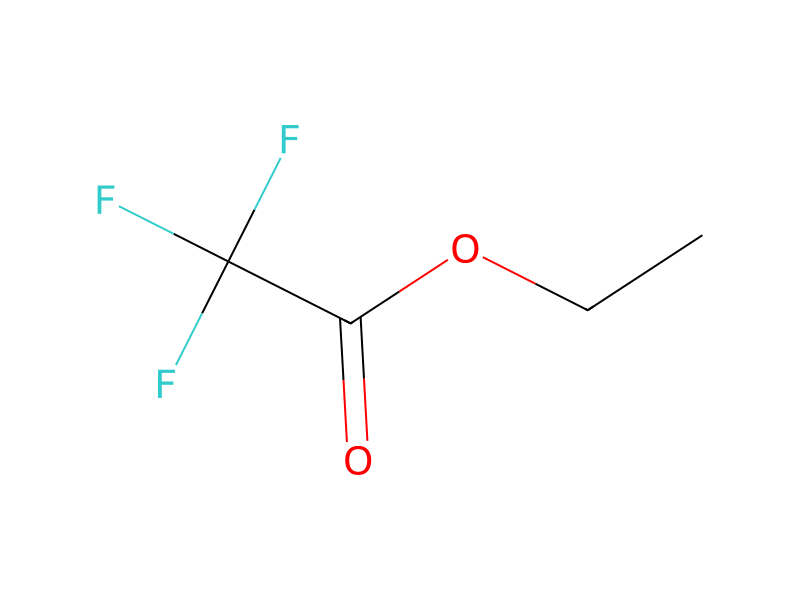
n-Butyllithium (2.5 M in hexane, 46 ml) was initially charged at −90° C. in tetrahydrofuran (250 ml). At −95° C., 4-bromo-1-fluoro-2-(trifluoromethyl)benzene (25 g, 103 mmol) was added dropwise. The reaction mixture was stirred at −78° C. for 40 min, then cooled to −100° C., and ethyl trifluoroacetate (16.1 g, 113 mmol) was added dropwise, in the course of which the temperature was kept between −90° C. and −80° C. The reaction mixture was gradually warmed up to −20° C. and then cooled to −80° C. 10% hydrochloric acid and saturated sodium chloride solution were added dropwise. The reaction mixture was thawed within 16 h and then extracted with diethyl ether. The organic phase was washed with water and saturated sodium chloride solution and dried over sodium sulphate, and the solvent was removed under reduced pressure. The residue was taken up in toluene and distilled first at standard pressure, then under reduced pressure. 22.5 g (86% of theory) of 2,2,2-trifluoro-1-[4-fluoro-3-(trifluoromethyl)phenyl]ethanone were obtained.