StartseiteMCPWorkbenchSkills
StartseiteWorkbenchBenachrichtigungenMein Bereich
llms.txt · MCP-AnleitungDatenschutz · Nutzungsbedingungen · Supportv1.8.3
  1. Startseite
  2. /Reaktion

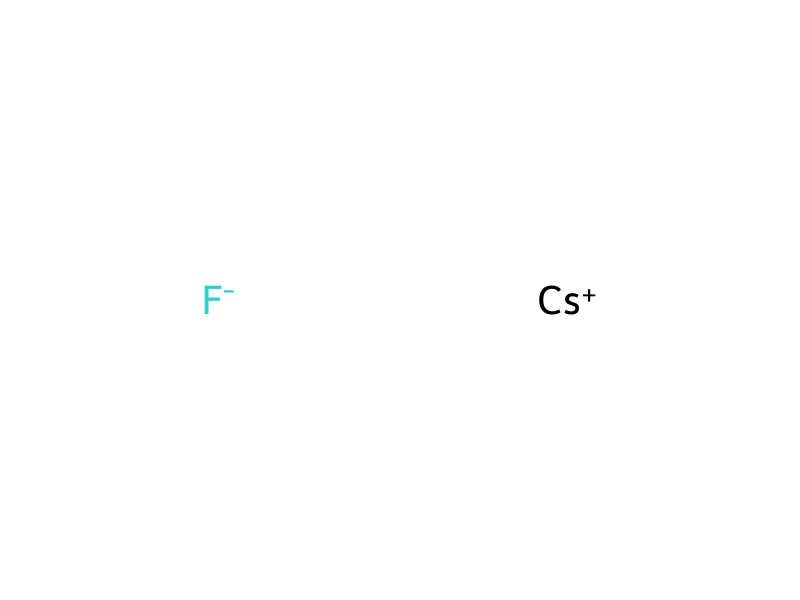
Cesium fluoride → 5-(4-Chloro-6-(4-isopropoxyphenyl)pyridin-2-yl)thiazole

HRID 523144
Drucken

Reaktionsgleichung

Reaktionsgleichung von HRID 523144
Cl[C:2]1[CH:7]=[C:6]([Cl:8])[CH:5]=[C:4]([C:9]2[CH:14]=[CH:13][C:12]([O:15][CH:16]([CH3:18])[CH3:17])=[CH:11][CH:10]=2)[N:3]=1.C([Sn](CCCC)(CCCC)[C:24]1[S:28][CH:27]=[N:26][CH:25]=1)CCC.[F-].[Cs+]>CCOC(C)=O.[Cu]I.C1C=CC([P]([Pd]([P](C2C=CC=CC=2)(C2C=CC=CC=2)C2C=CC=CC=2)([P](C2C=CC=CC=2)(C2C=CC=CC=2)C2C=CC=CC=2)[P](C2C=CC=CC=2)(C2C=CC=CC=2)C2C=CC=CC=2)(C2C=CC=CC=2)C2C=CC=CC=2)=CC=1>[Cl:8][C:6]1[CH:5]=[C:4]([C:9]2[CH:14]=[CH:13][C:12]([O:15][CH:16]([CH3:18])[CH3:17])=[CH:11][CH:10]=2)[N:3]=[C:2]([C:24]2[S:28][CH:27]=[N:26][CH:25]=2)[CH:7]=1
KomponentenVersuchsvorschriftAufarbeitungQuellen und NachweiseNotizen zur Reaktion

Komponenten

7

Edukt 3

HCID 25953Cesium fluorideHCID 27632575-(Tributylstannyl)-1,3-thiazole2×HCID 901180792,4-Dichloro-6-(4-isopropoxyphenyl)pyridine

Produkt 1

HCID 901180235-(4-Chloro-6-(4-isopropoxyphenyl)pyridin-2-yl)thiazoleAusbeute 55,2 %

Reagenzien, Katalysatoren, Lösungsmittel 3

HCID 24350
Copper(1+) iodide; Copper(I) iodide; Cuprous iodide; Cuprous iodide (CuI)
Katalysator
HCID 178418397HCID 178418397, VerbindungKatalysator2×
HCID 8857Ethyl AcetateLösungsmittel

Versuchsvorschrift

To a 2 dram vial equipped with a stir bar was added 2,4-dichloro-6-(4-isopropoxyphenyl)pyridine (189 mg, 0.668 mmol), 5-(tributylstannyl)thiazole (250 mg, 0.668 mmol), CuI (32 mg, 0.17 mmol), CsF (304 mg, 2.00 mmol), and Pd(PPh3)4 (39 mg, 0.033 mmol). The vial was capped with a septum screw-cap and then placed under N2 atmosphere. To the vial was added degassed DMF (4 mL). The vial was placed in an 80° C. heating block with stirring for 1 hour. The vial was cooled to room temperature and then opened, and to the solution was added an additional charge of 5-(tributylstannyl)thiazole (85 mg, 0.23 mmol) and Pd(PPh3)4 (39 mg, 0.033 mmol). The vial was capped, placed under N2 atmosphere, and then placed in a 80° C. heating block with stirring for an additional 1 hour. The reaction mixture was cooled to room temperature and then transferred to a 125 mL separatory funnel. The mixture was diluted with EtOAc (50 mL) and then washed with saturated aqueous NaCl (“brine”, 50 mL). The aqueous phase was extracted with EtOAc (25 mL). The combined organics were washed with brine (25 mL); dried over MgSO4; filtered; then concentrated in vacuo to afford a dark liquid. This material was subjected to silica gel chromatography to afford 5-(4-chloro-6-(4-isopropoxyphenyl)pyridin-2-yl)thiazole as a pale orange liquid (122 mg, 55%). 1H-NMR: (400 MHz, CDCl3-d) δ 8.87 (s, 1H), 8.40 (s, 1H), 8.04-7.98 (m, 2H), 7.60 (d, J=1.5 Hz, 1H), 7.55 (d, J=1.8 Hz, 1H), 7.04-6.98 (m, 2H), 4.65 (spt, J=6.1 Hz, 1H), 1.39 (d, J=6.3 Hz, 6H); MS: MS m/z 331.1 (M++1).

Aufarbeitung

  1. customTo a 2 dram vial equipped with a stir bar
  2. customThe vial was capped with a septum
  3. customscrew-cap
  4. additionTo the vial was added
  5. customdegassed DMF (4 mL)
  6. customwas placed in an 80° C.
  7. temperatureheating block
  8. additionto the solution was added
  9. customThe vial was capped
  10. customplaced in a 80° C.
  11. temperatureheating block
  12. stirringwith stirring for an additional 1 hour
  13. temperatureThe reaction mixture was cooled to room temperature
  14. customtransferred to a 125 mL separatory funnel
  15. washwashed with saturated aqueous NaCl (“brine”, 50 mL)
  16. extractionThe aqueous phase was extracted with EtOAc (25 mL)
  17. washThe combined organics were washed with brine (25 mL)
  18. dry with materialdried over MgSO4
  19. filtrationfiltered
  20. concentrationthen concentrated in vacuo
  21. customto afford a dark liquid

Quellen und Nachweise

ORD-Eintrag
ord-004ca1555c1b4acf8a83c4ad6872baad
Quelldatensatz
uspto-grants-2016_05
DOI
10.6084/m9.figshare.5104873.v1
Patentnummer
US09334279B2

Notizen zur Reaktion

Auf dieser SeiteKomponentenVersuchsvorschriftAufarbeitungQuellen und NachweiseNotizen zur Reaktion


