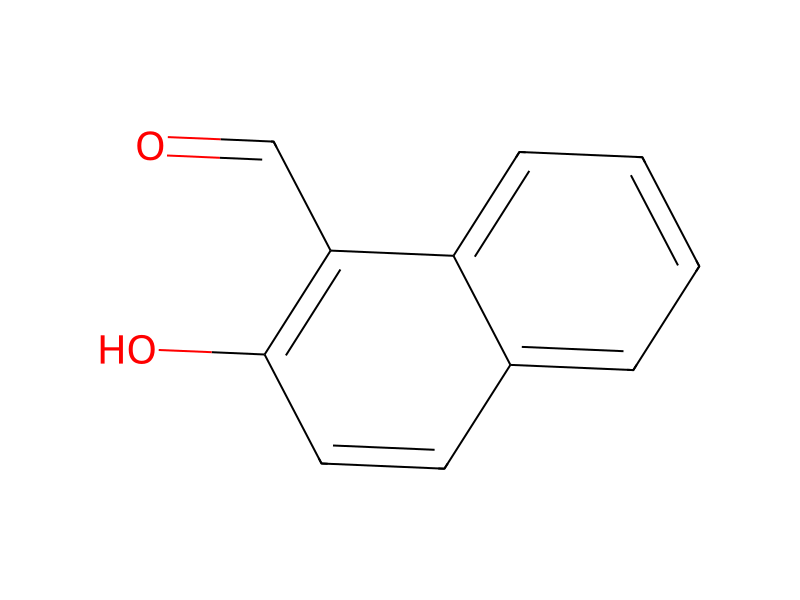
ClC(Cl)C.[OH:5][C:6]1[CH:15]=[CH:14][C:13]2[C:8](=[CH:9][CH:10]=[CH:11][CH:12]=2)[C:7]=1[CH:16]=[O:17].[Cl-].[Al+3].[Cl-].[Cl-].[CH2:22]([N:24]([CH2:29][CH3:30])[S:25](Cl)(=[O:27])=[O:26])[CH3:23]>C(Cl)Cl>[OH:5][C:6]1[CH:15]=[CH:14][C:13]2[C:8](=[CH:9][CH:10]=[C:11]([S:25](=[O:27])(=[O:26])[N:24]([CH2:29][CH3:30])[CH2:22][CH3:23])[CH:12]=2)[C:7]=1[CH:16]=[O:17]600 ml of a dichloroethane solution containing 150 g (0.87 mole) of 2-hydroxy-1-naphthaldehyde and 250 g (1.87 moles) of anhydrous aluminum chloride was stirred with heating at 50° C. To the solution was added dropwise 172.2 g (1 mole) of N,N-diethylsulfamoyl chloride. After the completion of the dropwise addition, the mixture was refluxed for 3 hours. After cooling to room temperature, the reaction mixture was poured into 1 liter of ice water. Methylene chloride was added to the mixture and it was extracted and separated. The organic layer was concentrated to about 500 ml. To the concentrate was added methanol to precipitate crystals. The precipitated crystals were collected by filtration, and washed with methanol to obtain 228 g (0.74 mole) of 2-hydroxy-6-(N,N-diethylsulfamoyl)-1-naphthaldehyde.