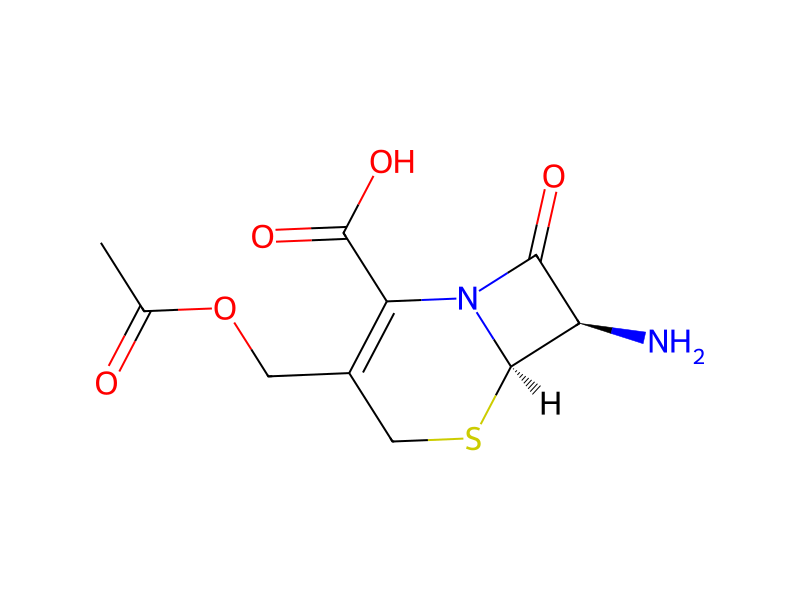
CC(O[CH2:5][C:6]1[CH2:15][S:14][C@@H:9]2[C@H:10]([NH2:13])[C:11](=[O:12])[N:8]2[C:7]=1[C:16]([OH:18])=[O:17])=O.[SH:19][C:20]1[N:24]([CH3:25])[N:23]=[N:22][N:21]=1.P(Cl)(Cl)(OP(Cl)(Cl)=O)=O.N>C(#N)C.O>[NH2:13][CH:10]1[C:11](=[O:12])[N:8]2[C:7]([C:16]([OH:18])=[O:17])=[C:6]([CH2:5][S:19][C:20]3[N:24]([CH3:25])[N:23]=[N:22][N:21]=3)[CH2:15][S:14][C@H:9]12In 5.4 ml of acetonitrile were suspended 0.909 g of 7-ACA and 0.504 g of 5-mercapto-1-methyl-1H-tetrazole, and 0.256 g of water was added. The suspension was cooled at -40° C. under stirring, and 3.58 g of diphosphoryl tetrachloride was added dropwise to it at -50° to -35° C. The reaction mixture was stirred at -35° to 0° C. for 5 minutes after the dropwise addition and placed in a warm water bath at 40° C. to warm, followed by stirring at the same temperature for 20 minutes. The reaction solution was cooled over an ice water bath and, after the addition of 11 ml of cold water, it was adjusted to pH 4.0 with aqueous concentrated ammonia. The separated-out precipitate was recovered by filtration, washed with water and dried, thereby affording 0.956 g of 7-amino-3-(1-methyl-1H-tetrazol-5-yl)thiomethyl-3-cephem-4 -carboxylic acid. The yield was 87.2%.