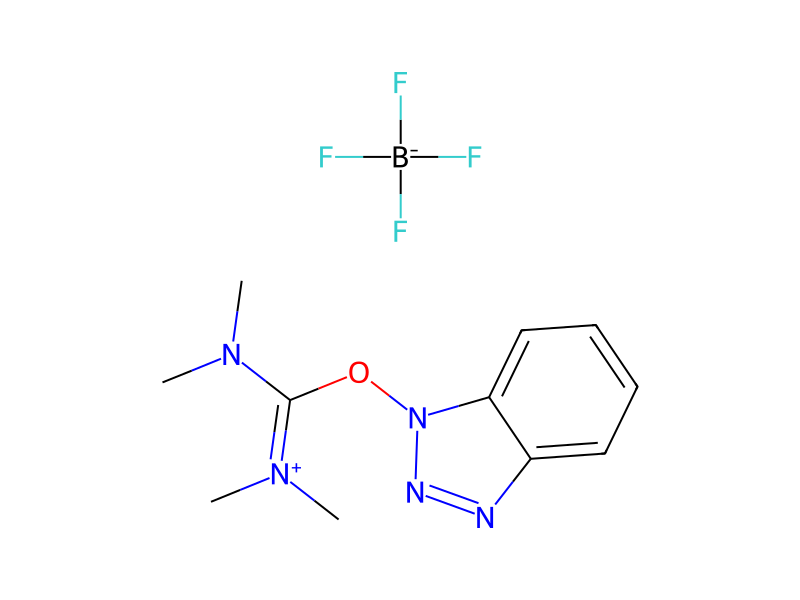
Triethylamine → 6-Bromo-2-[(4-methyl-6,7-dihydrothieno[3,2-c]pyridin-5(4H)-yl)carbonyl]pyrazolo[1,5-a]pyrimidine
Reaktionsgleichung

[Br:1][C:2]1[CH:3]=[N:4][C:5]2[N:6]([N:8]=[C:9]([C:11]([OH:13])=O)[CH:10]=2)[CH:7]=1.CN(C(ON1N=NC2C=CC=CC1=2)=[N+](C)C)C.[B-](F)(F)(F)F.C(N(CC)CC)C.[CH3:43][CH:44]1[C:49]2[CH:50]=[CH:51][S:52][C:48]=2[CH2:47][CH2:46][NH:45]1>C(#N)C.O>[Br:1][C:2]1[CH:3]=[N:4][C:5]2[N:6]([N:8]=[C:9]([C:11]([N:45]3[CH2:46][CH2:47][C:48]4[S:52][CH:51]=[CH:50][C:49]=4[CH:44]3[CH3:43])=[O:13])[CH:10]=2)[CH:7]=1Komponenten
7