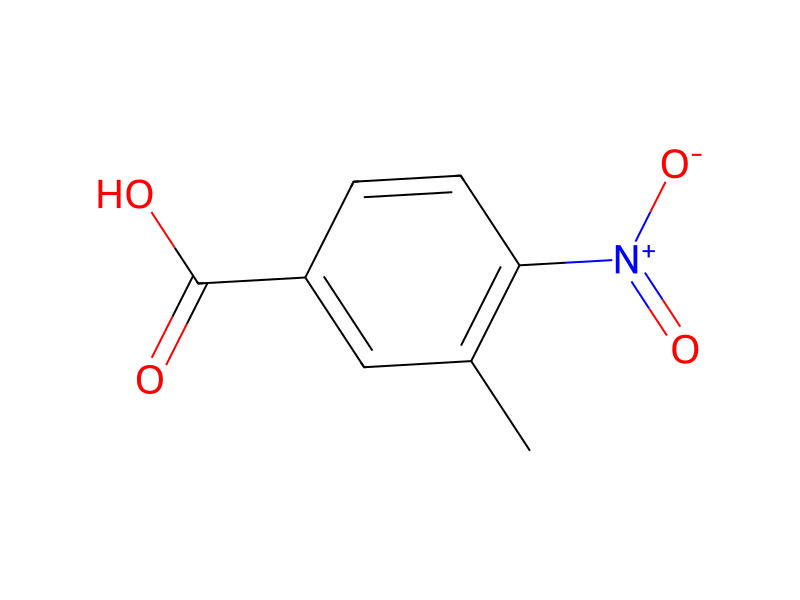
[CH3:1][C:2]1[CH:3]=[C:4]([CH:8]=[CH:9][C:10]=1[N+:11]([O-:13])=[O:12])[C:5]([OH:7])=[O:6].[CH2:14]([C:19]1[CH:24]=[CH:23][C:22](O)=[CH:21][CH:20]=1)[CH2:15][CH2:16][CH2:17][CH3:18]>C1COCC1.C(N(CC)CC)C.CN(C1C=CN=CC=1)C>[CH3:1][C:2]1[CH:3]=[C:4]([CH:8]=[CH:9][C:10]=1[N+:11]([O-:13])=[O:12])[C:5]([O:7][C:22]1[CH:21]=[CH:20][C:19]([CH2:14][CH2:15][CH2:16][CH2:17][CH3:18])=[CH:24][CH:23]=1)=[O:6]9.50 g of 3-methyl-4-nitrobenzoic acid (52.5 mM) were dissolved in 400 ml of THF and 53.1 g of triethylamine (525.0 mM). The solution was cooled to −30° C. and 6.01 g of methansulfochloride (52.5 mM) were added. The mixture was stirred for 1 h at this temperature, then a solution of 8.21 g of 4-pentylphenol (50.0 mM) in 20 ml of THF was added, followed by 100 mg of DMAP. The reaction mixture was stirred for 1 h at −30° C. and was allowed to warm to room temperature while stirred overnight. The next day, the mixture was filtered through a pad of celite filter aid, evaporated to dryness. The residue was flash chromatographed on silica gel using cyclohexane/ethyl acetate: 1/1 as eluent to afford 4-pentylphenyl 3-methyl-4-nitrobenzoate as a yellow oil. Yield: 16.2 g (49.5 mM, 99%).