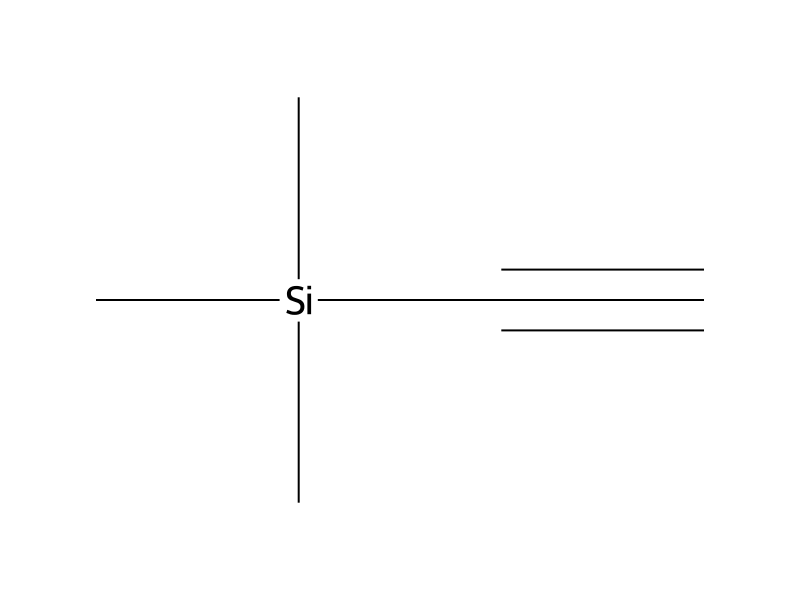
[Cl:1][C:2]1[CH:7]=[CH:6][N:5]=[CH:4][C:3]=1I.C1(P(C2C=CC=CC=2)C2C=CC=CC=2)C=CC=CC=1.C(N(CC)CC)C.[CH3:35][Si:36]([C:39]#[CH:40])([CH3:38])[CH3:37]>C1(C)C=CC=CC=1.[Cu](I)I.C([O-])(=O)C.[Pd+2].C([O-])(=O)C>[Cl:1][C:2]1[CH:7]=[CH:6][N:5]=[CH:4][C:3]=1[C:40]#[C:39][Si:36]([CH3:38])([CH3:37])[CH3:35]To a solution of 4-chloro-3-iodo pyridine (2.0 g, 8.3 mmol) in toluene (20 mL) add triphenyl phosphine (0.219 g, 0.83 mmol), copper iodide (0.079 g, 0.41 mmol) and palladium (II) acetate (0.093 g, 0.41 mmol), add triethylamine (3.49 mL, 25 mmol) dropwise at room temperature followed by the addition of trimethylsilylacetylene (1.65 mL, 11.69 mmol) at room temperature with continuous stirring. Stir the reaction mixture at room temperature for 2 hours. Concentrate the reaction mixture by evaporating the toluene under vacuum. Extract the compound (almost pure) by triturating with hexane and then decanting the hexane layer 4 to 5 times. Evaporate hexane under vacuum and dry it to obtain the pure compound (1.68 g, 96%). 1H NMR (400 MHz, CDCl3) δ 8.677 (s, 1H), 8.418 (s, 1H), 7.338 (d, J=2.6 Hz, 1H), 0.286 (s, 9H). MS (ES) m/z 210 [M+1]+.