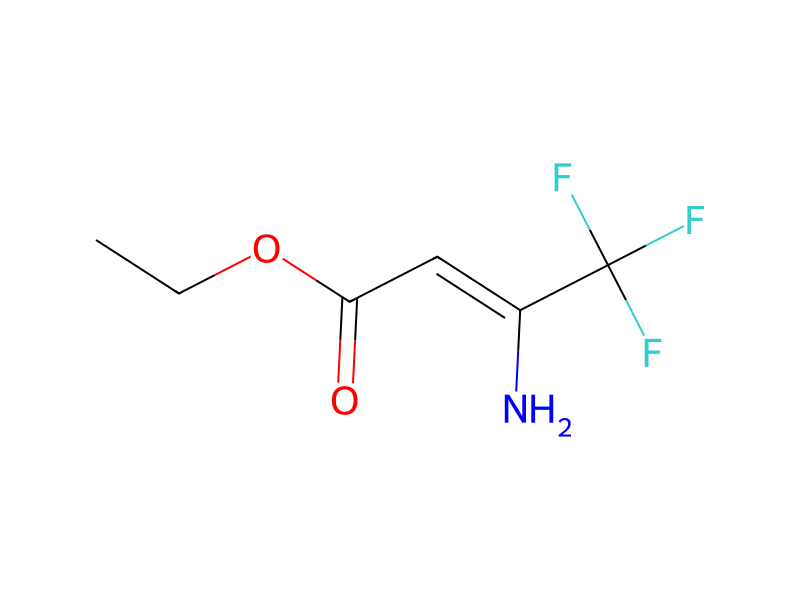
[NH2:1]/[C:2](/[C:9]([F:12])([F:11])[F:10])=[CH:3]\[C:4]([O:6]CC)=O.C[O-].[Na+].[Br:16][C:17]1[C:22]([O:23][CH2:24][CH3:25])=[CH:21][C:20]([NH:26][C:27](=O)[O:28]CC)=[C:19]([F:32])[CH:18]=1>CN(C=O)C>[Br:16][C:17]1[C:22]([O:23][CH2:24][CH3:25])=[CH:21][C:20]([N:26]2[C:4](=[O:6])[CH:3]=[C:2]([C:9]([F:10])([F:11])[F:12])[NH:1][C:27]2=[O:28])=[C:19]([F:32])[CH:18]=1Ethyl 3-amino-4,4,4-trifluorocrotonate (3.42 g) was dissolved in DMF (19 ml). To this solution, a suspension of sodium methoxide (1.10 g) in DMF was added dropwise at 5° C., and the mixture was stirred at 5° C. for 30 minutes. Then, a DNF solution of ethyl N-(4-bromo-5-ethoxy-2-fluorophenyl)-carbamate was added dropwise thereto, and the mixture was stirred at 130° C. for 4 hours. After the reaction, DMF was distilled off under reduced pressure. Then, the residue was acidified by adding diluted hydrochloric acid thereto. This was extracted with ethyl acetate, washed with water, and dried over anhydrous magnesium sulfate. Then, ethyl acetate was distilled off, and the resulting residue was crystallized from a mixed solvent of ethyl acetate and n-hexane (1:3 v/v) to obtain the objective 3-(4-bromo-5-ethoxy-2-fluorophenyl)-6-trifluoromethyl-2,4(1H,3H)-pyrimidinedione (3.63 g).