StartseiteMCPWorkbenchSkills
StartseiteWorkbenchBenachrichtigungenMein Bereich
llms.txt · MCP-AnleitungDatenschutz · Nutzungsbedingungen · Supportv1.8.3
  1. Startseite
  2. /Reaktion

Hexane → HCID 11416350, Verbindung

HRID 567775
Drucken

Reaktionsgleichung

Reaktionsgleichung von HRID 567775
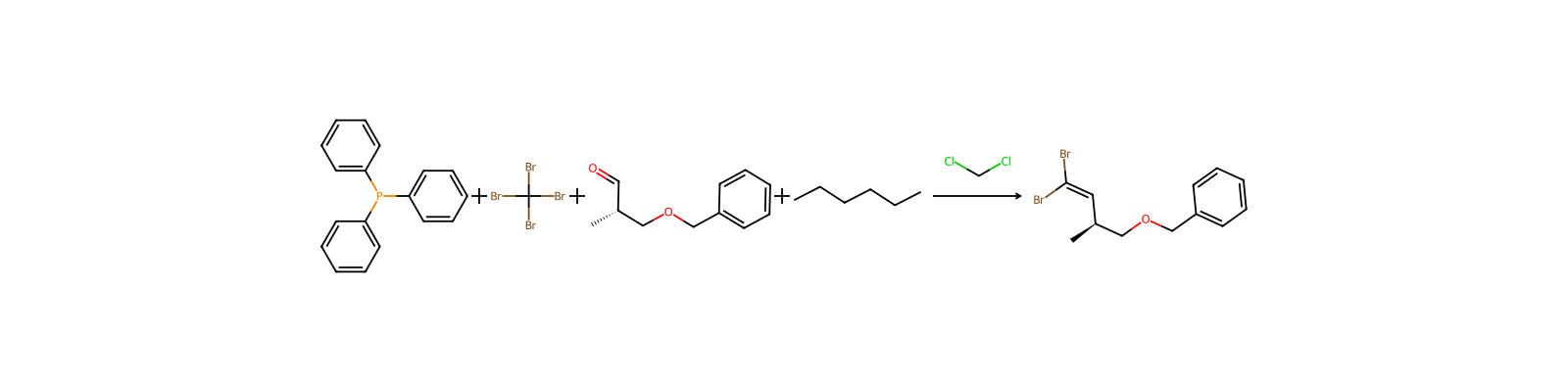
C1(P(C2C=CC=CC=2)C2C=CC=CC=2)C=CC=CC=1.[C:20]([Br:24])(Br)(Br)[Br:21].[CH2:25]([O:32][CH2:33][C@H:34]([CH3:37])[CH:35]=O)[C:26]1[CH:31]=[CH:30][CH:29]=[CH:28][CH:27]=1.CCCCCC>C(Cl)Cl>[CH2:25]([O:32][CH2:33][C@@H:34]([CH3:37])[CH:35]=[C:20]([Br:24])[Br:21])[C:26]1[CH:31]=[CH:30][CH:29]=[CH:28][CH:27]=1
KomponentenReaktionsbedingungenVersuchsvorschriftAufarbeitungQuellen und NachweiseNotizen zur Reaktion

Komponenten

6

Edukt 4

HCID 8058HexaneHCID 11205Carbon tetrabromideHCID 11776TriphenylphosphineHCID 10261648(S)-3-benzyloxy-2-methylpropanal

Produkt 1

HCID 11416350HCID 11416350, Verbindung

Reagenzien, Katalysatoren, Lösungsmittel 1

HCID 6344
Dichloromethane
Lösungsmittel
2×

Reaktionsbedingungen

Temperatur
2.5 °C

Versuchsvorschrift

An oven dried three-necked 2 L round bottom flask was equipped with a mechanical stirrer, a thermometer, an N2 inlet, and a septum. The flask was charged with 180.71 g (0.689 mol) of triphenylphosphine and 925 mL of CH2Cl2. The reaction mixture was stirred under an N2 atmosphere and cooled to 0-5° C. with an external ice-water bath. The septum was then removed and 114.25 g (0.344 mol) of carbon tetrabromide was added in portions through the open neck of the flask at a rate that maintained the temperature of the reaction mixture below 20° C. After the addition was complete the reaction was stirred for 1 h and then a solution of the (S)-3-benzyloxy-2-methylpropanal from the previous step dissolved in 150 mL of CH2Cl2 was added via cannula over a 5 min period. The reaction mixture was stirred under N2 for an additional 1 h and allowed to warm to room temperature. A separate 10 L three-necked round bottom flask was equipped with a mechanical stirrer and charged with 4 L of hexane. The stirrer was started and the crude reaction mixture was introduced as a slow stream which resulted in formation of a granular precipitate. After the transfer was complete the reaction mixture was filtered and the solids were carefully washed with hexane. The filtrate was evaporated in vacuo and additional solids were deposited. The residue was resuspended in hexane, filtered and the filtrate reevaporated. The resulting oil was purified by Kugelrohr distillation to afford 46.54 g (81% for two steps) of the title compound as an oil.

Aufarbeitung

  1. customAn oven dried three-necked 2 L round bottom flask was equipped with a mechanical stirrer
  2. customThe septum was then removed
  3. temperaturethat maintained the temperature of the reaction mixture below 20° C
  4. additionAfter the addition
  5. stirringwas stirred for 1 h
  6. additionwas added via cannula over a 5 min period
  7. stirringThe reaction mixture was stirred under N2 for an additional 1 h
  8. temperatureto warm to room temperature
  9. customA separate 10 L three-necked round bottom flask was equipped with a mechanical stirrer
  10. customthe crude reaction mixture
  11. additionwas introduced as a slow stream which
  12. customresulted in formation of a granular precipitate
  13. filtrationwas filtered
  14. washthe solids were carefully washed with hexane
  15. customThe filtrate was evaporated in vacuo and additional solids
  16. filtrationfiltered
  17. customthe filtrate reevaporated
  18. distillationThe resulting oil was purified by Kugelrohr distillation

Quellen und Nachweise

ORD-Eintrag
ord-5d4d103ff3784795b06ea730553b1d87
Quelldatensatz
uspto-grants-2001_01
DOI
10.6084/m9.figshare.5104873.v1
Patentnummer
US06180642B2

Notizen zur Reaktion

Auf dieser SeiteKomponentenReaktionsbedingungenVersuchsvorschriftAufarbeitungQuellen und NachweiseNotizen zur Reaktion

