Phosphorus pentachloride → Dibutylchlorophosphine
Reaktionsgleichung

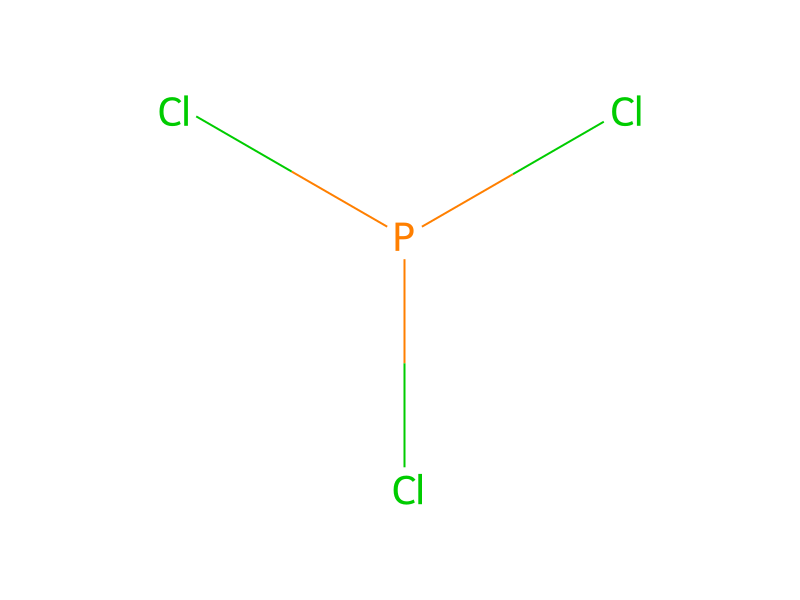
[CH2:1]([PH:5][CH2:6][CH2:7][CH2:8][CH3:9])[CH2:2][CH2:3][CH3:4].P(Cl)(Cl)(Cl)(Cl)[Cl:11]>P(Cl)(Cl)Cl>[CH2:1]([P:5]([CH2:6][CH2:7][CH2:8][CH3:9])[Cl:11])[CH2:2][CH2:3][CH3:4]Komponenten
4
Edukt 2


Produkt 1

Reagenzien, Katalysatoren, Lösungsmittel 1
Versuchsvorschrift
148 g (1 mol) di-n-butylphosphine was dropped at a maximum reaction temperature of 30° C. into a suspension of 232 g (1.1 mol) PCl5 in 500 ml toluene. HCl and PCl3 formed during the reaction were removed under a vacuum of 130 mbar and condensed in a cooling trap. After the reaction was complete, the reaction mixture was found to comprise two liquid phases. The upper phase contained PCl3 in toluene. The bulk quantity of chlorophosphine was in the lower phase (31P-NMR). It was worked up distillatively and 101 g product was obtained (55% of the theoretical). bp 92° C./16 mbar.
Aufarbeitung
- customformed during the reaction
- customwere removed under a vacuum of 130 mbar and condensed in a cooling trap
Quellen und Nachweise
- ORD-Eintrag
- ord-59cbf71311cf4f3cad9c3b4af5d6e4d9
- Quelldatensatz
- uspto-grants-1988_06
- Patentnummer
- US04752648
Notizen zur Reaktion
Wird geladen…