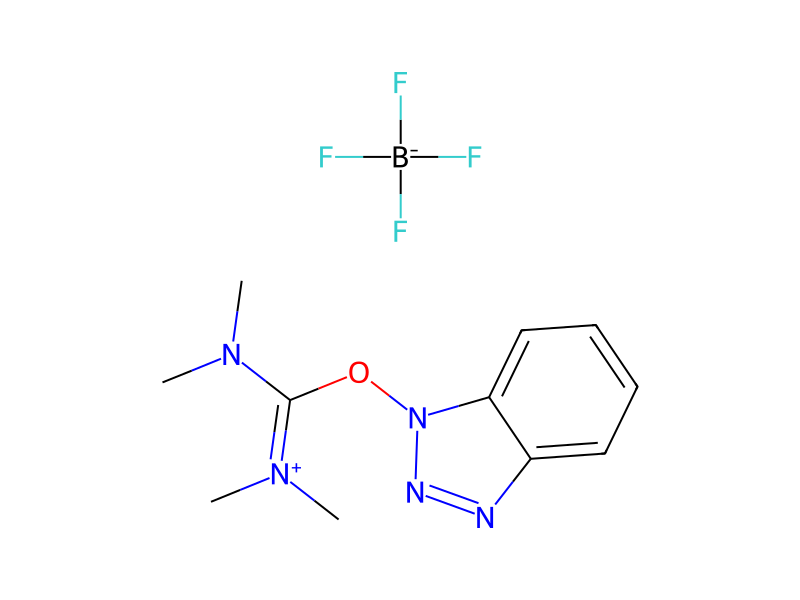
[F:1][C:2]1[CH:3]=[C:4]([C:8]#[C:9][C:10]2[CH:11]=[CH:12][C:13]([C:16]([OH:18])=O)=[N:14][CH:15]=2)[CH:5]=[CH:6][CH:7]=1.CCN(C(C)C)C(C)C.[CH3:28][C:29]1([CH3:35])[CH2:34][O:33][CH2:32][CH2:31][NH:30]1.CN(C(ON1N=NC2C=CC=CC1=2)=[N+](C)C)C.[B-](F)(F)(F)F>CN(C=O)C>[CH3:28][C:29]1([CH3:35])[CH2:34][O:33][CH2:32][CH2:31][N:30]1[C:16]([C:13]1[CH:12]=[CH:11][C:10]([C:9]#[C:8][C:4]2[CH:5]=[CH:6][CH:7]=[C:2]([F:1])[CH:3]=2)=[CH:15][N:14]=1)=[O:18](50 mg, 0.21 mmol) 5-(3-Fluoro-phenylethynyl)-pyridine-2-carboxylic acid (Example 1, step 2) was dissolved in DMF (0.5 ml) and Hunig's Base (44 μl, 0.31 mmol, 1.2 equiv.), 3,3-dimethylmorpholine (36 mg, 0.25 mmol, 1.5 equiv.) and TBTU (73 mg, 0.23 mmol, 1.1 equiv.) were added at room temperature. The mixture was stirred for 16 hours at room temperature. The reaction mixture was evaporated and extracted saturated NaHCO3 solution and two times with a small volume of dichloromethane. The crude product was purified by flash chromatography by directly loading the dichloromethane layers onto a silica gel column and eluting with an ethyl acetate:heptane gradient 0:100 to 80:20. The desired (3,3-dimethyl-morpholin-4-yl)[5-(3-fluoro-phenylethynyl)-pyridin-2-yl]-methanone (61 mg, 87% yield) was obtained as a light yellow oil, MS: m/e=339.2 (M+H+).
Wird geladen…