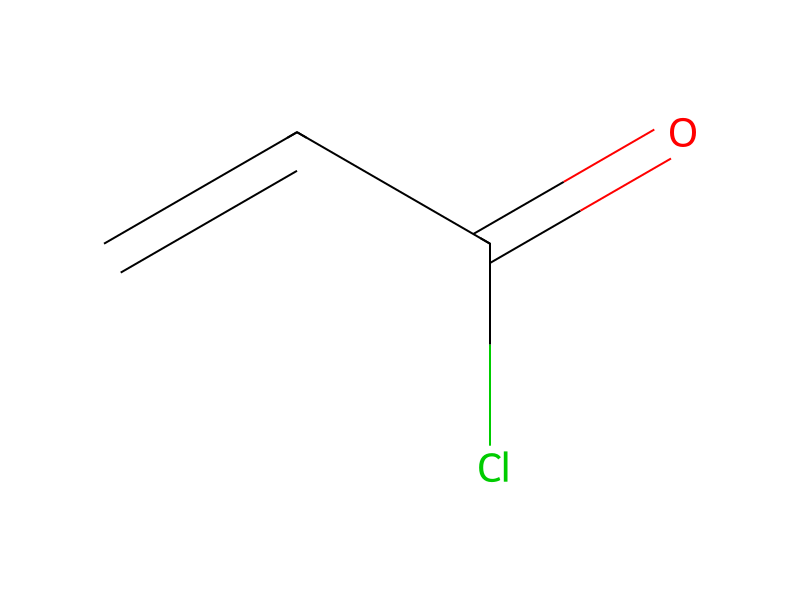
Cl.[Cl:2][C:3]1[C:8]([Cl:9])=[CH:7][C:6]([NH:10][CH2:11][C:12]([N:14]2[CH2:19][CH2:18][N:17]([CH:20]3[CH2:23][NH:22][CH2:21]3)[CH2:16][CH2:15]2)=[O:13])=[C:5]([OH:24])[CH:4]=1.CCN(CC)CC.[C:32](Cl)(=[O:35])[CH:33]=[CH2:34].O>C(Cl)Cl.CN(C=O)C>[Cl:2][C:3]1[C:8]([Cl:9])=[CH:7][C:6]([NH:10][CH2:11][C:12]([N:14]2[CH2:19][CH2:18][N:17]([CH:20]3[CH2:23][N:22]([C:32](=[O:35])[CH:33]=[CH2:34])[CH2:21]3)[CH2:16][CH2:15]2)=[O:13])=[C:5]([OH:24])[CH:4]=12-(4,5-dichloro-2-hydroxyphenylamino)-1-(4-(azetidin-3-yl)piperazin-1-yl)ethanone hydrochloride (120 mg, 0.30 mmol) was added to the mixture of Et3N (0.2 mL, 1.44 mmol) in DCM (10 mL) followed by addition of DMF (1 drop). The mixture was stirred for 5 min and then acryloyl chloride (27 mg, 0.30 mmol) was added. The resulting mixture was stirred at room temperature for 1 h, poured into water and then extracted with MeOH/DCM. The organic layer was washed with brine, dried over Na2SO4 and concentrated. The residue was purified by flash column chromatography on silica gel (DCM/MeOH/NH3.H2O=50:1:0.1 to 20:1:0.2) to afford the desired product (30 mg, 24% yield). 1H NMR (400 MHz, DMSO-d6) δ: 10.17 (s, 1H), 6.78 (s, 1H), 6.71 (s, 1H), 6.30 (dd, J=10.4, 17.2 Hz, 1H), 6.09 (dd, J=2.0, 17.2 Hz, 1H), 5.67 (dd, J=2.4, 10.4 Hz, 1H), 5.32 (t, J=4.4 Hz, 1H), 4.26-4.22 (m, 1H), 4.11-4.04 (m, 1H), 3.93-3.91 (m, 3H), 3.79-3.75 (m, 3H), 3.52-3.51 (m, 4H), 3.19-3.16 (m, 1H), 2.36-2.30 (m, 4H). ESI-MS m/z: 411.2 [M−H]−.