StartseiteMCPWorkbenchSkills
StartseiteWorkbenchBenachrichtigungenMein Bereich
llms.txt · MCP-AnleitungDatenschutz · Nutzungsbedingungen · Supportv1.8.3
  1. Startseite
  2. /Reaktion

Cesium carbonate → 2-(5-chloro-2-nitrophenylamino)-6-(pyridin-4-yl)-9-(tetrahydro-2H-pyran-4-yl)-7H-purin-8(9H)-one

HRID 600408
Drucken

Reaktionsgleichung

Reaktionsgleichung von HRID 600408
[NH2:1][C:2]1[N:10]=[C:9]2[C:5]([NH:6][C:7](=[O:17])[N:8]2[CH:11]2[CH2:16][CH2:15][O:14][CH2:13][CH2:12]2)=[C:4]([C:18]2[CH:23]=[CH:22][N:21]=[CH:20][CH:19]=2)[N:3]=1.C(=O)([O-])[O-].[Cs+].[Cs+].C1C=CC(P(C2C(C3C(P(C4C=CC=CC=4)C4C=CC=CC=4)=CC=C4C=3C=CC=C4)=C3C(C=CC=C3)=CC=2)C2C=CC=CC=2)=CC=1.Br[C:77]1[CH:82]=[C:81]([Cl:83])[CH:80]=[CH:79][C:78]=1[N+:84]([O-:86])=[O:85]>C1(C)C=CC=CC=1.CC([O-])=O.CC([O-])=O.[Pd+2].CS(C)=O>[Cl:83][C:81]1[CH:80]=[CH:79][C:78]([N+:84]([O-:86])=[O:85])=[C:77]([NH:1][C:2]2[N:10]=[C:9]3[C:5]([NH:6][C:7](=[O:17])[N:8]3[CH:11]3[CH2:12][CH2:13][O:14][CH2:15][CH2:16]3)=[C:4]([C:18]3[CH:23]=[CH:22][N:21]=[CH:20][CH:19]=3)[N:3]=2)[CH:82]=1
KomponentenReaktionsbedingungenVersuchsvorschriftAufarbeitungQuellen und NachweiseNotizen zur Reaktion

Komponenten

8

Edukt 4

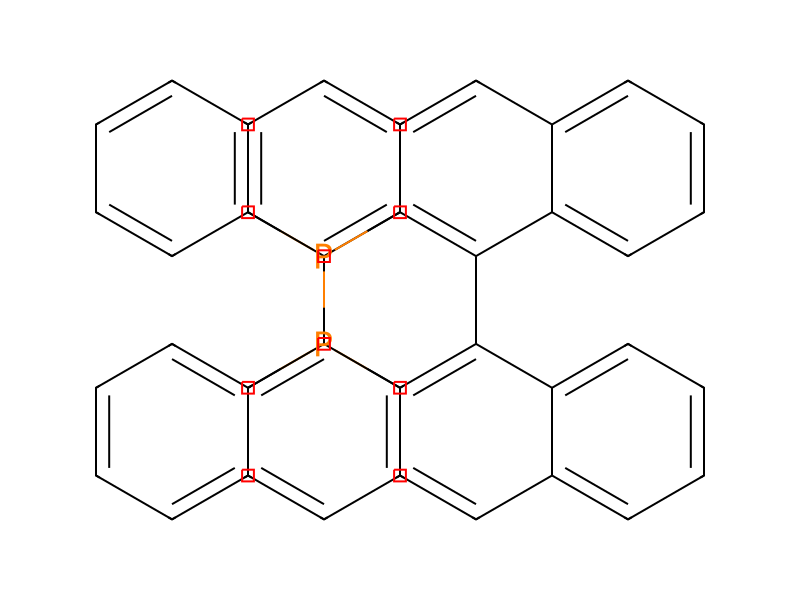
HCID 10796Cesium carbonateHCID 634876Binap, (A+-)-HCID 98561242-Bromo-4-chloro-1-nitrobenzeneHCID 576126402-amino-6-(pyridin-4-yl)-9-(tetrahydro-2H-pyran-4-yl)-7H-purin-8(9H)-one

Produkt 1

HCID 576127192-(5-chloro-2-nitrophenylamino)-6-(pyridin-4-yl)-9-(tetrahydro-2H-pyran-4-yl)-7H-purin-8(9H)-one
Ausbeute 11 %

Reagenzien, Katalysatoren, Lösungsmittel 3

HCID 167845palladium(II) acetateKatalysatorHCID 679Dimethyl SulfoxideLösungsmittelHCID 1140TolueneLösungsmittel

Reaktionsbedingungen

Temperatur
170 °C

Versuchsvorschrift

To an oven-dried vial was added 2-amino-6-(pyridin-4-yl)-9-(tetrahydro-2H-pyran-4-yl)-7H-purin-8(9H)-one (68 mg, 0.22 mmol, 1 equiv.) in anhydrous toluene (1 mL), then freshly grounded cesium carbonate (99.4 mg, 0.31 mmol, 1.4 equiv.) with stirring at room temperature under Ar. After 20 min, Pd(OAc)2 (15 mg, 0.02 mmol, 0.1 equiv.), racemic BINAP (20.5 mg, 0.03 mmol, 0.15 equiv.) and 1-bromo-5-chloro-2-nitrobenzene (WO 02/053545 A1) (67.6 mg, 0.29 mmol, 1.3 equiv.) were added as solids, followed by anhydrous DMSO (1 mL). The vial was purged with Ar for 3 min, then closed and heated in a microwave oven at 170° C. for 45 min. The reaction mixture was cooled to room temperature, diluted with ethyl acetate/methylene chloride, filtered through a Nylon 0.45 μm filter, and the filtrate was concentrated in vacuo. The resulting residue was purified using preparative TLC (silica gel, 7.5% methanol in methylene chloride) to give the desired product as a brown solid (11 mg, 11% yield). 1H NMR (300 MHz, CDCl3+CD3OD) δ, ppm: 9.13 (s, 1H), 8.63 (br m, 2H), 8.13 (d, J=8.9 Hz, 1H), 7.83 (br m, 2H), 6.91 (d, J=8.6 Hz, 1H), 4.70-4.50 (m, 1H), 4.10-4.03 (m, 2H), 3.51-3.43 (m, 2H), 2.68-2.65 (m, 2H), 1.71-1.66 (m, 2H); MS (EI) m/z 468.4 (MH)+.

Aufarbeitung

  1. customThe vial was purged with Ar for 3 min
  2. customclosed
  3. temperatureThe reaction mixture was cooled to room temperature
  4. additiondiluted with ethyl acetate/methylene chloride
  5. filtrationfiltered through a Nylon 0.45 μm
  6. filtrationfilter
  7. concentrationthe filtrate was concentrated in vacuo
  8. customThe resulting residue was purified

Quellen und Nachweise

ORD-Eintrag
ord-877b7683e96445b8bf14ea08ad5ca9a7
Quelldatensatz
uspto-grants-2011_03
DOI
10.6084/m9.figshare.5104873.v1
Patentnummer
US07902187B2

Notizen zur Reaktion

Auf dieser SeiteKomponentenReaktionsbedingungenVersuchsvorschriftAufarbeitungQuellen und NachweiseNotizen zur Reaktion