StartseiteMCPWorkbenchSkills
StartseiteWorkbenchBenachrichtigungenMein Bereich
llms.txt · MCP-AnleitungDatenschutz · Nutzungsbedingungen · Supportv1.8.0
  1. Startseite
  2. /Reaktion

Diisopropylethylamine → benzyl (2S)-2-[[(2S)-3-(difluoromethoxy)-2-[(2-morpholinoacetyl)amino]propanoyl]amino]-3-phenyl-propanoate

HRID 61303
Notizen
Druckvorschau

Reaktionsgleichung

Reaktionsgleichung von HRID 61303
Cl.[NH2:2][C@@H:3]([CH2:25][O:26][CH:27]([F:29])[F:28])[C:4]([NH:6][C@@H:7]([CH2:18][C:19]1[CH:24]=[CH:23][CH:22]=[CH:21][CH:20]=1)[C:8]([O:10][CH2:11][C:12]1[CH:17]=[CH:16][CH:15]=[CH:14][CH:13]=1)=[O:9])=[O:5].Cl.[O:31]1[CH2:36][CH2:35][N:34]([CH2:37][C:38](O)=[O:39])[CH2:33][CH2:32]1.C1C=C2N=NN(O)C2=CC=1.O.CCN=C=NCCCN(C)C.Cl.CCN(C(C)C)C(C)C>C(Cl)Cl>[F:29][CH:27]([F:28])[O:26][CH2:25][C@H:3]([NH:2][C:38](=[O:39])[CH2:37][N:34]1[CH2:35][CH2:36][O:31][CH2:32][CH2:33]1)[C:4]([NH:6][C@@H:7]([CH2:18][C:19]1[CH:20]=[CH:21][CH:22]=[CH:23][CH:24]=1)[C:8]([O:10][CH2:11][C:12]1[CH:17]=[CH:16][CH:15]=[CH:14][CH:13]=1)=[O:9])=[O:5]
KomponentenReaktionsbedingungenVersuchsvorschriftAufarbeitungQuellen und NachweiseNotizen zur Reaktion

Komponenten

7

Edukt 5

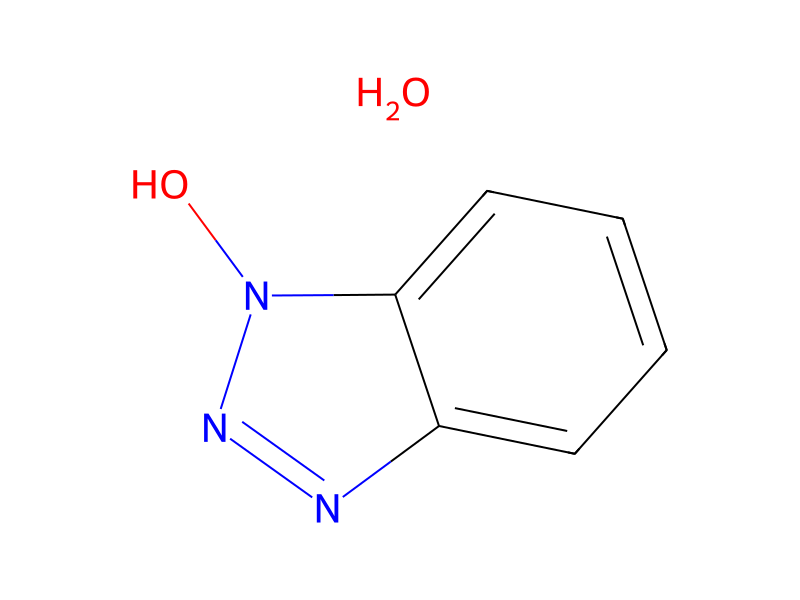
HCID 81531DiisopropylethylamineHCID 27239391,3-Propanediamine, N'-(ethylcarbonimidoyl)-N,N-dimethyl-, monohydrochlorideHCID 27960291-Hydroxybenzotriazole hydrateHCID 177509462-(Morpholin-4-yl)acetic acid hydrochlorideHCID 131737166benzyl (2S)-2-[[(2S)-2-amino-3-(difluoromethoxy)propanoyl]amino]-3-phenyl-propanoate hydrochloride


Produkt 1

HCID 118247689benzyl (2S)-2-[[(2S)-3-(difluoromethoxy)-2-[(2-morpholinoacetyl)amino]propanoyl]amino]-3-phenyl-propanoate

Reagenzien, Katalysatoren, Lösungsmittel 1

HCID 6344DichloromethaneLösungsmittel2×

Reaktionsbedingungen

Temperatur
0 °C

Versuchsvorschrift

To a stirred solution of benzyl (2S)-2-[[(2S)-2-amino-3-(difluoromethoxy)propanoyl]amino]-3-phenyl-propanoate hydrochloride (1.65 g, 3.84 mmol), 2-morpholinoacetic acid hydrochloride (768 mg, 4.23 mmol) and HOBt hydrate (648 mg, 4.23 mmol) in DCM (20 mL) was added EDC hydrochloride (811 mg, 4.23 mmol). The resulting mixture was cooled to 0° C. and treated with DIPEA (0.736 mL, 4.23 mmoL), dropwise, warmed to room temperature and stirred overnight. The mixture was diluted with DCM (30 mL) and washed with saturated sodium bicarbonate (2×50 mL). The organic phase was dried over anhydrous sodium sulfate, filtered and concentrated in vacuo then chromatographed on silica gel eluting with 0%-100% ethyl acetate in hexanes. The product-containing fractions were concentrated in vacuo giving the compound of Formula XVII(a) (1.54 g, 77%) as a white solid. 1H NMR (CDCl3, 400 MHz): δ (ppm) 7.72 (m, 1H), 7.35-6.90 (m, 10H), 6.12 (t, J=74 Hz, 1H), 5.14-5.04 (m, 2H), 4.81-4.75 (m, 1H), 4.65-4.55 (m, 1H), 4.26-4.20 (m, 1H), 3.93-3.87 (m, 1H), 3.65-3.50 (m, 4H), 3.15-2.90 (m, 4H), 2.45-2.35 (m, 4H).

Aufarbeitung

  1. temperaturedropwise, warmed to room temperature
  2. washwashed with saturated sodium bicarbonate (2×50 mL)
  3. dry with materialThe organic phase was dried over anhydrous sodium sulfate
  4. filtrationfiltered
  5. concentrationconcentrated in vacuo
  6. customthen chromatographed on silica gel eluting with 0%-100% ethyl acetate in hexanes
  7. concentrationThe product-containing fractions were concentrated in vacuo
  8. customgiving the compound of Formula XVII(a) (1.54 g, 77%) as a white solid

Quellen und Nachweise

ORD-Eintrag
ord-70173c065afa4076ad30aa6e4a5f3812
Quelldatensatz
uspto-grants-2016_09
DOI
10.6084/m9.figshare.5104873.v1
Patentnummer
US09441012B2

Notizen zur Reaktion

Wird geladen…

Auf dieser SeiteKomponentenReaktionsbedingungenVersuchsvorschriftAufarbeitungQuellen und NachweiseNotizen zur Reaktion