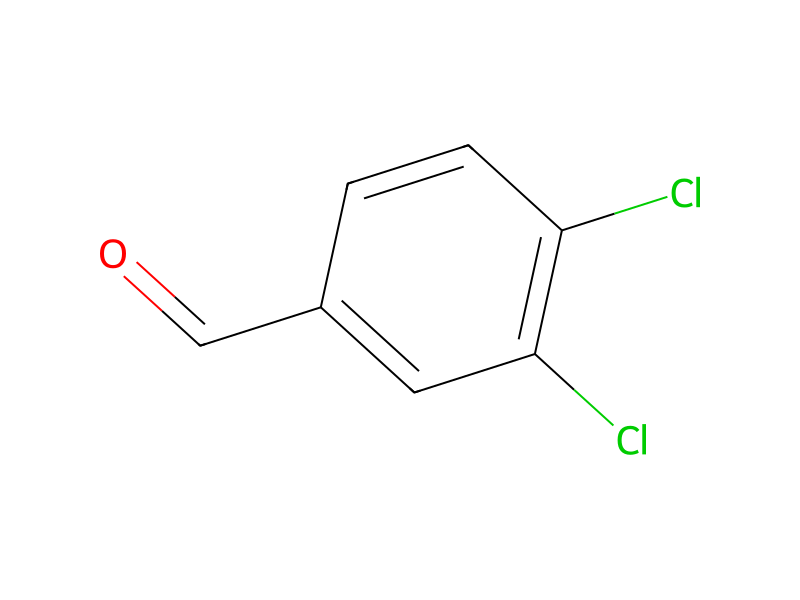
3,4-Dichlorobenzaldehyde → HCID 70201850, Verbindung
Reaktionsgleichung

[Cl:1][C:2]1[CH:11]=[C:10]2[C:5]([C:6]([NH:12][CH2:13][C:14]([CH3:17])([NH2:16])[CH3:15])=[CH:7][CH:8]=[N:9]2)=[CH:4][CH:3]=1.[Cl:18][C:19]1[CH:20]=[C:21]([CH:24]=[CH:25][C:26]=1[Cl:27])[CH:22]=O>C(O)C>[Cl:1][C:2]1[CH:11]=[C:10]2[C:5]([C:6]([NH:12][CH2:13][C:14]([CH3:17])([NH:16][CH2:22][C:21]3[CH:24]=[CH:25][C:26]([Cl:27])=[C:19]([Cl:18])[CH:20]=3)[CH3:15])=[CH:7][CH:8]=[N:9]2)=[CH:4][CH:3]=1Komponenten
4
Edukt 2

Produkt 1

Reagenzien, Katalysatoren, Lösungsmittel 1

Versuchsvorschrift
1.25 g of N1 -(7-chloro-quinolin-4-yl)-2-methyl-propane-1,2-diamine and 0.88 g of 3,4-dichlorobenzaldehyde were heated under reflux in 10 ml of ethanol for 3 hours. In order to complete the reaction, the solvent was evaporated in a vacuum. The resulting Schiff's base was again taken up in 20 ml of ethanol and reduced to the amine by the addition of 0.19 g of sodium borohydride. Excess reducing agent was decomposed after 2 hours by the addition of 10 ml of glacial acetic acid. The turbid solution was then evaporated on a rotary evaporator. 10 ml of methanol were added to the residue and the mixture was again evaporated. Addition of methanol and evaporation were repeated twice. The evaporation residue was then taken up in 25 ml of water. The pH was adjusted to 10 by the addition of dilute sodium hydroxide solution, separating the product. The product was purified by recrystallization from 45 ml of ethyl acetate. Yield: 1.09 g (53%), m.p. 178-179° C.