Reaktionsgleichung

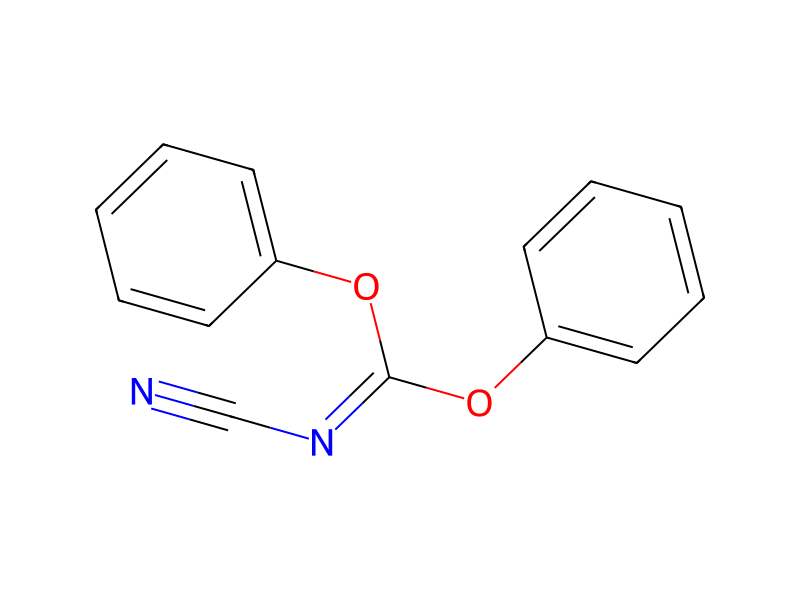
[CH:1]1[C:10]2[C:5](=[CH:6][CH:7]=[CH:8][CH:9]=2)[CH:4]=[CH:3][C:2]=1[C:11]([NH:13][NH2:14])=[O:12].C(N(CC)CC)C.C1C=CC(O[C:29](OC2C=CC=CC=2)=[N:30][C:31]#[N:32])=CC=1>C(O)(C)C>[CH:1]1[C:10]2[C:5](=[CH:6][CH:7]=[CH:8][CH:9]=2)[CH:4]=[CH:3][C:2]=1[C:11]1[O:12][CH:29]([NH:30][C:31]#[N:32])[NH:14][N:13]=1Komponenten
5
Edukt 3


Produkt 1

Reagenzien, Katalysatoren, Lösungsmittel 1

Versuchsvorschrift
To a stirred solution of naphthalene-2-carboxylic acid hydrazide (0.7 g, 3.76 mmol) in isopropanol (40 ml) was added triethylamine (630 μl, 4.51 mmol) and diphenyl cyanocarbonimidate (0.99 g, 4.14 mmol) and the resulting reaction mixture was stirred at room temperature for 1.5 h. The volatiles were evaporated in vacuo and to the residue was added water (50 ml) and diethyl ether (50 ml). The organic phase was separated and the aqueous phase was acidified to pH=1 with concentrated hydrochloric acid. The precipitate was filtered off and washed with water (3×10 ml) and diethyl ether (2×10 ml) and dried in vacuo at 50° C. which afforded 0.45 g (51%) of the title compound as a solid.
Aufarbeitung
- customthe resulting reaction mixture
- customThe volatiles were evaporated in vacuo and to the residue
- additionwas added water (50 ml) and diethyl ether (50 ml)
- customThe organic phase was separated
- filtrationThe precipitate was filtered off
- washwashed with water (3×10 ml) and diethyl ether (2×10 ml)
- customdried in vacuo at 50° C. which
Quellen und Nachweise
- ORD-Eintrag
- ord-0f08127f98624c6abfbb8876c1e434a0
- Quelldatensatz
- uspto-grants-1999_09
- Patentnummer
- US05958957
Verknüpfte Notizen
Wird geladen…