StartseiteMCPWorkbenchSkills
StartseiteWorkbenchBenachrichtigungenMein Bereich
llms.txt · MCP-AnleitungDatenschutz · Nutzungsbedingungen · Supportv1.8.1
  1. Startseite
  2. /Reaktion

4-Chloro-3-nitrotoluene → 4-Methyl-2-nitro-1-(1-propen-2-yl)benzene

HRID 62039
Drucken

Reaktionsgleichung

Reaktionsgleichung von HRID 62039
Cl[C:2]1[CH:7]=[CH:6][C:5]([CH3:8])=[CH:4][C:3]=1[N+:9]([O-:11])=[O:10].[CH3:12][C:13]1(C)[C:17](C)(C)OB(C(C)=C)O1.C(=O)([O-])[O-].[Na+].[Na+]>O.O1CCOCC1.Cl[Pd](Cl)([P](C1C=CC=CC=1)(C1C=CC=CC=1)C1C=CC=CC=1)[P](C1C=CC=CC=1)(C1C=CC=CC=1)C1C=CC=CC=1>[CH3:8][C:5]1[CH:6]=[CH:7][C:2]([C:13]([CH3:17])=[CH2:12])=[C:3]([N+:9]([O-:11])=[O:10])[CH:4]=1
KomponentenReaktionsbedingungenVersuchsvorschriftAufarbeitungQuellen und NachweiseNotizen zur Reaktion

Komponenten

7

Edukt 3

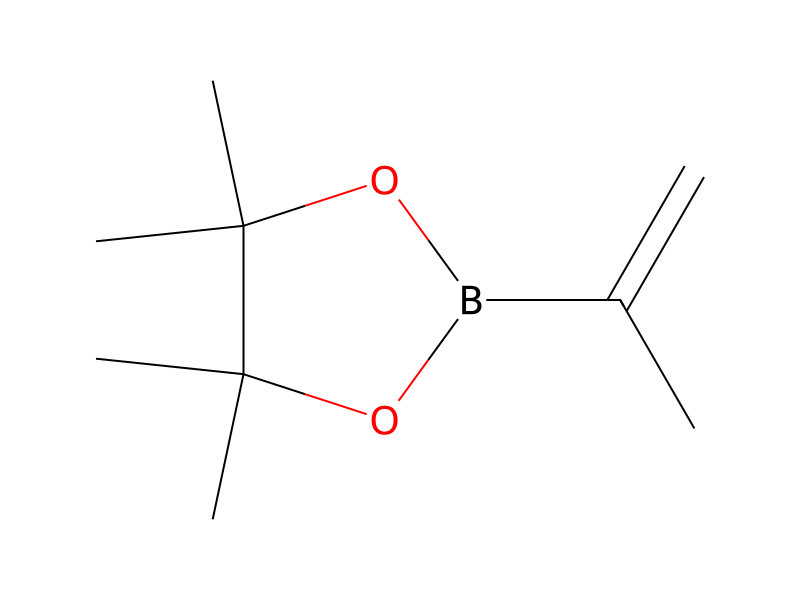
HCID 69764-Chloro-3-nitrotolueneHCID 10340Sodium CarbonateHCID 109974264,4,5,5-Tetramethyl-2-(prop-1-en-2-yl)-1,3,2-dioxaborolane

Produkt 1

HCID 897388014-Methyl-2-nitro-1-(1-propen-2-yl)benzeneAusbeute 95,4 %

Reagenzien, Katalysatoren, Lösungsmittel 3

HCID 178418476HCID 178418476, Verbindung
Katalysator
HCID 962WaterLösungsmittel
HCID 312751,4-DioxaneLösungsmittel

Reaktionsbedingungen

Temperatur
140 °C

Versuchsvorschrift

1-Chloro-4-methyl-2-nitrobenzene (0.771 mL, 5.83 mmol), 4,4,5,5-tetramethyl-2-(prop-1-en-2-yl)-1,3,2-dioxaborolane (1.32 mL, 6.99 mmol), bis(triphenyl phosphine)palladium(II) chloride (0.327 g, 0.466 mmol), sodium carbonate (0.741 g, 6.99 mmol) in water (2.9 mL) and dioxane (11.4 mL) was capped in two separate 10-20 mL vials and heated on a Biotage Initiator® microwave reactor for 30 minutes at 140° C., with external IR-sensor temperature monitoring from the side of the vessel. The contents of the two vials were combined and diluted with ethyl acetate and washed with water. The aqueous layer was extracted with ethyl acetate (2×). The combined organic layers were dried over magnesium sulfate, filtered, and concentrated. Purification by flash column chromatography using 1-5% ethyl acetate/hexanes provided the title compound as a yellow oil (0.986 g, 95%): IR (thin film) 3084 (w), 2976 (m), 2919 (w), 1641 (w), 1560 (w), 1526 (vs), 1349 (s) cm−1; 1H NMR (400 MHz, CDCl3) δ 7.68-7.65 (m, 1H), 7.37-7.32 (m, 1H), 7.21 (d, J=7.9 Hz, 1H), 5.15 (p, J=1.5 Hz, 1H), 4.91 (p, J=1.0 Hz, 1H), 2.42 (s, 3H), 2.06 (t, J=1.2 Hz, 3H); 13C NMR (101 MHz, CDCl3) δ 148.06, 142.71, 138.30, 136.15, 133.38, 130.32, 124.29, 115.17, 23.32, 20.81.

Aufarbeitung

  1. customseparate 10-20 mL vials
  2. additiondiluted with ethyl acetate
  3. washwashed with water
  4. extractionThe aqueous layer was extracted with ethyl acetate (2×)
  5. dry with materialThe combined organic layers were dried over magnesium sulfate
  6. filtrationfiltered
  7. concentrationconcentrated
  8. customPurification by flash column chromatography

Quellen und Nachweise

ORD-Eintrag
ord-2131dcd688744a948c8f0f8a8e0001c8
Quelldatensatz
uspto-grants-2016_09
DOI
10.6084/m9.figshare.5104873.v1
Patentnummer
US09445594B2

Notizen zur Reaktion

Auf dieser SeiteKomponentenReaktionsbedingungenVersuchsvorschriftAufarbeitungQuellen und NachweiseNotizen zur Reaktion