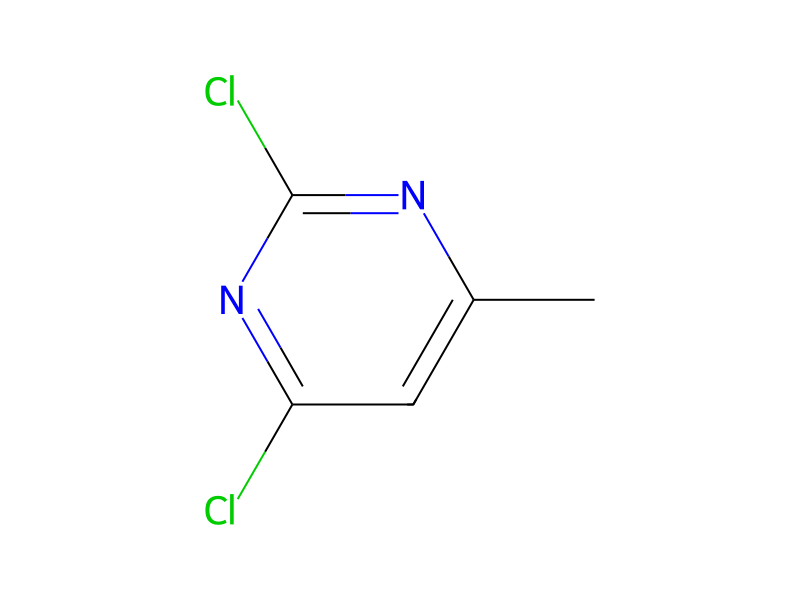
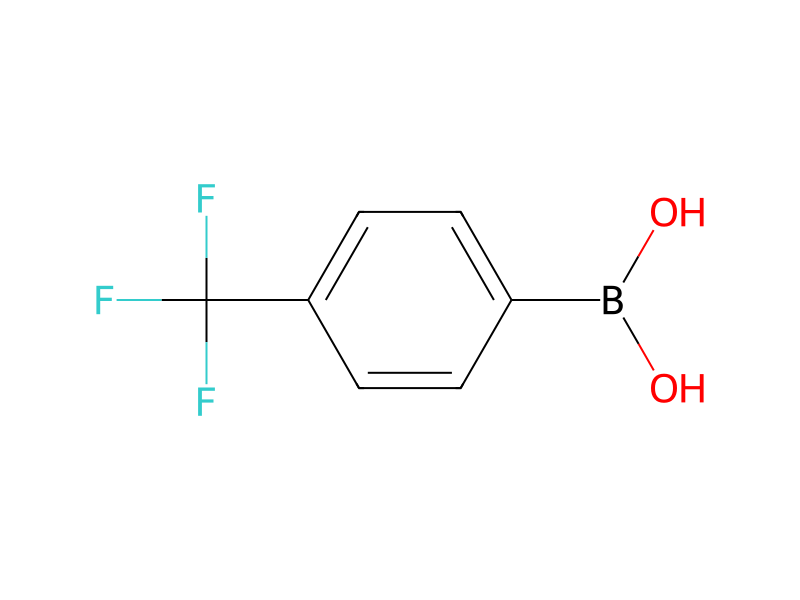
[Cl:1][C:2]1[N:7]=[C:6](Cl)[CH:5]=[C:4]([CH3:9])[N:3]=1.C(=O)([O-])[O-].[Na+].[Na+].[F:16][C:17]([F:28])([F:27])[C:18]1[CH:23]=[CH:22][C:21](B(O)O)=[CH:20][CH:19]=1>COCCOC.O.C1(C=CC=CC=1)[P](C1C=CC=CC=1)(C1C=CC=CC=1)[Pd][P](C1C=CC=CC=1)(C1C=CC=CC=1)C1C=CC=CC=1>[Cl:1][C:2]1[N:3]=[C:4]([CH3:9])[CH:5]=[C:6]([C:21]2[CH:22]=[CH:23][C:18]([C:17]([F:28])([F:27])[F:16])=[CH:19][CH:20]=2)[N:7]=1To a solution of 2,4-dichloro-6-methyl-pyrimidine (5 g, 30.67 mmol) in 1,2-dimethoxyethane (35 mL) and water (25 mL) was added sodium carbonate (9.75 g, 92.03 mmol), and 4-(trifluoromethyl)-phenylboronic acid (5.53 g, 29.14 mmol). This was degassed with nitrogen for 5 minutes. The bis(triphenylphosphine)palladium (II) dichloride (1.08 g, 1.53 mmol) was then added and the reaction was heated to 90° C. overnight. The solvent was evaporated and the residue was partitioned between water (300 mL) and EtOAc (300 mL). The organics were washed with brine (100 mL), dried over MgSO4 and concentrated in vacuo to afford a yellow oil. The material was purified using a Biotage SP4, 0 to 50% i-hexane/EtOAc and the fractions containing the lower (major) spot were collected and the solvent evaporated to afford the 2-chloro-4-methyl-6-[4-(trifluoromethyl)-phenyl]pyrimidine (D11) (4.65 g, 17.06 mmol, 55.6% yield) as a colourless solid.