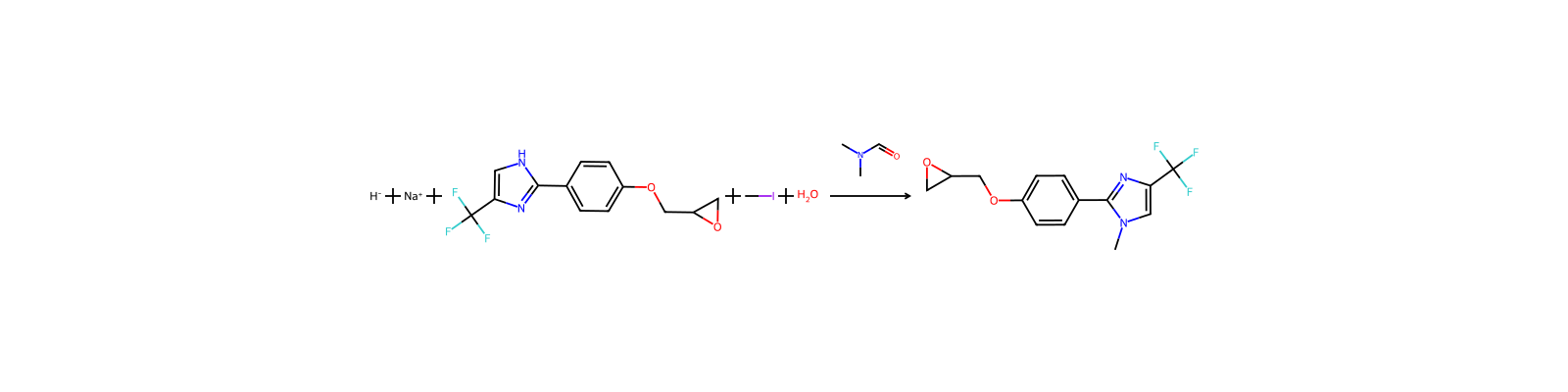
[H-].[Na+].[O:3]1[CH2:22][CH:4]1[CH2:5][O:6][C:7]1[CH:12]=[CH:11][C:10]([C:13]2[NH:14][CH:15]=[C:16]([C:18]([F:21])([F:20])[F:19])[N:17]=2)=[CH:9][CH:8]=1.[CH3:23]I.O>CN(C)C=O>[O:3]1[CH2:22][CH:4]1[CH2:5][O:6][C:7]1[CH:8]=[CH:9][C:10]([C:13]2[N:14]([CH3:23])[CH:15]=[C:16]([C:18]([F:20])([F:19])[F:21])[N:17]=2)=[CH:11][CH:12]=12 g of sodium hydride dispersion (55% in oil) are added, while cooling in an ice bath, to a solution of 12 g of 2-[4-(2,3-epoxypropoxy)-phenyl]-4-(trifluoromethyl)-imidazole (J. med. Chem. 20, 1024 (1977)) in 90 ml of dimethylformamide and the yellow suspension is stirred for 11/2 hours at room temperature. After the addition of 8 ml of methyl iodide, stirring is continued for a further 12 hours at room temperature, the reaction mixture is subsequently poured into water and extracted several times with ethyl acetate. After separating off the organic phase and removing the solvent, the residue is dissolved in chloroform and filtered over silica gel. The filtrate is again concentrated by evaporation and the residue is recrystallized from ether/hexane, yielding 2-[4-(2,3-epoxypropoxy)-phenyl]-1-methyl-4-(trifluoromethyl)-imidazole having a melting point of 65°-68°.
Wird geladen…