Nitric Acid → 2,3-Dihydro-2,2-dimethyl-4-nitro-7-benzofuranol
HRID 638151
Reaktionsgleichung

[CH3:1][C:2]1([CH3:12])[CH2:6][C:5]2[CH:7]=[CH:8][CH:9]=[C:10]([OH:11])[C:4]=2[O:3]1.[N+:13]([O-])([OH:15])=[O:14]>CCOCC>[CH3:1][C:2]1([CH3:12])[CH2:6][C:5]2[C:7]([N+:13]([O-:15])=[O:14])=[CH:8][CH:9]=[C:10]([OH:11])[C:4]=2[O:3]1Komponenten
4
Edukt 2

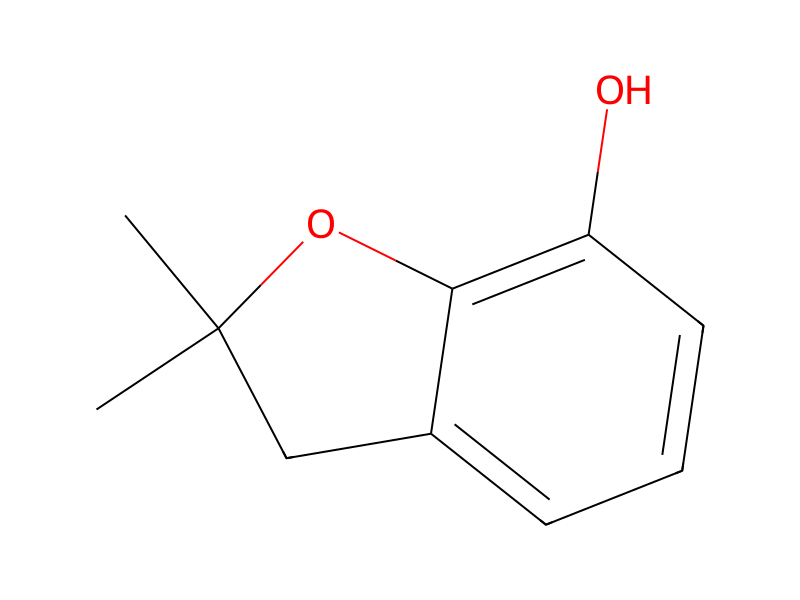
Produkt 1

Reagenzien, Katalysatoren, Lösungsmittel 1

Versuchsvorschrift
To a solution of 2,3-dihydro-2,2-dimethyl-7-benzofuranol (16.4 g, 0.1 mol) in 150 ml of ether, 70% nitric acid (9.0 g, 0.1 mol) was slowly dropwise added at room temperature. The reaction solution was stirred for further 20 minutes, then washed with water, dried over anhydrous sodium sulfate and concentrated. The solid substance thereby obtained, was repeatedly recrystallized from hexane-ethyl acetate, whereby 6.2 g of 2,3-dihydro-2,2-dimethyl-4-nitro-7-benzofuranol and 6.0 g of 2,3-dihydro-2,2-dimethyl-6-nitro-7-benzofuranol as its 6-nitro isomer, were obtained. The melting points of these products were 164°-165° C. and 125°-126° C., respectively. Further, the structures of these intermediate phenols were confirmed by 1H-NMR spectra. 2,3-Dihydro-2,2-dimethyl-4-nitro-7-benzofuranol thus obtained, was reacted with O-ethyl-S-n-propylthiophosphoryl chloride in the same manner as in Example 1, whereby the compound (No. 6) identified in Table 1 was obtained.