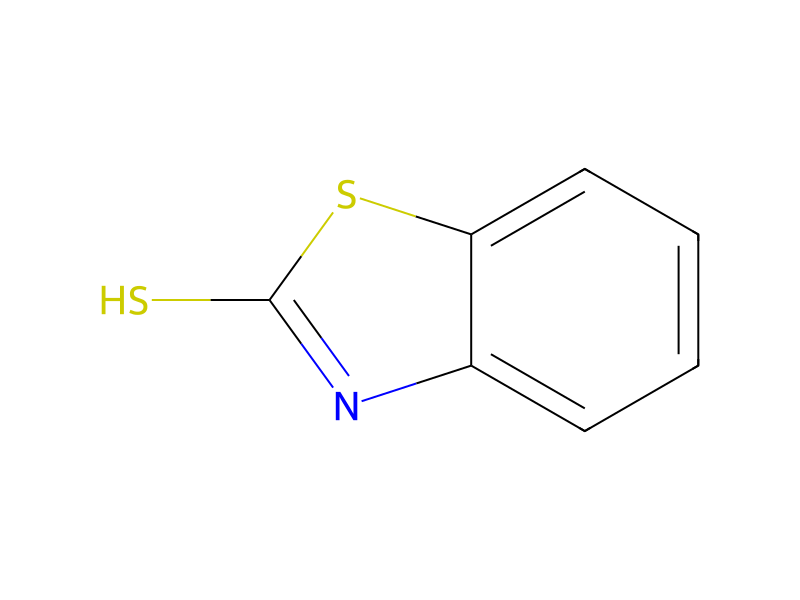
[SH:1][C:2]1[S:3][C:4]2[CH:10]=[CH:9][CH:8]=[CH:7][C:5]=2[N:6]=1.[CH2:11]([C:21]([OH:23])=[O:22])[CH:12]([C:18]([OH:20])=[O:19])[C:13]([C:15]([OH:17])=[O:16])=[CH2:14].OS(O)(=O)=O>O>[S:3]1[C:4]2[CH:10]=[CH:9][CH:8]=[CH:7][C:5]=2[N:6]=[C:2]1[S:1][CH2:14][CH:13]([C:15]([OH:17])=[O:16])[CH:12]([C:18]([OH:20])=[O:19])[CH2:11][C:21]([OH:23])=[O:22]4.45 g of 2-mercaptobenzothiazole and 5 g of but-3-ene-1,2,3-tricarboxylic acid are ground together in a mortar. The powdered mixture is introduced in portions into 60 ml of 70% H2SO4 at 48°-50° in the course of 1 hour, with stirring. After a further 3 hours at 48°-50°, the reaction mixture is cooled to room temperature and diluted with 250 ml of water at 25°-30°, with stirring. The aqueous solution is decanted from a little glutinous sediment and diluted with a further 200 ml of water. After stirring for 1 hour, the precipitate is filtered off and dried. The 4-(benzothiazol-2-ylthio)-butane-1,2,3-tricarboxylic acid obtained has a melting point of 188°-190°, after recrystallisation from methanol/water.