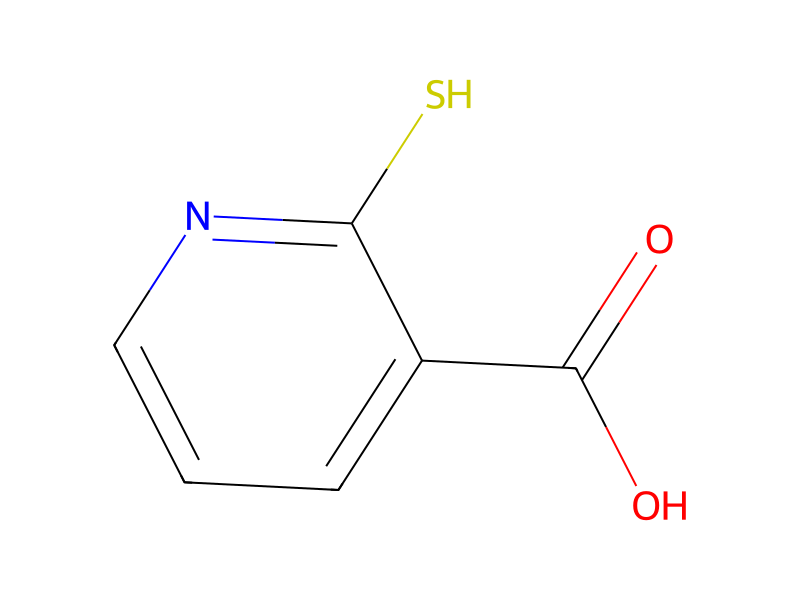
C([O-])([O-])=O.[K+].[K+].[SH:7][C:8]1[N:16]=[CH:15][CH:14]=[CH:13][C:9]=1[C:10]([OH:12])=[O:11].Cl[CH2:18][CH2:19][S:20]([C:23]1[CH:28]=[CH:27][CH:26]=[C:25]([C:29]([F:32])([F:31])[F:30])[CH:24]=1)(=[O:22])=[O:21].Cl>CN(C=O)C.C(OCC)(=O)C.O>[F:32][C:29]([F:30])([F:31])[C:25]1[CH:24]=[C:23]([S:20]([CH2:19][CH2:18][S:7][C:8]2[N:16]=[CH:15][CH:14]=[CH:13][C:9]=2[C:10]([OH:12])=[O:11])(=[O:21])=[O:22])[CH:28]=[CH:27][CH:26]=1683 mg (4.92 mmol) of K2CO3 were added to a suspension of 349 mg (2.25 mmol) of 2-mercaptonicotinic acid in DMF (5 ml), and the mixture was stirred for 30 min at RT. 614 mg (2.25 mmol) of 2-chloroethyl-(3-(trifluoromethyl)phenyl)sulfone were then added, and stirring was continued for a further 72 h at RT. The reaction solution was concentrated in vacuo, the residue obtained was taken up in ethyl acetate, and water was added. The pH was adjusted to 3 with 2 M hydrochloric acid, and the phases were separated. The aqueous phase was extracted with ethyl acetate. The combined organic phases were dried over MgSO4, filtered and concentrated in vacuo. 778 mg (1.99 mmol, 88%) of 2-(2-(3-(trifluoromethyl)phenylsulfonyl)ethylthio)nicotinic acid were obtained as residue.
Wird geladen…