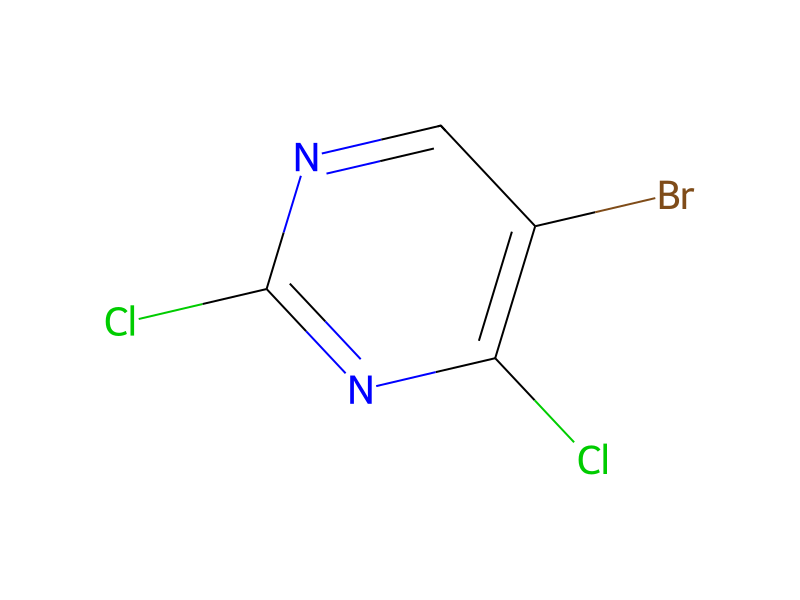
[Br:1][C:2]1[C:3](Cl)=[N:4][C:5]([Cl:8])=[N:6][CH:7]=1.CCN(C(C)C)C(C)C.[C:19]([O:23][C:24]([NH:26][CH2:27][CH2:28][NH2:29])=[O:25])([CH3:22])([CH3:21])[CH3:20]>C(O)C>[Br:1][C:2]1[C:3]([NH:29][CH2:28][CH2:27][NH:26][C:24](=[O:25])[O:23][C:19]([CH3:21])([CH3:20])[CH3:22])=[N:4][C:5]([Cl:8])=[N:6][CH:7]=1To a solution of 5-bromo-2,4-dichloropyrimidine 3.2 g (0.0135 mole) in ethanol 80 mL was added Hunig's base 3.0 mL followed by the addition of a solution of N-(tert-butoxycarbonyl)-1,2-diaminoethane 2.5 g (0.0156 mole) in 20 mL ethanol. The contents were stirred overnight for 20 hrs. The solvent was evaporated under vacuum. Ethyl acetate (200 mL) and water (100 mL) was added and the layers separated. The organic layer was dried with magnesium sulfate and then concentrated under vacuum. Column chromatography on silica gel using hexane/ethyl acetate (0-60%) afforded tert-butyl N-[2-[(5-bromo-2-chloro-pyrimidin-4-yl)amino]ethyl]carbamate. 1HNMR (d6-DMSO) 8.21 (s, 1H), 7.62 (brs, 1H), 7.27 (brs, 1H), 3.39 (m, 2H), 3.12 (m, 2H), 1.34 (s, 9H). LCMS (ESI) 351 (M+H)