StartseiteMCPWorkbenchSkills
StartseiteWorkbenchBenachrichtigungenMein Bereich
llms.txt · MCP-AnleitungDatenschutz · Nutzungsbedingungen · Supportv1.8.3
  1. Startseite
  2. /Reaktion

Sodium Bicarbonate → HCID 178427385, Verbindung

HRID 74470
Drucken

Reaktionsgleichung

Reaktionsgleichung von HRID 74470
[NH2:1][C:2]1[N:6]([C:7]2[CH:16]=[CH:15][C:10]3[NH:11][C:12]([CH3:14])=[N:13][C:9]=3[CH:8]=2)[N:5]=[CH:4][C:3]=1[C:17]([C:19]1[N:20]([S:29]([C:32]2[CH:37]=[CH:36][C:35]([CH3:38])=[CH:34][CH:33]=2)(=[O:31])=[O:30])[C:21]2[C:26]([CH:27]=1)=[CH:25][CH:24]=[C:23](I)[CH:22]=2)=[O:18].C([O-])(=O)C.[K+].Br[C:45]1[CH:50]=[CH:49][N:48]=[N:47][CH:46]=1.C(=O)(O)[O-].[Na+]>C1C=CC(P(C2C=CC=CC=2)[C-]2C=CC=C2)=CC=1.C1C=CC(P(C2C=CC=CC=2)[C-]2C=CC=C2)=CC=1.Cl[Pd]Cl.[Fe+2].ClCCl.Cl[Pd](Cl)([P](C1C=CC=CC=1)(C1C=CC=CC=1)C1C=CC=CC=1)[P](C1C=CC=CC=1)(C1C=CC=CC=1)C1C=CC=CC=1.O1CCOCC1.ClCCl.CO.CS(C)=O>[NH2:1][C:2]1[N:6]([C:7]2[CH:16]=[CH:15][C:10]3[NH:11][C:12]([CH3:14])=[N:13][C:9]=3[CH:8]=2)[N:5]=[CH:4][C:3]=1[C:17]([C:19]1[N:20]([S:29]([C:32]2[CH:37]=[CH:36][C:35]([CH3:38])=[CH:34][CH:33]=2)(=[O:31])=[O:30])[C:21]2[C:26]([CH:27]=1)=[CH:25][CH:24]=[C:23]([C:45]1[CH:50]=[CH:49][N:48]=[N:47][CH:46]=1)[CH:22]=2)=[O:18]
KomponentenReaktionsbedingungenVersuchsvorschriftAufarbeitungQuellen und NachweiseNotizen zur Reaktion

Komponenten

10

Edukt 4

HCID 516892Sodium BicarbonateHCID 517044Potassium AcetateHCID 178889274-BromopyridazineHCID 178427388HCID 178427388, Verbindung

Produkt 1

HCID 178427385HCID 178427385, Verbindung

Reagenzien, Katalysatoren, Lösungsmittel 5

HCID 178418476
HCID 178418476, Verbindung
Katalysator
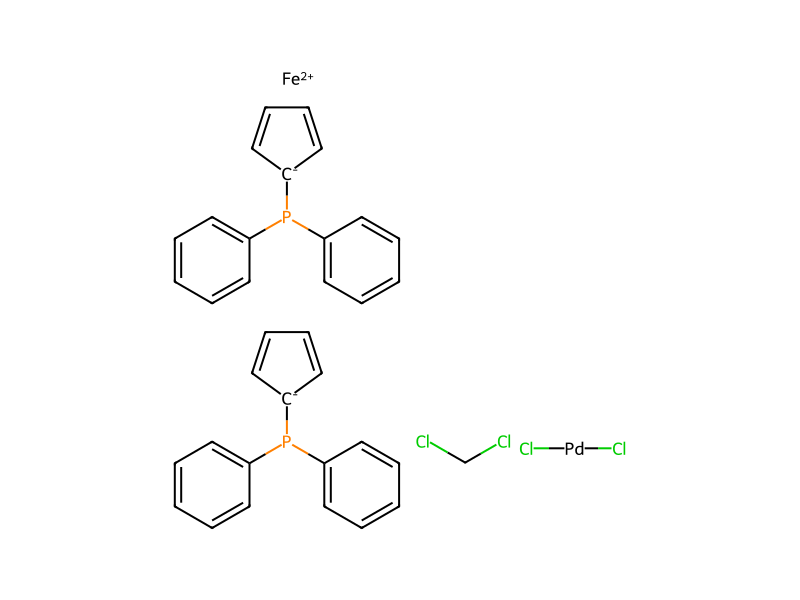
HCID 178418807HCID 178418807, VerbindungKatalysator
HCID 679Dimethyl SulfoxideLösungsmittel
HCID 312751,4-DioxaneLösungsmittel
HCID 21226129Dichloromethane methanolLösungsmittel

Reaktionsbedingungen

Temperatur
110 °C

Versuchsvorschrift

A mixture of [5-amino-1-(2-methyl-1H-benzimidazol-5-yl)-1H-pyrazol-4-yl]-[6-iodo-1-(toluene-4-sulfonyl)-1H-indol-2-yl]-methanone (194.9 mg, 0.306 mmol), [1,1′-bis(diphenylphosphino)ferrocene]dichloro-palladium (II)/dichloromethane adduct (14.4 mg, 0.015 mmol) bis(pinacol)diborane (100.9 mg, 0.397 mmol), potassium acetate (132.3 mg, 1.35 mmol), and anhydrous dimethylsulfoxide (DMSO) (1.5 ml) was deaerated. Then, the air was replaced three times with argon, and was heated and stirred at 110° C. for six hours. Then, the reaction mixture was extracted with ethyl acetate. The extract was dried over anhydrous sodium sulfate. The desiccant was removed by filtration, and concentration was performed. Then, the residue obtained by concentration under reduced pressure was subjected to silica gel column chromatography (dichloromethane/methanol=15/1). The resulting crude product was mixed with 4-bromo-pyridazine (78.0 mg, 0.491 mol), dichlorobis(triphenylphosphine)palladium (II) (17.2 mg, 0.025 mmol), an aqueous solution of 2 M sodium bicarbonate (0.325 mmol), and dioxane (0.4 ml). After deaeration, the air was replaced three times with argon, and this was microwaved at 150° C. for five minutes. Then, the reaction mixture was extracted with ethyl acetate. The extract was dried over anhydrous sodium sulfate. The desiccant was removed by filtration, and concentration was performed. Then, the residue obtained by concentration under reduced pressure was purified by silica gel column chromatography (dichloromethane/methanol=1% to 12%). Thus, [5-amino-1-(2-methyl-1H-benzimidazol-5-yl)-1H-pyrazol-4-yl]-[6-pyridazin-4-yl-1-(toluene-4-sulfonyl)-1H-indol-2-yl]-methanone was obtained as a pale yellow amorphous material (20.0 mg, yield of 11%).

Aufarbeitung

  1. temperaturewas heated
  2. extractionThen, the reaction mixture was extracted with ethyl acetate
  3. dry with materialThe extract was dried over anhydrous sodium sulfate
  4. customThe desiccant was removed by filtration, and concentration
  5. customThen, the residue obtained by concentration under reduced pressure
  6. customthis was microwaved at 150° C. for five minutes
  7. extractionThen, the reaction mixture was extracted with ethyl acetate
  8. dry with materialThe extract was dried over anhydrous sodium sulfate
  9. customThe desiccant was removed by filtration, and concentration
  10. customThen, the residue obtained by concentration under reduced pressure
  11. customwas purified by silica gel column chromatography (dichloromethane/methanol=1% to 12%)

Quellen und Nachweise

ORD-Eintrag
ord-c9494a3fe4b647ce80f8f575bf0825a9
Quelldatensatz
uspto-grants-2014_09
DOI
10.6084/m9.figshare.5104873.v1
Patentnummer
US08829199B2

Notizen zur Reaktion

Auf dieser SeiteKomponentenReaktionsbedingungenVersuchsvorschriftAufarbeitungQuellen und NachweiseNotizen zur Reaktion