StartseiteMCPWorkbenchSkills
StartseiteWorkbenchBenachrichtigungenMein Bereich
llms.txt · MCP-AnleitungDatenschutz · Nutzungsbedingungen · Supportv1.8.3
  1. Startseite
  2. /Reaktion

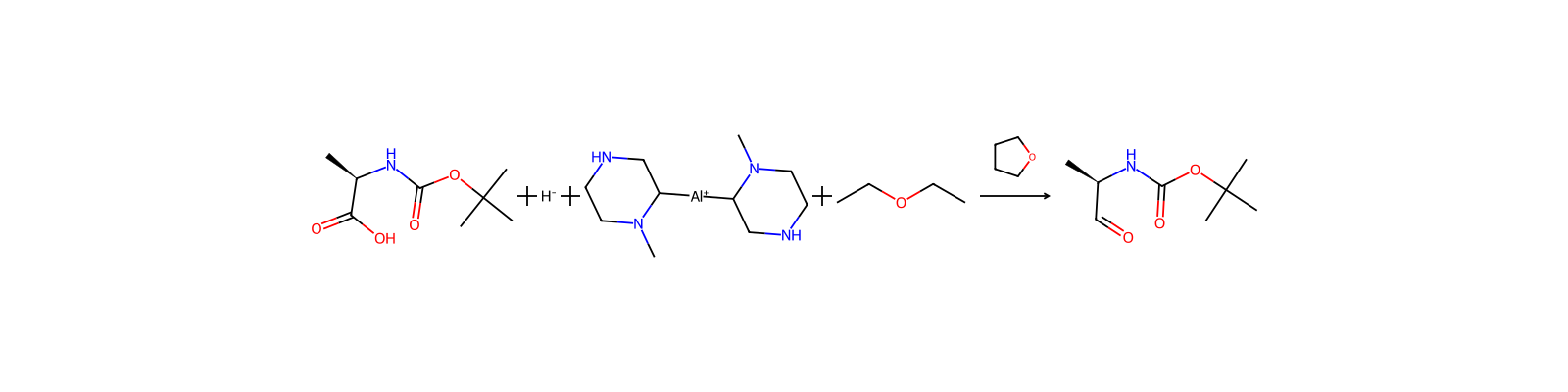
Diethyl Ether → tert-butyl N-((2R)-1-oxopropan-2-yl)carbamate

HRID 746167
Drucken

Reaktionsgleichung

Reaktionsgleichung von HRID 746167
[C:1]([NH:8][C@@H:9]([C:11](O)=[O:12])[CH3:10])([O:3][C:4]([CH3:7])([CH3:6])[CH3:5])=[O:2].[H-].CN1CCNCC1[Al+]C1CNCCN1C.CCOCC>O1CCCC1>[C:1]([NH:8][C@@H:9]([CH:11]=[O:12])[CH3:10])([O:3][C:4]([CH3:5])([CH3:7])[CH3:6])=[O:2]
KomponentenReaktionsbedingungenVersuchsvorschriftAufarbeitungQuellen und NachweiseNotizen zur Reaktion

Komponenten

5

Edukt 3

HCID 3283Diethyl EtherHCID 637606BOC-D-alanineHCID 18792082Bis(1-methylpiperazin-2-yl)alumanylium;hydride

Produkt 1

HCID 10910049tert-butyl N-((2R)-1-oxopropan-2-yl)carbamate

Reagenzien, Katalysatoren, Lösungsmittel 1

HCID 8028TetrahydrofuranLösungsmittel

Reaktionsbedingungen

Temperatur
0 °C

Versuchsvorschrift

N-Boc-D-alanine is dissolved in tetrahydrofuran and stirred at 0° C. under argon. Bis(N-methylpiperazinyl)aluminum hydride is added and the reaction mixture is heated to reflux overnight. Ether is then added, and the excess hydride is quenched with saturated NaCl. The aqueous phase is separated and extracted with ether. The combined organic phases are washed with 2M NaOH, 2M HCl and saturated NaCl. The solution is dried over Na2SO4 and evaporated to yield N-Boc-D-alaninal.

Aufarbeitung

  1. temperaturethe reaction mixture is heated
  2. temperatureto reflux overnight
  3. customthe excess hydride is quenched with saturated NaCl
  4. customThe aqueous phase is separated
  5. extractionextracted with ether
  6. washThe combined organic phases are washed with 2M NaOH, 2M HCl and saturated NaCl
  7. dry with materialThe solution is dried over Na2SO4
  8. customevaporated

Quellen und Nachweise

ORD-Eintrag
ord-60a3ace8400c42f898a3c30ec192111b
Quelldatensatz
uspto-grants-1986_07
DOI
10.6084/m9.figshare.5104873.v1
Patentnummer
US04603012

Notizen zur Reaktion

Auf dieser SeiteKomponentenReaktionsbedingungenVersuchsvorschriftAufarbeitungQuellen und NachweiseNotizen zur Reaktion