Reaktionsgleichung
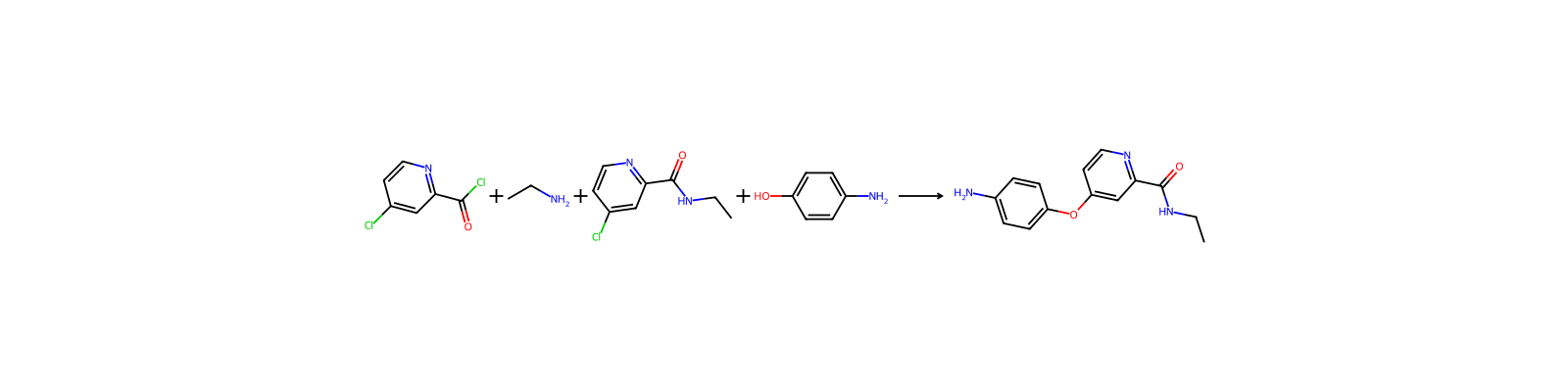
ClC1C=CN=C(C(Cl)=O)C=1.C(N)C.Cl[C:15]1[CH:20]=[CH:19][N:18]=[C:17]([C:21]([NH:23][CH2:24][CH3:25])=[O:22])[CH:16]=1.[NH2:26][C:27]1[CH:32]=[CH:31][C:30]([OH:33])=[CH:29][CH:28]=1>>[CH2:24]([NH:23][C:21]([C:17]1[CH:16]=[C:15]([O:33][C:30]2[CH:31]=[CH:32][C:27]([NH2:26])=[CH:28][CH:29]=2)[CH:20]=[CH:19][N:18]=1)=[O:22])[CH3:25]Komponenten
5


Versuchsvorschrift
Entry 88: 4-Chloropyridine-2-carbonyl chloride was reacted with ethylamine according to Method A2, Step 3b. The resulting 4-chloro-N-ethyl-2-pyridinecarboxamide was reacted with 4-aminophenol according to Method A2, Step 4 to give 4-(2-(N-ethylcarbamoyl)-4-pyridyloxy)aniline. 4-Bromo-3-(trifluoromethyl)aniline was converted into 4-bromo-3-(trifluoromethyl)phenyl isocyanate according to Method B1. According to Method C1a, 4-bromo-3-(trifluoromethyl)phenyl isocyanate was reacted with 4-(2-(N-ethylcarbamoyl)-4-pyridyloxy)aniline to afford the urea.
Quellen und Nachweise
- ORD-Eintrag
- ord-ee181981982e4c7e87fd0200ffb8ce34
- Quelldatensatz
- uspto-grants-2014_09
- Patentnummer
- US08841330B2
Verknüpfte Notizen
Wird geladen…