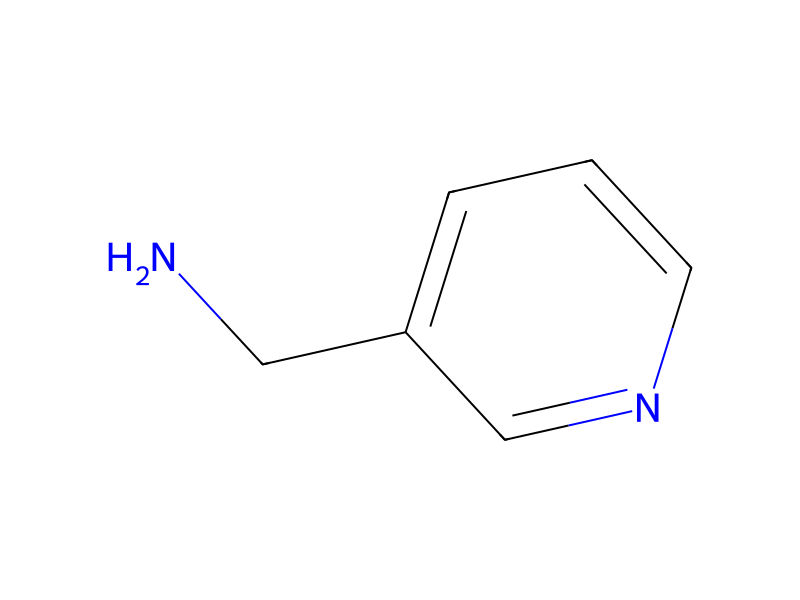
[CH2:1]([O:3][C:4]([C:6]1[O:7][C:8]2[CH:15]=[CH:14][CH:13]=[C:12]([O:16][CH2:17][CH2:18][CH2:19]Br)[C:9]=2[C:10]=1[CH3:11])=[O:5])[CH3:2].[N:21]1[CH:26]=[CH:25][CH:24]=[C:23]([CH2:27][NH2:28])[CH:22]=1>C(O)C.C(OCC)(=O)C>[CH2:1]([O:3][C:4]([C:6]1[O:7][C:8]2[CH:15]=[CH:14][CH:13]=[C:12]([O:16][CH2:17][CH2:18][CH2:19][NH:28][CH2:27][C:23]3[CH:22]=[N:21][CH:26]=[CH:25][CH:24]=3)[C:9]=2[C:10]=1[CH3:11])=[O:5])[CH3:2]4-(3-bromo-propoxy)-3-methyl-benzofuran-2-carboxylic acid ethyl ester (Example 5-a: 180 mg) and 3-picolylamine (500 μl) were dissolved in ethanol (2 ml) and heated at 50° C. for 16 hours. The reaction mixture was dissolved in ethyl acetate and washed with saturated ammonium chloride solution and water. The organic solvent was dried over anhydrous sodium sulfate and evaporated to dryness. The residue was purified by silica gel column chromatography (dichloromethane-MeOH) to afford 3-methyl-4-{3-[(pyridin-3-ylmethyl)-amino]-propoxy}-benzofuran-2-carboxylic acid ethyl ester (150 mg) as a colorless oil. EI-MS: m/z 368 (M+); 1H-NMR (CDCl3): δ 1.44 (3H, t, J=7 Hz), 2.07 (2H, quintet, J=6.5 Hz), 2.67 (3H, s), 2.89 (2H, t, J=7 Hz), 3.84 (2H, s), 4.17 (2H, t, J=6 Hz), 4.44 (2H, q, J=7 Hz), 6.62 (1H, d, 8 Hz), 7.12 (1H, d, J=8 Hz), 7.21 (1H, dd, J1=8 Hz, J2=5 Hz), 7.30 (1H, t, J=8 Hz), 7.66 (1H, dd, J1=8 Hz, J2=2 Hz), 8.49 (1H, dd, J1=5 Hz, J2=2 Hz), 8.57 (1H, d, J=2 Hz).