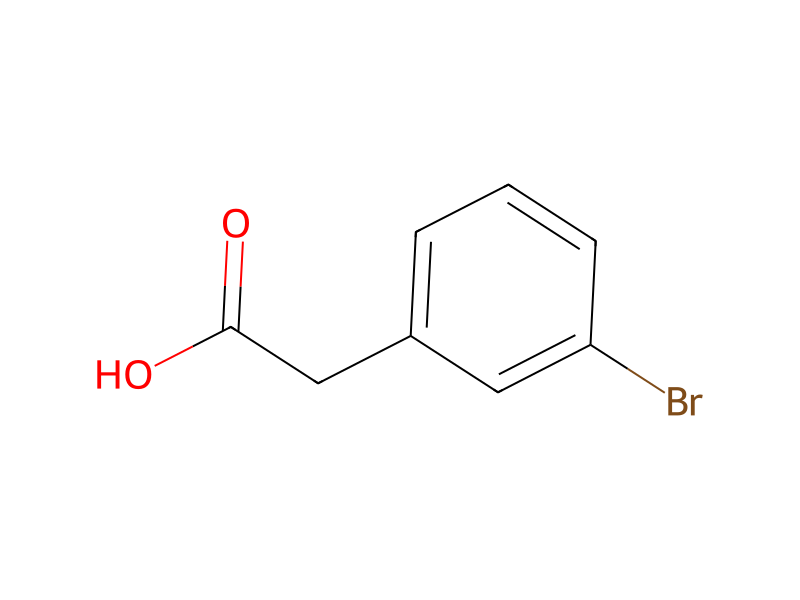
A mixture of 3-bromophenyl acetic acid (1 g, 4.6 mmol), t-butyldimethylsilylchloride (1.6 g, 10.7 mmol) and THF (15 ml) were stirred at 0° C. under nitrogen. Lithium diisopropyl amide (5 ml-2M solution in heptane) was added to the mixture drop wise and the reaction was allowed to proceed first at 0° C., then at room temperature over night. The solvent was removed in vacuo and the crude material was redissolved in acetonitrile (20 ml). Selectfluor (2.1 g, 6.0 mmol) in acetonitrile (40 ml) was added drop wise and the reaction was allowed to stir at room temperature overnight. Solvent was removed under vacuum, redissolved in ethyl acetate and extracted with 1N HCl. The organic layer was dried with Na2SO4, decanted, and concentrated to dryness. Silica chromatography of the crude using a gradient of ethyl acetate and hexane afforded (3-bromo-phenyl)-fluoro-acetic acid (436 mg, 40% yield). 1H NMR (500 MHz, DMSO-d6) δ 6.0-6.1 (d, 1H), 7.44 (m, 2H), 7.62 (m, 2H).