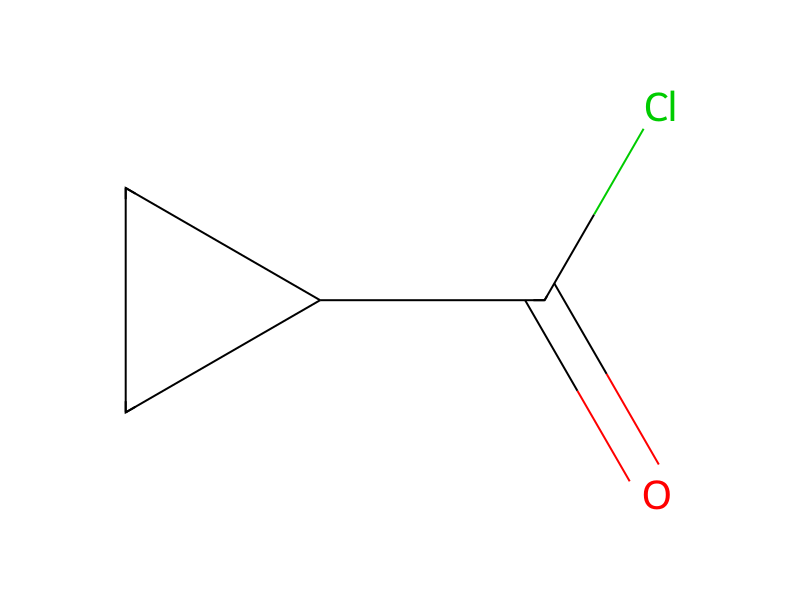
Cyclopropanecarbonyl chloride → HCID 178516793, Verbindung
Reaktionsgleichung

[CH2:1]([O:8][C:9]([N:11]1[CH2:15][C:14](=[O:16])[N:13]=[C:12]1[NH2:17])=[O:10])[C:2]1[CH:7]=[CH:6][CH:5]=[CH:4][CH:3]=1.[CH:18]1([C:21](Cl)=[O:22])[CH2:20][CH2:19]1.CCN(C(C)C)C(C)C>C(#N)C>[CH2:1]([O:8][C:9]([N:11]1[CH2:15][C:14](=[O:16])[N:13]=[C:12]1[NH:17][C:21]([CH:18]1[CH2:20][CH2:19]1)=[O:22])=[O:10])[C:2]1[CH:7]=[CH:6][CH:5]=[CH:4][CH:3]=1Komponenten
5




Versuchsvorschrift
A suspension of 2-amino-4-oxo-4,5-dihydro-imidazole-1-carboxylic acid benzyl ester (100.0 mg, 0.43 mmol), cyclopropanecarbonylchloride (45.0 mg, 0.43 mmol) and Hunig's base (83.0 mg, 0.64 mmol) in acetonitrile (4 mL) was heated to reflux under argon for 0.5 hr. Cooled to r.t., the reaction mixture was concentrated and the residue was partitioned between EtOAc and water. The organic layer was dried over Na2SO4 and concentrated and the residue was triturated with AcOEt to give a suspension. The solid was filtered to give 2-(cyclopropanecarbonyl-amino)-4-oxo-4,5-dihydro-imidazole-1-carboxylic acid benzyl ester as an oil (113.0 mg, 87.6%).
Aufarbeitung
- temperaturewas heated
- temperatureto reflux under argon for 0.5 hr
- concentrationthe reaction mixture was concentrated
- customthe residue was partitioned between EtOAc and water
- dry with materialThe organic layer was dried over Na2SO4
- concentrationconcentrated
- customthe residue was triturated with AcOEt
- customto give a suspension
- filtrationThe solid was filtered
Quellen und Nachweise
- ORD-Eintrag
- ord-608f8ef03d714b5e98e1c7686031c6bf
- Quelldatensatz
- uspto-grants-2007_09
- Patentnummer
- US07268231B2
Notizen zur Reaktion
Wird geladen…