Reaktionsgleichung

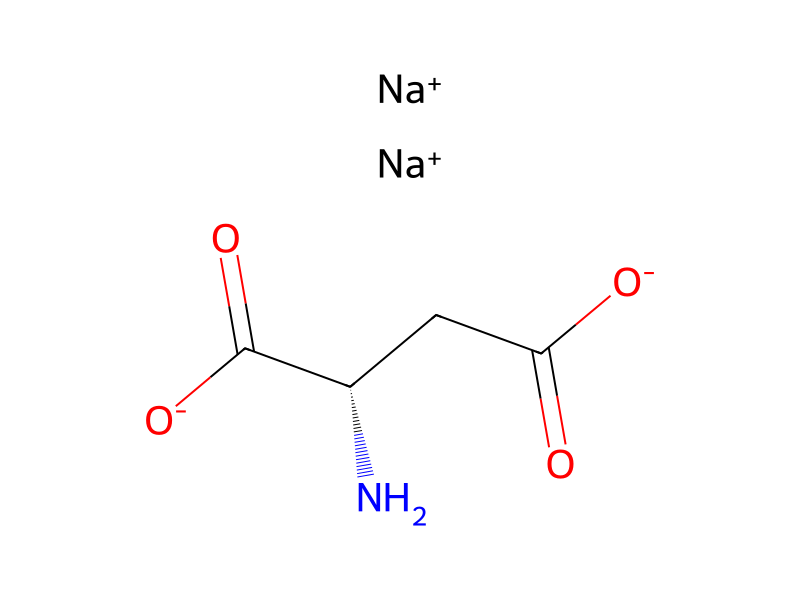
[NH2:1][C@H:2]([C:7]([OH:9])=[O:8])[CH2:3][C:4]([OH:6])=[O:5].[OH-].[Na+:11].[NH4+:12].[OH-]>>[NH2:1][C@H:2]([C:7]([OH:9])=[O:8])[CH2:3][C:4]([OH:6])=[O:5].[NH2:1][C@H:2]([C:7]([O-:9])=[O:8])[CH2:3][C:4]([O-:6])=[O:5].[NH4+:12].[NH4+:1].[NH2:1][C@H:2]([C:7]([O-:9])=[O:8])[CH2:3][C:4]([O-:6])=[O:5].[Na+:11].[Na+:11]Komponenten
6




Versuchsvorschrift
A sample of 13.3 g (100 mmol) of aspartic acid was slurried in 100 ml distilled water with stirring, and the aspartic acid was partially neutralized with 5 ml of 10 N NaOH (50 mmol). Conc. NH4OH (3.38 ml, 14.8 N, 50 mmol) was pipetted into the beaker, fully neutralizing and solubilizing the aspartic acid. The beaker was placed in a drying oven at 120° C. overnight, producing a clear, slightly yellowish glass of the comonomers, aspartic acid (plus residual ammonium aspartate) and sodium aspartate. The beaker was then heated in a vacuum oven at 200° C., 25 mm Hg, for 4 hours, to convert the material to a copolymer of sodium aspartate and succinimide. Titration data confirmed the 1:1 residue ratio.
Aufarbeitung
- distillationdistilled water
Quellen und Nachweise
- ORD-Eintrag
- ord-e9f0bef708674089b4baba65dc3ddbb7
- Quelldatensatz
- uspto-grants-2006_08
- Patentnummer
- US07091305B2
Verknüpfte Notizen
Wird geladen…