StartseiteMCPWorkbenchSkills
StartseiteWorkbenchBenachrichtigungenMein Bereich
llms.txt · MCP-AnleitungDatenschutz · Nutzungsbedingungen · Supportv1.8.3
  1. Startseite
  2. /Reaktion

Diphenylmethyl 3-[(5RS)-2,5-dihydro-2-oxofuran-5-yl methyl]-7beta-phenylacetamidoceph-3-em-4-carboxylate → Diphenylmethyl 3-[(5RS)-2-oxotetrahydrofuran-5-yl methyl]-7beta-phenylacetamidoceph-3-em-4-carboxylate

HRID 973874
Drucken

Reaktionsgleichung

Reaktionsgleichung von HRID 973874
[O:1]=[C:2]1[CH:6]=[CH:5][CH:4]([CH2:7][C:8]2[CH2:9][S:10][C@@H:11]3[C@H:31]([NH:32][C:33](=[O:41])[CH2:34][C:35]4[CH:40]=[CH:39][CH:38]=[CH:37][CH:36]=4)[C:30](=[O:42])[N:12]3[C:13]=2[C:14]([O:16][CH:17]([C:24]2[CH:29]=[CH:28][CH:27]=[CH:26][CH:25]=2)[C:18]2[CH:23]=[CH:22][CH:21]=[CH:20][CH:19]=2)=[O:15])[O:3]1>C(O)C.C1C=CC=CC=1.[Pd].C1C=CC(P(C2C=CC=CC=2)C2C=CC=CC=2)=CC=1.C1C=CC(P(C2C=CC=CC=2)C2C=CC=CC=2)=CC=1.C1C=CC(P(C2C=CC=CC=2)C2C=CC=CC=2)=CC=1.[Cl-].[Rh]>[O:1]=[C:2]1[CH2:6][CH2:5][CH:4]([CH2:7][C:8]2[CH2:9][S:10][C@@H:11]3[C@H:31]([NH:32][C:33](=[O:41])[CH2:34][C:35]4[CH:40]=[CH:39][CH:38]=[CH:37][CH:36]=4)[C:30](=[O:42])[N:12]3[C:13]=2[C:14]([O:16][CH:17]([C:18]2[CH:19]=[CH:20][CH:21]=[CH:22][CH:23]=2)[C:24]2[CH:29]=[CH:28][CH:27]=[CH:26][CH:25]=2)=[O:15])[O:3]1
KomponentenVersuchsvorschriftAufarbeitungQuellen und NachweiseNotizen zur Reaktion

Komponenten

5

Edukt 1

HCID 70366830Diphenylmethyl 3-[(5RS)-2,5-dihydro-2-oxofuran-5-yl methyl]-7beta-phenylacetamidoceph-3-em-4-carboxylate

Produkt 1

HCID 67923952Diphenylmethyl 3-[(5RS)-2-oxotetrahydrofuran-5-yl methyl]-7beta-phenylacetamidoceph-3-em-4-carboxylateAusbeute 39,1 %

Reagenzien, Katalysatoren, Lösungsmittel 3

HCID 23938PalladiumKatalysator
HCID 84599
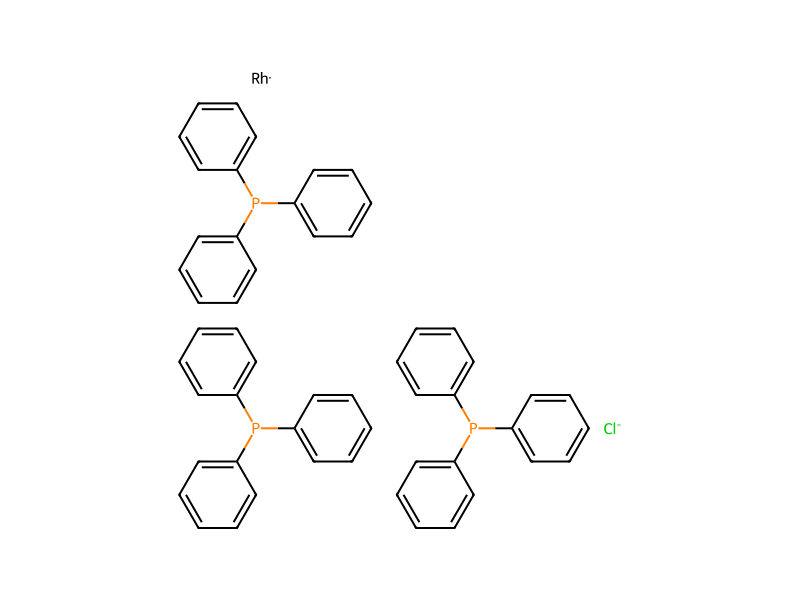
Chlorotris(triphenylphosphine)rhodium(I)
Katalysator
HCID 21965192Npc112006Lösungsmittel

Versuchsvorschrift

Diphenylmethyl 3-[(5RS)-2,5-dihydro-2-oxofuran-5-yl methyl]-7β-phenylacetamidoceph-3-em-4-carboxylate (Example 2(a)), (1.58 g) in 50% ethanol/benzene (100 mls) was treated with tris(triphenylphosphine)rhodium (I) chloride (0.75 g) and 10% palladium on carbon (0.2 g) and hydrogenated for several hours at room temperature. The reaction was monitored by t.l.c. analysis until formation of the slightly more polar product was complete. The solution was filtered through a small pad of silica gel and then concentrated. Purificationby `flash` chromatography afforded the title compound as a brown solid, (0.62 g, 39%); a sample recrystallized from ethyl acetate was shown to be a single isomer by spectroscopic analysis, m.p. 84°-89° C., νmax (KBr) 3400 (br), 3299, 1782, 1770, 1735, 1719, 1661, 1619, 1533, 1494, 1453 and 1373cm-1 ; δH (CDCl3) 1.75 (1H, m), 2.23 (2H, m), 2.43 (2H, m), 3.02 (1H, dd, J2.3, 13.8Hz), 3.52 (2H, ABq, J18.7Hz), 3.66 (2H, ABq, J16.2Hz), 4.66 (1H, m), 4.93 (1H, d, J4.7Hz), 5.87 (1H, dd, J4.7, 9.2Hz), 6.11 (1H, d, J9.2Hz), 6.84 (1H, s) and 7.25-7.5 (15H, m); [mass spectrum: +ve ion (3NOBA, Na+) MNa+ 605].

Aufarbeitung

  1. filtrationThe solution was filtered through a small pad of silica gel
  2. concentrationconcentrated

Quellen und Nachweise

ORD-Eintrag
ord-fd9498bef97d4a3282197b5e7e700553
Quelldatensatz
uspto-grants-1991_11
DOI
10.6084/m9.figshare.5104873.v1
Patentnummer
US05064649

Notizen zur Reaktion

Auf dieser SeiteKomponentenVersuchsvorschriftAufarbeitungQuellen und NachweiseNotizen zur Reaktion