Pamidronic Acid → Sodium (3-amino-1-hydroxy-1-phosphonopropyl)phosphonate
Reaktionsgleichung

[NH2:1][CH2:2][CH2:3][C:4]([OH:13])([P:9]([OH:12])(=[O:11])[OH:10])[P:5]([OH:8])(=[O:7])[OH:6].[OH-].[Na+:15]>O>[NH2:1][CH2:2][CH2:3][C:4]([OH:13])([P:5]([OH:8])(=[O:6])[OH:7])[P:9]([O-:12])(=[O:10])[O-:11].[Na+:15].[Na+:15]Komponenten
4
Edukt 2
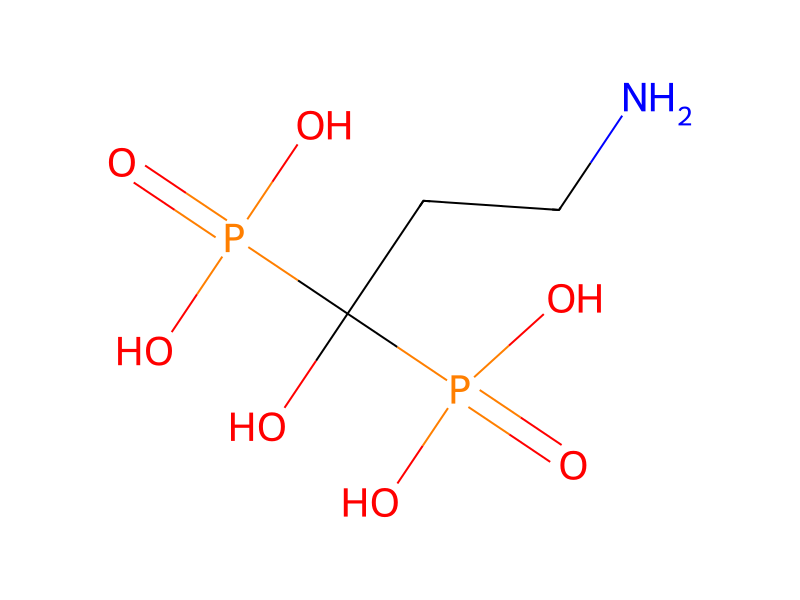

Produkt 1

Reagenzien, Katalysatoren, Lösungsmittel 1

Versuchsvorschrift
50.0 g of 3-amino-1-hydroxypropane-1,1-diphosphonic acid are suspended in 370 ml of demineralised water and, while stirring, heated to 50°. 56.6 g of 30% aqueous sodium hydroxide solution are then added in such a manner that the temperature of the reaction mixture during neutralisation rises to 59°. The reaction mixture is heated to 65°, filtered hot over diatomaceous earth, heated to 75° and, while stirring, 300 ml of water are distilled off under reduced pressure. The mixture is allowed to cool to approximately 52°, and inoculated and allowed to cool slowly to room temperature while stirring, crystallisation starting at approximately 45°. The crystals are left to stand in the mother liquor overnight, stirred for 1 hour in an ice bath to complete the reaction, filtered with suction, washed with a little ice-water and dried under reduced pressure at room temperature until the weight is constant. Disodium 3-amino-1-hydroxypropane-1,1-diphosphonate is obtained in the granular-crystalline crystal form of modification B which contains less water than the crystal modification containing water of crystallisation according to the invention (modification E). This form is characterised by the following lattice spacings (d-values) and relative line intensities (intensities) of its X-ray powder pattern (camera according to Guinier-de-Wolff, radiation source: copper-Kα):