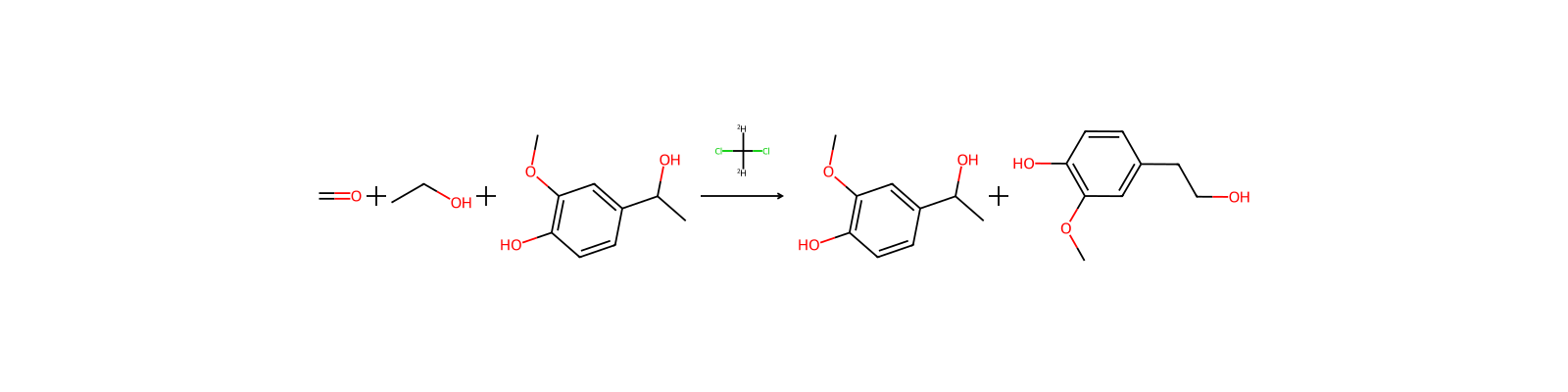
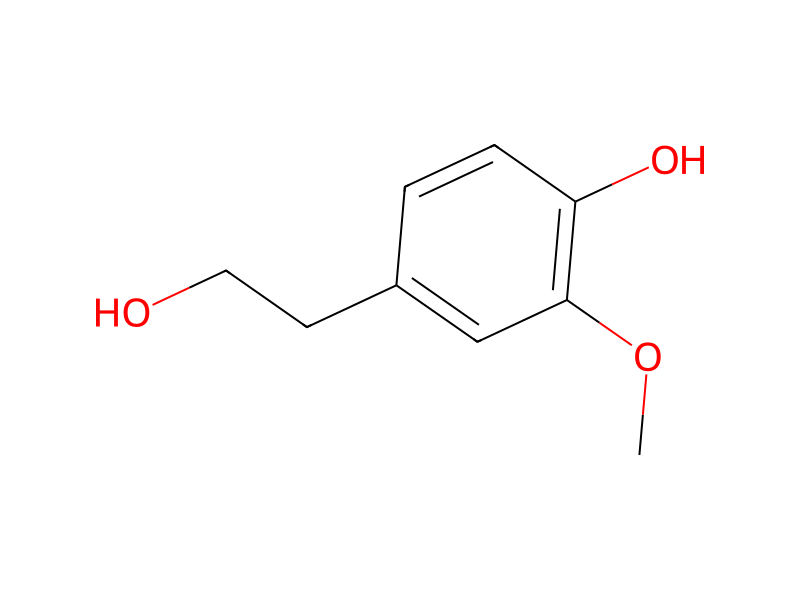
The activity of F8 indicated the presence of a more polar substance than any of the aforementioned compounds. This substance was unaffected by BF3 methylation or catalytic hydrogenation at atmospheric pressure, but its activity and presence was completely destroyed by acetylation or bromination. Acetylation followed by scgc-ms disclosed a spectrum (scgc-ms spectrum disclosed a dominant base peak at m/Z=150; as well as 135, 20%; 137, 18%; 192, 4%; and 252, 2%. Nmr in CD2C12 at 400 mHz for 114 h (97,456 scans), δ= 2.01(3H, singlet, acetoxymethyl); δ=2.26(3H, singlet, aryl acetoxymethyl); δ=2.92(2H, triplet, J=7 Hz, benzylic methylene); δ=3.08(3H, singlet, aryl (OCH3); δ=4.26(2H, triplet, J=7 Hz, CH2O); 6.80(1H, quartet, J=2 Hz, H6 aryl); δ=6.85(1H, doublet, J=2 Hz, H2 aryl); δ=6.94(1H, doublet, J=8 Hz, H5 aryl). A 10,000 scan decoupling of the δ=2.92 signal eliminated the -0.5 Hz coupling to δ=6.80 and δ =6.85 aryl hydrogen confirming these hydrogens as ortho to the ethanol side chain) reminiscent of the material observed in HQMC and thought to be 4-hydroxy-2-methoxyphenylethanol (R. M. Crewe and H. H. W. Velthuis, Naturwissenschaften 67, 467 (1980)). Synthesis of this compound as reported (A. S. Howard, J. P. Michael and M. A. Schmidt, S.-Afr. Tydskr. Chem. 34, 132 (1981). The reported structural assignments in this paper are reversed. The reader is directed to K. D. Kaufman and W. E. Russey, J. Org. Chem. 30, 1320 (1965) for the correct structural precursors) led to two hydroxymethoxyphenylethanols, the acetate derivatives of which had chromatographic retention characteristics different from the F8 HQMC component. Neither of these hydroxymethoxyphenylethanols was active, nor enhanced activity, when tested with the other materials in the micro-pipette biassay. Therefore, in November, 1986, the isomer responsible for the enhanced activity was isolated and identified from a HQMC extract of five queens that had been laying through the summer. This extract was active and contained the F8 component even though only small quantities of queen pheromone are produced in the fall (J. Pain, B. Roger and J. Theurkauff, Apidologie 5, 319 (1974)). After isolation and acetylation, we obtained only 2-3 μg of the putatively active compound in F8. High resolution 1H nuclear magnetic resonance (nmr) spectroscopy of this material (scgc-ms spectrum disclosed a dominant base peak at m/Z=150; as well as 135, 20%; 137, 18%; 192, 4%; and 252, 2%. Nmr in CD2C12 at 400 mHz for 114 h (97,456 scans), δ=2.01(3H, singlet, acetoxymethyl); δ=2.26(3H, singlet, aryl acetoxymethyl); δ=2.92(2H, triplet, J=7 Hz, benzylic methylene); δ=3.08(3H, singlet, aryl (OCH3); δ=4.26(2H, triplet, J=7 Hz, CH2O); δ=6.80(1H, guartet, J=2 Hz, H6 aryl); δ=6.85 (1H, doublet, J=2 Hz, H2 aryl); δ=6.94(1 H, doublet, J=8 Hz, H5 aryl). A 10,000 scan decoupling of the δ=2.92 signal eliminated the -0.5 Hz coupling to the δ=6.80 and δ=6.85 aryl hydrogen confirming these hydrogens as ortho to the ethanol side chain) gave a spectrum interpreted as 4-hydroxy-3-methoxyphenylethanol. Acetylation of 4-hydroxy-3-methoxyphenylethanol or homovanillyl alcohol, (HVA), provided nmr and scgc-ms spectra and retention times identical to those obtained from the acetylated derivative of HQMC present in F8. The addition of HVA to the three previously implicated compounds raised the response to 83% of that obtained from HQMC.