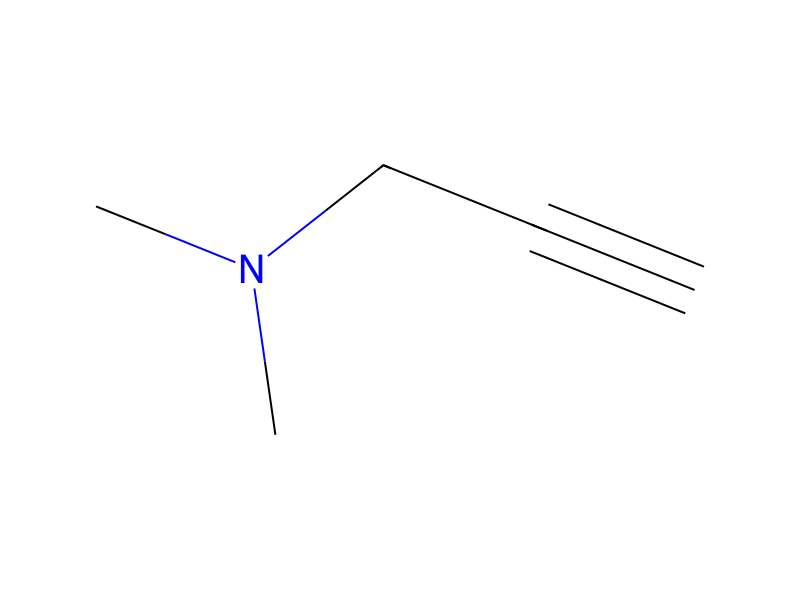
A mixture of 5.02 g of 2-bromothiazole, 20 ml of triethylamine, and 4.3 ml of 1-dimethylamino-2-propyne is stirred under argon for 5 minutes. Seven hundred and fifty milligrams of bis(triphenylphosphine) palladium (II) chloride and 0.450 mg of copper (I) iodide is added and the stirred reaction is heated at 80°-85° C. for 3 hours. The reaction mixture is cooled, partitioned between diethyl ether and 65 ml of 10% sodium carbonate, and the layers are separated. The organic layer is filtered through diatomaceous earth, washed with aqueous sodium chloride and dried over magnesium sulfate. The crude product is purified by chromatography using silica gel as absorbant followed by filtration of the product band through a pad of magnesium silicate to give 0.35 g of the desired product as an oil, MH+ 167. Purity is determined by 1H PMR spectroscopy and by thin layer chromatography.