Reaktionsgleichung

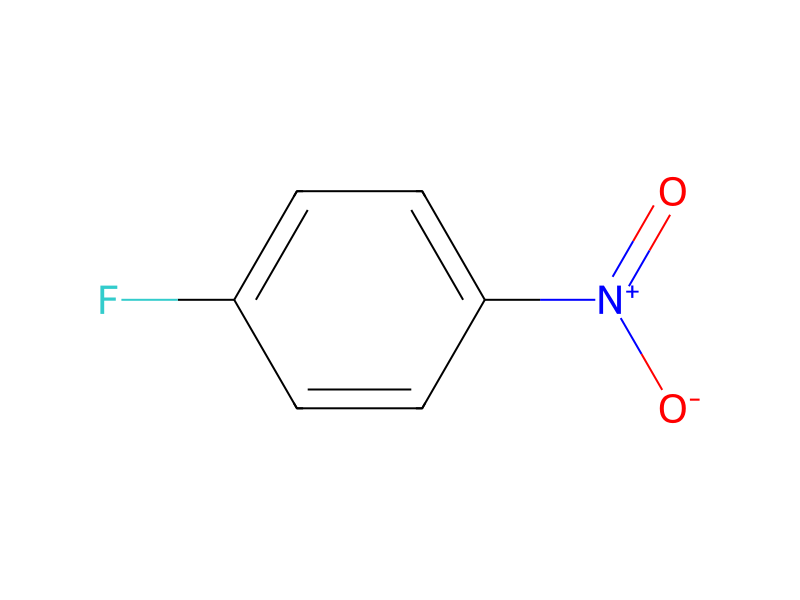
[N+:1]([C:4]1[CH:9]=[CH:8][C:7](Cl)=[CH:6][CH:5]=1)([O-:3])=[O:2].[F-:11].[K+]>CS(C)=O>[N+:1]([C:4]1[CH:9]=[CH:8][C:7]([F:11])=[CH:6][CH:5]=1)([O-:3])=[O:2]Komponenten
4
Edukt 2


Produkt 1
Reagenzien, Katalysatoren, Lösungsmittel 1

Reaktionsbedingungen
- Temperatur
- 170 °C
Versuchsvorschrift
157 g of 4-nitrochlorobenzene, 200 g of dimethylsulfoxide, 62.7 g of potassium fluoride, and 2.49 g of (N,N-dimethylimidazolidino)tetramethyl-guanidinium chloride were placed in a 1 liter four-neck flask equipped with thermometer, anchor stirrer, and reflux condenser with bubble counter. The mixture was heated with stirring to 170° C. and kept at this temperature for 5 hours. The reaction mixture was then cooled to room temperature, water was added at a volumetric ratio of 1:1, the phases that formed were separated, and, from the organic phase, by fractional distillation at reduced pressure, 4-nitrofluorobenzene was obtained in a yield of 96% of theory.
Aufarbeitung
- customequipped with thermometer, anchor stirrer
- temperaturereflux condenser
- customwith bubble counter
- temperatureThe mixture was heated
- temperatureThe reaction mixture was then cooled to room temperature
- additionwater was added at a volumetric ratio of 1:1
- customthe phases that formed
- customwere separated
- distillationfrom the organic phase, by fractional distillation at reduced pressure
Quellen und Nachweise
- ORD-Eintrag
- ord-9a8619cf766f4e9b8699861270e51844
- Quelldatensatz
- uspto-grants-2006_08
- Patentnummer
- US07091362B2
Verknüpfte Notizen
Wird geladen…