HomeMCPWorkbenchSkills
HomeWorkbenchNotificationsMe
llms.txt · MCP GuidePrivacy Policy · Terms of Service · Supportv1.8.3
  1. Home
  2. /Compound

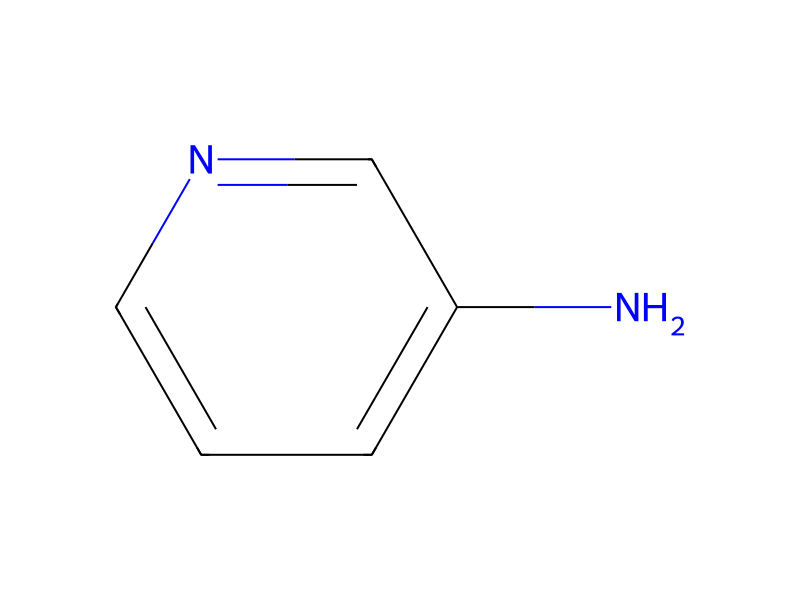
3-Aminopyridine

HCID 10009
New reaction
Print
Basic informationOverviewNames & identifiersPropertiesSafety & regulationChemistry & industryRelated reactionsCompound notes
Substructure searchFind similar structures

Basic information

CAS
462-08-8
Standard SMILES
Nc1cccnc1
InChIKey
CUYKNJBYIJFRCU-UHFFFAOYSA-N
Molecular formula
C5H6N2
Average molar mass
94.11 g/mol
Monoisotopic mass
94.0530982

Overview

RN given refers to parent cpd

Names & identifiers

Preferred name
3-Aminopyridine
IUPAC
pyridin-3-amine
English name
3-Aminopyridine
Molecular formula
C5H6N2
Molecular weight
94.11

Names & synonyms

3-AMINOPYRIDINE462-08-83-Pyridinaminem-Aminopyridinebeta-AminopyridineDTXSID9047461UN267169JE8P2L84NSC-15040DTXCID7027461UN-2671RefChem:911164
Show more names
462-08-0462-08-03APYNSC 15040AKOS 909773-Pyridylamin
207-322-2pyridin-3-amine3-PyridylamineAmino-3 pyridinePyridine, 3-amino-pyridin-3-ylamine3-amino pyridine3-Pyridinylamine

Database identifiers

CAS
462-08-8
PubChem CID
10009
DTXSID
DTXSID9047461
ChEMBL
CHEMBL25541
UNII
69JE8P2L84
EC Number
207-322-2
Nikkaji
J1.535K

Properties

Computed structural properties

XLogP
0.1
Topological polar surface area
38.9 Ų
Hydrogen bond donors
1
Hydrogen bond acceptors
2
Rotatable bonds
0
Heavy atoms
7
Formal charge
0
Complexity
54

Experimental & physicochemical properties

Chemical ClassesNitrogen Compounds -> Pyridines
SpringerMaterials PropertiesMolecular structure
LogP0.05
Flash Point190.4 °F
Boiling Point483.8 °F
Melting Point147.2 °F
Vapor Pressure0.43 [mmHg]
Physical Description · 3 items

Other Solid

Solid; [Merck Index] Brown solid; [NTP] White to light brown solid with an unpleasant odor; [OSHA] Brown crystalline solid; [Alfa Aesar MSDS]

White to yellow-brown crystals with an unpleasant odor.

Ionization Efficiency · 6 items

Positive

3.09

2.7

Agilent XCT

Electrospray ionization

formic acid (5.3nM)

Safety & regulation

Safety information is for reference only and does not replace the supplier’s Safety Data Sheet (SDS), applicable regulations, or professional assessment.

GHS classification

GHS Classification · 4 items

Danger

H300 (15%): Fatal if swallowed [Danger Acute toxicity, oral]

P260, P261, P262, P264, P264+P265, P270, P271, P273, P280, P301+P316, P302+P352, P304+P340, P305+P351+P338, P316, P319, P321, P330, P332+P317, P337+P317, P361+P364, P362+P364, P391, P403+P233, P405, and P501 (click each P-code to see the statement)

Aggregated GHS information provided per 60 reports by companies from 11 notifications to the ECHA C&L Inventory. Each notification may be associated with multiple companies.

Hazard information

Regulatory Information · 4 items

Chemical: 3-Pyridinamine

3-Pyridinamine is listed on the EPA's Chemical Data Reporting (CDR) system. Manufacturers and importers of 3-Pyridinamine are required to report information about their production and use of this chemical to the EPA under the Toxic Substances Control Act (TSCA). (40 eCFR Part 711)

REACH registered substance: 3-pyridylamine (EC: 207-322-2)

3-Aminopyridine: Does not have an individual approval but may be used under an appropriate group standard

Hazards Summary · 1 item

Causes convulsions in intracerebral lethal-dose studies of mice; Intravenous LD50 (mouse) = 24 mg/kg; [RTECS] Readily absorbed through skin; [NTP] A skin, eye, and mucous membrane irritant; Toxic by ingestion; [ToxPlanet: OSHA] A skin and strong eye irritant; Harmful by skin absorption; Toxic by ingestion; Oral LD50 (rat) = 50-200 mg/kg; [Alfa Aesar MSDS] See 2-Aminopyridine.

Hazard Classes and CategoriesAcute Tox. 2 (15%)

Toxicology

Adverse Effects

Chemistry & industry

Uses & manufacturing

UsesUsed to make pharmaceuticals and dyes; [Merck Index] Also used to make agrochemicals and as a plant growth regulator; [NTP]
U.S. Production2023: 250,000 - <550,000 lb
Industry UsesIntermediate
General Manufacturing Information · 2 items

All Other Basic Organic Chemical Manufacturing

3-Pyridinamine: ACTIVE

Applications · 3 items

Uses3-Aminopyridine is a monosubstituted pyridine that shows convulsive effects on cortical Neurons. 3-Aminopyridine is used in the synthesis of of organic ligand 3-Pyridylnicotinamide. 3-Aminopyridine al ong with other aminopyridines have been shown to reversibly block voltage-dependent potassium channels,

Uses3-Aminopyrodine is also used as an intermediate for agrochemicals, pharmaceuticals and colorants. These are involved in photosensitizer chemistry, luminescent materials, metal complex chemistry and liquid crystal. Aminopyridine is used as a monomer for polymerization. It is also used in the Production of cationic dyes and Apa amoxicillin sodium raw materials.

Usesmanufacture of pharmaceuticals and dyes.
Upstream & downstream products

Upstream raw materials

NicotinamidePotassium hydroxideLead tetraacetatetert-ButanolAluminum oxide

Related reactions

830 records
New reaction record
HRID 204 reaction equation
HRID 204As reactant
HRID 455 reaction equation
HRID 455As reactant
HRID 456 reaction equation
HRID 456As reactant
HRID 457 reaction equation
HRID 457As reactant
HRID 2430 reaction equation
HRID 2430As reactant
HRID 3208 reaction equation
HRID 3208As reactant
HRID 5398 reaction equation
HRID 5398As reactant
HRID 6213 reaction equation
HRID 6213As reactant
PreviousPage 1 of 104

Compound notes

On this pageBasic informationOverviewNames & identifiersPropertiesSafety & regulationChemistry & industryRelated reactionsCompound notes
Collision Cross Section
115.0 Ų [M+H]+ [CCS Type: DT; Buffer gas: N2; Ionization: APCI+; Dataset: TOXCAST; Source Identifier: DTXSID9047461]

Physicochemical properties

Melting point
65 °C · 65 °C (149 °F; 338 K)
Boiling point
248 °C · 248 °C (478 °F; 521 K)
Density
1.0308 · 1.0308 (estimate)
refractive index
1.556 · 1.5560 (estimate)
Flash point
124 °C · 124 °C (255 °F; 397 K)
storage temp.
Poison room
solubility
1000 g/l · >1000g/l
pka
6.04 · 6.04(at 25℃)
form
Solid
color
White to pale yellow
PH
10 · 10 (100g/l, H2O, 20℃)
Water Solubility
It is soluble in water as well as soluble in alcohol, benzene.
Sensitive
Air Sensitive & Hygroscopic
Merck
14 · 14,473
BRN
105692 · 105692
InChI
1S/C5H6N2/c6-5-2-1-3-7-4-5/h1-4H,6H2
InChIKey
CUYKNJBYIJFRCU-UHFFFAOYSA-N
SMILES
Nc1cccnc1
LogP
0.11 · 0.110
CAS DataBase Reference
462 · 462-08-8(CAS DataBase Reference)
FDA UNII
69 JE8P2L84 · 69JE8P2L84
NIST Chemistry Reference
3 · 3-Pyridinamine(462-08-8)
EPA Substance Registry System
3 · 3-Aminopyridine (462-08-8)
UNSPSC Code
12352100 · 12352100
NACRES
22 · NA.22
Symbol(GHS)
6 · GHS06,GHS09
Signal word
Danger
Hazard statements
300 · H300+H310+H330-H315-H319-H411
Precautionary statements
501 · P501-P273-P260-P270-P262-P271-P264-P280-P284-P391-P337+P313-P305+P351+P338-P361+P364-P332+P313-P301+P310+P330-P302+P352+P310-P304+P340+P310-P403+P233-P405
target organs
Respiratory system
PPE
2 · Eyeshields, Faceshields, Gloves, type P2 (EN 143) respirator cartridges
Hazard Codes
T,Xi
Risk Statements
23 · 23/24/25-33-36/37/38-25
Safety Statements
36 · 36/37/39-45-37/39-28B-26
RIDADR
2671 · UN 2671 (AMINOPYRIDINES (o-, m-, p,))
WGK Germany
3 · 3
RTECS
1650000 · US1650000
F
3 · 3-8-9-23
Hazard Note
Toxic/Irritant
TSCA
TSCA listed
HazardClass
6.1 · 6.1
PackingGroup
II
HS Code
2933399090 · 2933399090
Storage Class
6.1 A · 6.1A - Combustible acute toxic Cat. 1 and 2very toxic hazardous materials
Hazard Classifications
3 DermalAcute · Acute Tox. 3 DermalAcute Tox. 3 InhalationAcute Tox. 3 OralEye Irrit. 2Skin Irrit. 2STOT RE 2STOT SE 3
Toxicity
50 ipr-mus: · LD50 ipr-mus: 28 mg/kg JMCMAR 8,296,65
REACH Registrations
Active
Limited Quantities
100 ml · 100ml (liquid) or 0.5 Kg (solid)
Excepted Quantities
Max Inner Pack (1g or 1ml) and Max Outer Pack (500g or 500ml)
Neurotoxin - Other CNS neurotoxin

Safety data

F
3-8-9-23
PPE
Eyeshields, Faceshields, Gloves, type P2 (EN 143) respirator cartridges
wgk
3
tsca
TSCA listed
rtecs
US1650000
ridadr
UN 2671 (AMINOPYRIDINES (o-, m-, p,))
hs_code
2933399090
Toxicity
LD50 ipr-mus: 28 mg/kg JMCMAR 8,296,65
risk_code
23/24/25-33-36/37/38-25
Signal word
Danger
Symbol(GHS)
GHS06,GHS09
hazard_code
T,Xi
hazard_note
Toxic/Irritant
safety_code
36/37/39-45-37/39-28B-26
hazard_class
6.1
Storage Class
6.1A - Combustible acute toxic Cat. 1 and 2very toxic hazardous materials
packing_group
II
target organs
Respiratory system
Hazard statements
H300+H310+H330-H315-H319-H411
Limited Quantities
100ml (liquid) or 0.5 Kg (solid)
Excepted Quantities
Max Inner Pack (1g or 1ml) and Max Outer Pack (500g or 500ml)
REACH Registrations
Active
Hazard Classifications
Acute Tox. 3 DermalAcute Tox. 3 InhalationAcute Tox. 3 OralEye Irrit. 2Skin Irrit. 2STOT RE 2STOT SE 3
Precautionary statements
P501-P273-P260-P270-P262-P271-P264-P280-P284-P391-P337+P313-P305+P351+P338-P361+P364-P332+P313-P301+P310+P330-P302+P352+P310-P304+P340+P310-P403+P233-P405
3-Piperidinamine, 6-chloro-
Sulfuric acid
2-Chloro-5-nitropyridine
5-Amino-2-chloropyridine
5-Amino-2-bromopyridine

Downstream products

2,6-Dichloropyridin-3-amine1,5-Naphthyridine-2-carboxylicacid2,6-Dibromopyridin-3-amine3-Iodo-2-nitropyridine6-Bromo-2-methoxy-pyridin-3-ylamineN-(4-Formyl-pyridin-3-yl)-2,2-dimethyl-propionamidetert-Butyl 4-formylpyridin-3-ylcarbamatePirenzepine3-Iodopyridine3-HYDRAZINOPYRIDINE Dihydrochloride2-Chloro-3-fluoropyridine2,6-Dibromopyridine