
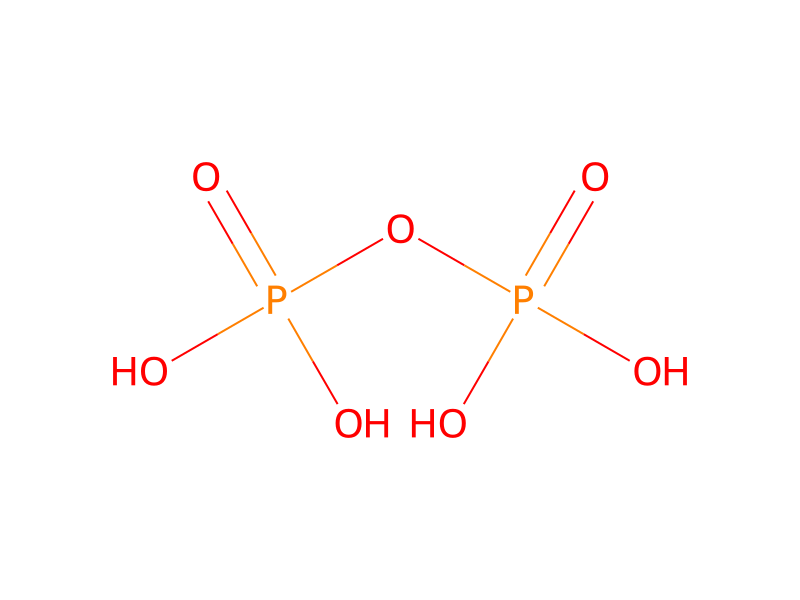
Basic information
- CAS
14000-31-8- Standard SMILES
O=P(O)(O)OP(=O)(O)O- InChIKey
XPPKVPWEQAFLFU-UHFFFAOYSA-N- Molecular formula
- H4O7P2
- Average molar mass
- 177.98 g/mol
- Monoisotopic mass
- 177.94322646
Names & identifiers
- Preferred name
- Pyrophosphoric acid
- IUPAC
- phosphono dihydrogen phosphate
- English name
- Diphosphate
- Molecular formula
- O7P2
- Molecular weight
- 173.94
Names & synonyms
Diphosphoric acidPyrophosphoric acid2466-09-3phosphono dihydrogen phosphate(phosphonooxy)phosphonic acid4E862E7GRQH4P2O7CHEBI:29888DTXSID4075035RefChem:55955DTXCID4037118219-574-0
Show more names
Diphosphatediphosphate(4-)
hydron;phosphonato phosphateDiphosphorsaeurePhosphonooxyphosphonic acidPyrophosphoric Acid (Technical Grade)33943-49-6PPVPyrophosphorsaeureacide diphosphorique
Database identifiers
- CAS
14000-31-8、2466-09-3、33943-49-6- PubChem CID
- 1023
- DTXSID
DTXSID4075035- ChEMBL
CHEMBL1160571- ChEBI
CHEBI:29888- UNII
- 4E862E7GRQ
- EC Number
- 219-574-0
- Nikkaji
- J43.595C
Properties
Computed structural properties
- XLogP
- -3.2
- Topological polar surface area
- 124 Ų
- Hydrogen bond donors
- 4
- Hydrogen bond acceptors
- 7
- Rotatable bonds
- 2
- Heavy atoms
- 9
- Formal charge
- 0
- Complexity
- 147
Experimental & physicochemical properties
Melting Point
61
61 °C
Physical Description
Hygroscopic solid; [Merck Index] Light yellow hygroscopic solid; [Acros Organics MSDS]
Solid
Collision Cross Section
145.58 Ų [M+Na]+ [CCS Type: DT; Method: stepped-field]
144.7 Ų [M+Na]+
Physicochemical properties
- FDA UNII
- 3 SSV2V6L3 · X3SSV2V6L3
- EPA Substance Registry System
- Diphosphate (14000-31-8)
- Symbol(GHS)
- 7 · GHS07
- Signal word
- Warning
- Hazard statements
- 319 · H319-H315
- Precautionary statements
- 264 · P264-P280-P305+P351+P338-P337+P313P-P264-P280-P302+P352-P321-P332+P313-P362
Safety & regulation
GHS classification
GHS Classification
Danger
H302 (63.9%): Harmful if swallowed [Warning Acute toxicity, oral];H314 (100%): Causes severe skin burns and eye damage [Danger Skin corrosion/irritation];H318 (31.1%): Causes serious eye damage [Danger Serious eye damage/eye irritation]
P260, P264, P264+P265, P270, P280, P301+P317, P301+P330+P331, P302+P361+P354, P304+P340, P305+P354+P338, P316, P317, P321, P330, P363, P405, and P501 (click each P-code to see the statement)
Aggregated GHS information provided per 119 reports by companies from 3 notifications to the ECHA C&L Inventory. Each notification may be associated with multiple companies.;Information may vary between notifications depending on impurities, additives, and other factors. The percentage value in parenthesis indicates the notified classification ratio from companies that provide hazard codes. Only hazard codes with percentage values above 10% are shown. For more detailed information, please visit ECHA C&L website.
Hazard information
Regulatory Information
Chemical: Diphosphoric acid
Diphosphoric acid: Does not have an individual approval but may be used under an appropriate group standard
Other Safety InformationIMAP assessments - Polyphosphoric acids: Human health tier II assessment
Hazards SummaryCauses somnolence, ataxia, and dyspnea in oral lethal-dose studies of rats; [RTECS] Causes burns; Inhalation may cause corrosive injuries to upper respiratory tract and lungs; [Acros Organics MSDS]
Hazard Classes and Categories
Acute Tox. 4 (63.9%);Skin Corr. 1B (100%);Eye Dam. 1 (31.1%)
Acute toxicity - category 4;Skin corrosion - category 1
Toxicology
Adverse EffectsDermatotoxin - Skin burns.;Toxic Pneumonitis - Inflammation of the lungs induced by inhalation of metal fumes or toxic gases and vapors.
Regulatory information
Regulatory Information
Chemical: Diphosphoric acid
Diphosphoric acid: Does not have an individual approval but may be used under an appropriate group standard
Safety data
- Signal word
- Warning
- Symbol(GHS)
- GHS07
- Hazard statements
- H319-H315
- Precautionary statements
- P264-P280-P305+P351+P338-P337+P313P-P264-P280-P302+P352-P321-P332+P313-P362
Chemistry & industry
Pharmacology
Tissue LocationsEpidermis;Fibroblasts;Intestine;Neuron;Platelet;Prostate;Skeletal Muscle;Testis
Cellular LocationsCytoplasm;Endoplasmic reticulum;Mitochondria;Nucleus;Peroxisome
Metabolite Pathways
2-Hydroxyglutric Aciduria (D And L Form);27-Hydroxylase Deficiency;3-Phosphoglycerate dehydrogenase deficiency;4-Hydroxybutyric Aciduria/Succinic Semialdehyde Dehydrogenase Deficiency;Abacavir Action Pathway;Acylcarnitine (13Z,16Z)-Hexacosa-13,16-dienoylcarnitine;Acylcarnitine (17Z)-Hexacos-17-enoylcarnitine;Acylcarnitine (2S,3R)-3-Hydroxy-2-methylbutanoylcarnitine;Acylcarnitine (7Z,9Z,12Z,15Z,18Z,21Z)-tetracosa-7,9,12,15,18,21-hexaenoylcarnitine;Acylcarnitine 3-Hydroxydecanoylcarnitine;Total 25388 pathways, visit the HMDB page for details
Uses & manufacturing
UsesPyrophosphates are used with technetium 99m for bone scanning; [REPROTOX]
Upstream & downstream products
Upstream raw materials
Suppliers2 total
陕西缔都新材料有限公司81124267 17392282731 · [email protected]
陕西缔都医药化工有限公司+86-29-81139210 17389186172 · [email protected]
Additional notes
DefinitionChEBI: Diphosphate(4-) is a diphosphate ion. It is a conjugate base of a diphosphate(3-).
Related reactions
37 records


Compound notes
Loading…