
HRID 5213As reactant

503-30-0C1COC1AHHWIHXENZJRFG-UHFFFAOYSA-N1,3-propylene oxide is a clear, colorless liquid with an agreeable aromatic odor. (NTP, 1992)
503-30-0DTXSID8025969CHEMBL1538076CHEBI:30965log Kow= -0.14
-0.14
0.893 at 77 °F (NTP, 1992) - Less dense than water; will float
0.8930 @ 25 °C/4 °C
10 to 50 mg/mL at 68 °F (NTP, 1992)
SOL IN ALL PROPORTIONS OF WATER, ALCOHOL; SOL IN ETHER; VERY SOL IN ACETONE, ORGANIC SOLVENTS
In water, miscible.
-19 °F (NTP, 1992)
-28 °C
122 °F at 760 mmHg (NTP, 1992)
48 °C @ 750 mm Hg
Safety information is for reference only and does not replace the supplier’s Safety Data Sheet (SDS), applicable regulations, or professional assessment.
Danger
H225: Highly Flammable liquid and vapor [Danger Flammable liquids]
P210, P233, P240, P241, P242, P243, P261, P264, P270, P271, P280, P301+P317, P302+P352, P303+P361+P353, P304+P340, P317, P321, P330, P362+P364, P370+P378, P403+P235, and P501 (click each P-code to see the statement)
Danger
H225 (100%): Highly Flammable liquid and vapor [Danger Flammable liquids]
P210, P233, P240, P241, P242, P243, P261, P264, P270, P271, P280, P301+P317, P302+P352, P303+P361+P353, P304+P340, P317, P321, P330, P362+P364, P370+P378, P403+P235, and P501 (click each P-code to see the statement)
1,3-PROPYLENE OXIDE reacts with Grignard reagents and organolithium compounds. It is also incompatible with oxidizing agents and strong acids. (NTP, 1992). An explosion occurred when propylene oxide was added to epoxy resin. Polymerization was catalyzed by amine accelerator in the resin [Bretherick 1995]. Propylene oxide and sodium hydroxide base-catalyzed the polymerization of the former, causing ignition and explosion of a drum of the crude product. [Combust Sci. Technol., 1983].
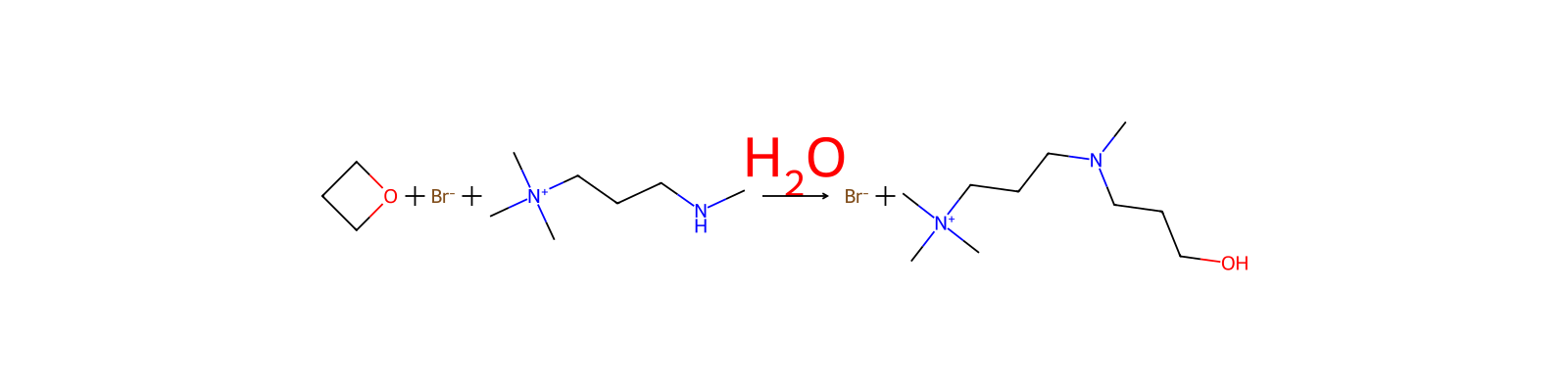
Used as a chemical intermediate for epoxy resins and 3-substituted propanols; [HSDB]
CHEM INT, EG, FOR EPOXY RESINS & 3-SUBSTITUTED PROPANOLS
Photoreactions leading to carefully selected oxetanes are impressive tools in the construction of complex molecules ... such as drugs, crop protection agents, and fragrants. /Oxetanes/
/Chemical intermediate/
Prepd by dropwise addition of 3-chloropropyl acetate to hot potassium hydroxide soln: Noller, Org Syn 29, 92 (1949); modified procedure: Searles, J Am Chem Soc, 73, 124 (1951).
REACTION OF 3-BROMOPROPANOL WITH POTASSIUM HYDROXIDE
UsesTrimethylene oxide useful for the synthesis of 3-substituted propanols by reaction with Grignards or organolithiums in the presence of CuBr.
General DescriptionClear, colorless liquid with an agreeable aromatic odor.





324.0 [mmHg]
324 mm Hg @ 25 °C
Flam. Liq. 2 (100%)
Flammable liquid - category 2
Flam. Liq. 2
EYES: First check the victim for contact lenses and remove if present. Flush victim's eyes with water or normal saline solution for 20 to 30 minutes while simultaneously calling a hospital or poison control center. Do not put any ointments, oils, or medication in the victim's eyes without specific instructions from a physician. IMMEDIATELY transport the victim after flushing eyes to a hospital even if no symptoms (such as redness or irritation) develop.
SMALL SPILLS AND LEAKAGE: If you spill this chemical, FIRST REMOVE ALL SOURCES OF IGNITION. Then, use absorbent paper to pick up all liquid spill material. Seal the absorbent paper, as well as any of your clothing which may be contaminated, in a vapor-tight plastic bag for eventual disposal. Wash any surfaces you may have contaminated with a soap and water solution. Do not reenter the contaminated area until the Safety Officer (or other responsible person) has verified that the area has been properly cleaned.
SRP: At the time of review, criteria for land treatment or burial (sanitary landfill) disposal practices are subject to significant revision. Prior to implementing land disposal of waste residue (including waste sludge), consult with environmental regulatory agencies for guidance on acceptable disposal practices.
RECOMMENDED RESPIRATOR: When working with this chemical, wear a NIOSH-approved full face chemical cartridge respirator equipped with the appropriate organic vapor cartridges. If that is not available, a half face respirator similarly equipped plus airtight goggles can be substituted. However, please note that half face respirators provide a substantially lower level of protection than do full face respirators. (NTP, 1992)
TERRESTRIAL FATE: Based on a classification scheme(1), an estimated Koc value of 20(SRC), determined from a measured log Kow of -0.14(2) and a regression-derived equation(3), indicates that 1,3-epoxypropane is expected to have very high mobility in soil(SRC). Volatilization of 1,3-epoxypropane from moist soil surfaces may be an important fate process(SRC) given an estimated Henry's Law constant of 2.5X10⁻⁵ atm-cu m/mole(SRC), calculated from its vapor pressure of 324 mm Hg(4) and water solubility of 1,000,000 mg/l(5). The potential for volatilization of 1,3-epoxypropane from dry soil surfaces may exist(SRC) based upon its vapor pressure(4).
AQUATIC FATE: Based on a classification scheme(1), an estimated Koc value of 20(SRC), determined from a measured log Kow of -0.14(2) and a regression-derived equation(3), indicates that 1,3-epoxypropane is not expected to adsorb to suspended solids and sediment(SRC). Volatilization of 1,3-epoxypropane from water surfaces is expected to be an important fate process(SRC) given an estimated Henry's Law constant of 2.5X10⁻⁵ atm-cu m/mole(SRC), calculated from its vapor pressure of 324 mm Hg(4) and water solubility of 1,000,000 mg/l(5). Using this Henry's Law constant and an estimation method(3), volatilization half-lives for a model river and model lake are 29 and 269 hours, respectively(SRC). According to a classification scheme(6), an estimated BCF of 0.5(SRC), calculated from a log Kow of -0.14(2) and a regression-derived equation(7), suggests the potential for bioconcentration in aquatic organisms is low.
ATMOSPHERIC FATE: According to a model of gas/particle partitioning of semivolatile organic compounds in the atmosphere(1), 1,3-epoxypropane, which has a vapor pressure of 3.24X10+002 mm Hg at 25 °C(2), is expected to exist solely in the vapor-phase. Vapor-phase 1,3-epoxypropane is degraded in the atmosphere by reaction with photochemically-produced hydroxyl radicals(SRC); the half-life for this reaction in air is estimated to be 1.6 days(SRC), calculated from its rate constant of 1.03X10⁻¹¹ cu cm/molecule-sec at 25 °C(3).
The Koc of 1,3-epoxypropane is estimated as 20(SRC), using a log Kow of -0.14(1) and a regression-derived equation(2). According to a classification scheme(3), this estimated Koc value suggests that 1,3-epoxypropane is expected to have very high mobility in soil.
An estimated BCF of 0.5 was calculated for 1,3-epoxypropane(SRC), using a log Kow of -0.14(1) and a regression-derived equation(2). According to a classification scheme(3), this BCF suggests the potential for bioconcentration in aquatic organisms is low(SRC).
The Henry's Law constant for 1,3-epoxypropane is estimated as 2.5X10⁻⁵ atm-cu m/mole(SRC) based upon its vapor pressure, 324 mm Hg(1), and water solubility, 1,000,000 mg/l(2). This Henry's Law constant indicates that 1,3-epoxypropane is expected to volatilize from water surfaces(3). Based on this Henry's Law constant, the volatilization half-life from a model river (1 m deep, flowing 1 m/sec, wind velocity of 3 m/sec)(3) is estimated as 29 hours(SRC). The volatilization half-life from a model lake (1 m deep, flowing 0.05 m/sec, wind velocity of 0.5 m/sec)(3) is estimated as 269 hours(SRC). 1,3-Epoxypropane's estimated Henry's Law constant indicates that volatilization from moist soil surfaces may occur(SRC). The potential for volatilization of 1,3-epoxypropane from dry soil surfaces may exist(SRC) based upon its vapor pressure(1).
The rate constant for the vapor-phase reaction of 1,3-epoxypropane with photochemically-produced hydroxyl radicals is 1.3X10⁻¹¹ cu cm/molecule-sec at 25 °C(1). This corresponds to an atmospheric half-life of about 1.6 days at an atmospheric concentration of 5X10+5 hydroxyl radicals per cu cm(1). 1,3-Epoxypropane may undergo hydrolysis in the environment because it contains hydrolyzable functional groups(2) but is not expected to directly photolyze due to a lack of absorption in the environmental UV spectrum (>290 nm)(2).
1,3-Epoxypropane's production and use as a chemical intermediate may result in its release to the environment through various waste streams. If released to air, a vapor pressure of 324 mm Hg at 25 °C indicates 1,3-epoxypropane will exist solely as a vapor in the ambient atmosphere. Vapor-phase 1,3-epoxypropane will be degraded in the atmosphere by reaction with photochemically-produced hydroxyl radicals; the half-life for this reaction in air is estimated to be 1.6 days. If released to soil, 1,3-epoxypropane is expected to have very high mobility based upon an estimated Koc of 20. Volatilization from moist soil surfaces may be an important fate process based upon an estimated Henry's Law constant of 2.5X10⁻⁵ atm-cu m/mole. 1,3-Epoxypropane may volatilize from dry soil surfaces based upon its vapor pressure. If released into water, 1,3-epoxypropane is not expected to adsorb to suspended solids and sediment based upon its estimated Koc. Volatilization from water surfaces may be an important fate process based upon this compound's estimated Henry's Law constant. Estimated volatilization half-lives for a model river and model lake are 29 and 269 hours, respectively. An estimated BCF of 0.5 suggests the potential for bioconcentration in aquatic organisms is low. Hydrolysis may be an important environmental fate process since this compound contains hydrolyzable functional groups, however information regarding the kinetics of this reaction are not available. Occupational exposure to 1,3-epoxypropane may occur through inhalation and dermal contact with this compound at workplaces where 1,3-epoxypropane is produced or used. (SRC)
DefinitionChEBI: A saturated organic heteromonocyclic parent that is a four-membered ring comprising of three carbon atoms and an oxygen atom.