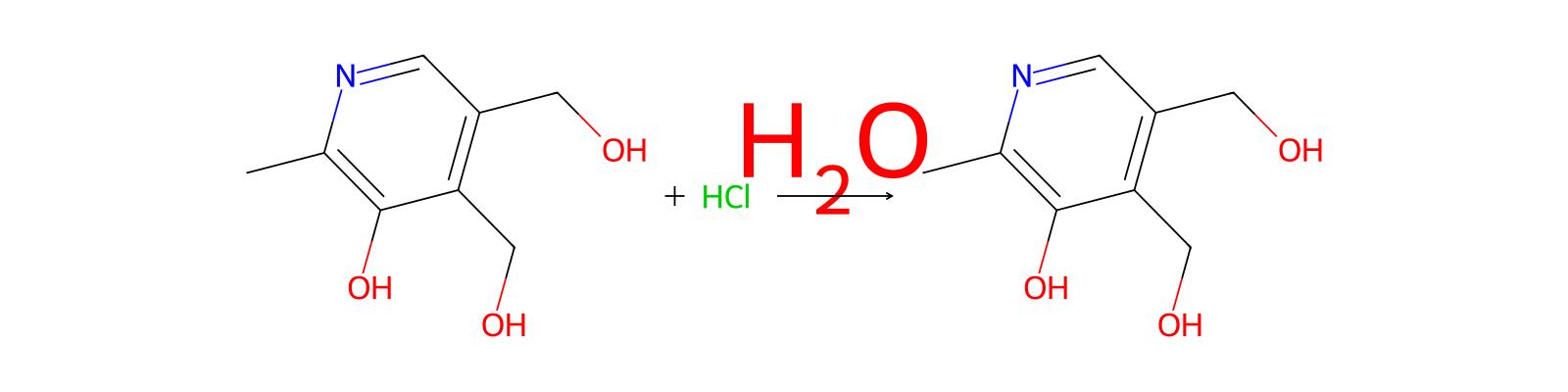
HRID 198087As reactant
Completing data — refresh the page later to see the latest

65-23-6Cc1ncc(CO)c(CO)c1OLXNHXLLTXMVWPM-UHFFFAOYSA-NPyridoxine is a hydroxymethylpyridine with hydroxymethyl groups at positions 4 and 5, a hydroxy group at position 3 and a methyl group at position 2. The 4-methanol form of vitamin B6, it is converted intoto pyridoxal phosphate which is a coenzyme for synthesis of amino acids, neurotransmitters, sphingolipids and aminolevulinic acid. It has a role as a cofactor, a mouse metabolite, a Saccharomyces cerevisiae metabolite, an Escherichia coli metabolite and a human metabolite. It is a member of methylpyridines, a vitamin B6, a monohydroxypyridine and a hydroxymethylpyridine.
65-23-6DTXSID4023541CHEMBL1364CHEBI:16709Pharmaceuticals
Pharmaceuticals -> Listed in ZINC15
-0.77
-0.77
Breast Feeding; Lactation; Milk, Human; Vitamins
FDA approved drugs -> Active ingredient
FDA approved drugs -> Active ingredient
FDA approved drugs -> Active ingredient
Vitamins and minerals
159-162 °C
159 - 162 °C
Dry Powder
White powder; [Alfa Aesar MSDS]
Solid
Positive
3.28
2.7
Agilent XCT
Electrospray ionization
formic acid (5.3nM)
133.7 Ų [M+H]+ [CCS Type: DT; Buffer gas: N2; Ionization: APCI+; Dataset: TOXCAST; Source Identifier: DTXSID1040792]
132.4 Ų [M-H]- [CCS Type: DT; Method: single field calibrated with ESI Low Concentration Tuning Mix (Agilent)]
132.3 Ų [M+H]+ [CCS Type: TW; Method: calibrated with polyalanine and drug standards]
130.75 Ų [M-H]- [CCS Type: DT; Method: single field calibrated with Agilent tune mix (Agilent)]
129.89 Ų [M+H]+ [CCS Type: TW; Method: calibrated with polyalanine and drug standards]
148.49 Ų [M+Na]+ [CCS Type: DT; Method: stepped-field]
Safety information is for reference only and does not replace the supplier’s Safety Data Sheet (SDS), applicable regulations, or professional assessment.
This chemical does not meet GHS hazard criteria for 3.8% (2 of 52) of reports.
Warning
H315 (96.2%): Causes skin irritation [Warning Skin corrosion/irritation]
P261, P264, P264+P265, P271, P280, P302+P352, P304+P340, P305+P351+P338, P319, P321, P332+P317, P337+P317, P362+P364, P403+P233, P405, and P501 (click each P-code to see the statement)
Aggregated GHS information provided per 52 reports by companies from 8 notifications to the ECHA C&L Inventory. Each notification may be associated with multiple companies.
Chemical: 3,4-Pyridinedimethanol, 5-hydroxy-6-methyl-
3,4-Pyridinedimethanol, 5-hydroxy-6-methyl- is listed on the EPA's Chemical Data Reporting (CDR) system. Manufacturers and importers of 3,4-Pyridinedimethanol, 5-hydroxy-6-methyl- are required to report information about their production and use of this chemical to the EPA under the Toxic Substances Control Act (TSCA). (40 eCFR Part 711)
REACH registered substance: Pyridoxine (EC: 200-603-0)
Pyridoxine: Does not have an individual approval but may be used under an appropriate group standard
Has been tested in humans to relieve nausea and vomiting during pregnancy; Chronic ingestion of gram quantities can cause ataxia and sensory neuropathy; Has demonstrated testicular toxicity in rats; [REPROTOX] An irritant; May have cumulative adverse effects; [Alfa Aesar MSDS] See Pyridoxine hydrochloride.
Vitamin B6 is the collective term for a group of three related compounds, pyridoxine (PN), pyridoxal (PL) and pyridoxamine (PM), and their phosphorylated derivatives, pyridoxine 5'-phosphate (PNP), pyridoxal 5'-phosphate (PLP) and pyridoxamine 5'-phosphate (PMP). Although all six of these compounds should technically be referred to as vitamin B6, the term vitamin B6 is commonly used interchangeably with just one of them, pyridoxine. Vitamin B6, principally in its biologically active coenzyme form pyridoxal 5'-phosphate, is involved in a wide range of biochemical reactions, including the metabolism of amino acids and glycogen, the synthesis of nucleic acids, hemogloblin, sphingomyelin and other sphingolipids, and the synthesis of the neurotransmitters serotonin, dopamine, norepinephrine and gamma-aminobutyric acid (GABA).
Drug-Induced Liver Injury Severity and Toxicity (DILIst)
pyridoxine
DILI Negative
Intravenous
DOI:10.1016/j.drudis.2019.09.022
A11HA02
A - Alimentary tract and metabolism
QA - Alimentary tract and metabolism
A11HA02
Vitamin B6 (pyridoxine) is a water-soluble vitamin used in the prophylaxis and treatment of vitamin B6 deficiency and peripheral neuropathy in those receiving isoniazid (isonicotinic acid hydrazide, INH). Vitamin B6 has been found to lower systolic and diastolic blood pressure in a small group of subjects with essential hypertension. Hypertension is another risk factor for atherosclerosis and coronary heart disease. Another study showed pyridoxine hydrochloride to inhibit ADP- or epinephrine-induced platelet aggregation and to lower total cholesterol levels and increase HDL-cholesterol levels, again in a small group of subjects. Vitamin B6, in the form of pyridoxal 5'-phosphate, was found to protect vascular endothelial cells in culture from injury by activated platelets. Endothelial injury and dysfunction are critical initiating events in the pathogenesis of atherosclerosis. Human studies have demonstrated that vitamin B6 deficiency affects cellular and humoral responses of the immune system. Vitamin B6 deficiency results in altered lymphocyte differentiation and maturation, reduced delayed-type hypersensitivity (DTH) responses, impaired antibody production, decreased lymphocyte proliferation and decreased interleukin (IL)-2 production, among other immunologic activities.
Vitamin B6 is the collective term for a group of three related compounds, pyridoxine (PN), pyridoxal (PL) and pyridoxamine (PM), and their phosphorylated derivatives, pyridoxine 5'-phosphate (PNP), pyridoxal 5'-phosphate (PLP) and pyridoxamine 5'-phosphate (PMP). Although all six of these compounds should technically be referred to as vitamin B6, the term vitamin B6 is commonly used interchangeably with just one of them, pyridoxine. Vitamin B6, principally in its biologically active coenzyme form pyridoxal 5'-phosphate, is involved in a wide range of biochemical reactions, including the metabolism of amino acids and glycogen, the synthesis of nucleic acids, hemogloblin, sphingomyelin and other sphingolipids, and the synthesis of the neurotransmitters serotonin, dopamine, norepinephrine and gamma-aminobutyric acid (GABA).
Pyridoxine is a prodrug primarily metabolized in the liver. The metabolic scheme for pyridoxine is complex, with formation of primary and secondary metabolites along with interconversion back to pyridoxine. Pyridoxine's major metabolite is 4-pyridoxic acid.
Hepatic. Half Life: 15-20 days
KV2JZ1BI6Z
PYRIDOXINE
Established Pharmacologic Class [EPC] - Vitamin B6 Analog
Chemical/Ingredient structural concept [Chemical/Ingredient] - Vitamin B 6
Chemical/Ingredient structural concept [Chemical/Ingredient] - Analogs/Derivatives
Pyridoxine is a Vitamin B6 Analog. The chemical classification of pyridoxine is Vitamin B 6 and Analogs/Derivatives.
The B vitamins are readily absorbed from the gastrointestinal tract, except in malabsorption syndromes. Pyridoxine is absorbed mainly in the jejunum. The Cmax of pyridoxine is achieved within 5.5 hours.
The major metabolite of pyridoxine, 4-pyridoxic acid, is inactive and is excreted in urine
Pyridoxine main active metabolite, pyridoxal 5’-phosphate, is released into the circulation (accounting for at least 60% of circulating vitamin B6) and is highly protein bound, primarily to albumin.
The 4-methanol form of vitamin B6 that is converted to the coenzyme pyridoxal phosphate; [ChemIDplus] Permitted for use as an inert ingredient in non-food pesticide products; [EPA]
Use (kg; approx.) in Germany (2009): >7500
For the treatment of vitamin B6 deficiency and for the prophylaxis of isoniazid-induced peripheral neuropathy.
Soap, Cleaning Compound, and Toilet Preparation Manufacturing
3,4-Pyridinedimethanol, 5-hydroxy-6-methyl-: ACTIVE
DescriptionPyridoxine hydrochloride provides pyridoxine, which is also known as vitamin B6. Vitamin B6 is naturally found in foods such as cereals, beans, vegetables, liver, meat, and eggs. Vitamin B6 functionalizes as a coenzyme in the metabolism of protein, carbohydrate, and fat. Vitamin 6 is needed to maintain the health of nerves, skin, and red blood cells. Pyridoxine is used to prevent or treat vitamin B6 deficiency caused by inadequate dietary intake. It is also used to treat drug induced deficiency in patients taking isoniazid or oral contraceptives.
HistoryThe discovery of vitamin was tortuous and legendary. After fat-soluble A and water soluble B were discovered by the year of 1915, the discovery of vitamins entered into a rapid developed period. In separation process of riboflavin by Kuhn and his colleagues, they noticed the unusual relationship between growth-promoting activ ity and fluorescence of extracts. Then they supposed that the existence of no fluorescent substances were very necessary for growth-promoting activity of riboflavin. And they considered this phenomenon as the evidence of a second chem ical existence in the thermostable complex. At last, they named this substance as vitamin B6 .Vitamin B6 is widely distributed in foods, including meats, whole-grain products (especially wheat), vegetables, and nuts. In the cereal grains, vitamin B6 is concen trated primarily in the germ and aleuronic layer. Thus, the refining of grains in the production of flours, which removes much of these fractions, results in substantial reductions of vitamin B6 content. The chemical forms of vitamin B6 tend to vary among foods between plant and animal origin: plant tissues contain most pyridox ine (the free alcohol form, pyridoxol), whereas animal tissues contain most pyri doxal and pyridoxamine.
Usesantibacterial
Usespyridoxine HCL is a skin-conditioning agent that is also widely used in hair products.
UsesVitamin B6, a water-soluble vitamin with a solubility of 1 g in 5 ml of water. It functions in the utilization of protein and is an essential nutrient in enzyme reactions. It is necessary for proper growth. During processing, there is a loss due to leaching of the vitamin in water. It is destroyed by high temperatures, high irradiation, and exposure to light. During storage, loss increases with temperature and storage time. It is found in liver, eggs, and meats.
General DescriptionThe discovery of vitamin B6 is generally ascribed to Paul Gyrgy who first realized there was a vitamin that was distinctly different from vitamin B2 in 1934. Pyridoxine (PN) is the C4 hydroxymethyl derivative, pyridoxal (PL) is the C4 formyl derivative and pyridoxamine (PM) is the C4 aminomethyl derivative of 5-(hydroxymethyl)- 2-methylpyridin-3-ol). Each of these are also converted to their corresponding 5'-phosphate derivatives referred to as pyridoxine 5'-phosphate (PNP), pyridoxal 5'-phosphate (PLP), and pyridoxamine 5'-phosphate (PMP), respectively . Because of their ability to interconvert, all are considered active forms of vitamin B6 in vivo. Although PLP is the major coenzyme form, PMP can also function as a coenzyme primarily in aminotransferases. The major metabolite is 4-pyridoxic acid, which is excreted in the urine.
DefinitionChEBI: A hydroxymethylpyridine with hydroxymethyl groups at positions 4 and 5, a hydroxy group at position 3 and a methyl group at position 2. The 4-methanol form of vitamin B6, it is converted intoto pyridoxal phosphate which is a coenzyme f r synthesis of amino acids, neurotransmitters, sphingolipids and aminolevulinic acid.