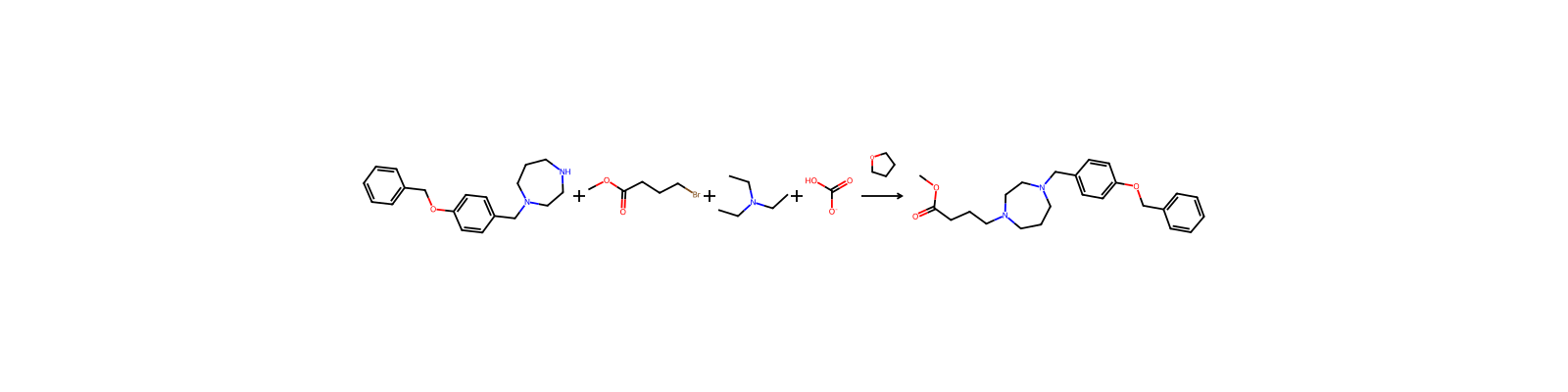

Basic information
- CAS
4897-84-1- Standard SMILES
COC(=O)CCCBr- InChIKey
QAWFLJGZSZIZHO-UHFFFAOYSA-N- Molecular formula
- C5H9BrO2
- Average molar mass
- 181.03 g/mol
- Monoisotopic mass
- 179.97859
Names & identifiers
- Preferred name
- Methyl 4-bromobutyrate
- IUPAC
- methyl 4-bromobutanoate
- English name
- Methyl 4-bromobutyrate
- Molecular formula
- C5H9BrO2
- Molecular weight
- 181.03
Names & synonyms
Methyl 4-bromobutyrate4897-84-1EINECS 225-523-3DTXSID50197651RefChem:816295DTXCID10120142225-523-3methyl 4-bromobutanoateBr-C3-methyl ester4-Bromobutyric Acid Methyl EsterMETHYL-4-BROMOBUTYRATEMFCD00041482
Show more names
Br(CH2)3C(O)OCH34-broMo butyrate4-bromopentanoateMethyl 4-broMobutyraMethl 4-broMobutyrateMETHYL 4-BROMO-N-BUTYRATEM**Methyl 4-bromobutyrate
Butanoic acid, 4-bromo-, methyl ester4-bromo-butyric acid methyl ester4-bromobutanoic acid methyl esterButyric acid, 4-bromo-, methyl esterMethyl gamma-bromobutyrate5RA3LF2EYNSCHEMBL260980orb1690499
Database identifiers
- CAS
4897-84-1- PubChem CID
- 107604
- DTXSID
DTXSID50197651- UNII
- 5RA3LF2EYN
- EC Number
- 225-523-3
- Nikkaji
- J26.261G
Properties
Computed structural properties
- XLogP
- 1.5
- Topological polar surface area
- 26.3 Ų
- Hydrogen bond donors
- 0
- Hydrogen bond acceptors
- 2
- Rotatable bonds
- 4
- Heavy atoms
- 8
- Formal charge
- 0
- Complexity
- 72
Physicochemical properties
- Melting point
- 175 · 175-190 °C
- Boiling point
- 186 · 186-187 °C
- Density
- 1.434 · 1.434
- refractive index
- 1.462 · 1.4620
- Flash point
- 186 · 186-187°C
- storage temp.
- Keep in dark place,Sealed in dry,Room Temperature
- form
- Liquid
- Specific Gravity
- 1.434 · 1.434
- color
- Clear colorless to pale yellow
- Water Solubility
- insoluble
- BRN
- 1745618 · 1745618
- InChI
- InChI=1S/C5H9BrO2/c1-8-5(7)3-2-4-6/h2-4H2,1H3
- InChIKey
- QAWFLJGZSZIZHO-UHFFFAOYSA-N
- SMILES
- C(OC)(=O)CCCBr
- CAS DataBase Reference
- 4897 · 4897-84-1(CAS DataBase Reference)
- NIST Chemistry Reference
- 4 · Methyl 4-bromobutyrate(4897-84-1)
- Symbol(GHS)
- 7 · GHS07
- Signal word
- Warning
- Hazard statements
- 227 · H227-H315-H319
- Precautionary statements
- 210 · P210-P264-P280-P302+P352+P332+P313+P362+P364-P305+P351+P338+P337+P313-P403+P235-P501-P280a-P305+P351+P338-P321-P332+P313-P337+P313
- Hazard Codes
- Xn
- Risk Statements
- 36 · 36/37/38-22
- Safety Statements
- 37 · 37/39-26-24/25
- HS Code
- 29156000 · 29156000
Safety & regulation
GHS classification
GHS Classification
Warning
H302 (10%): Harmful if swallowed [Warning Acute toxicity, oral];H315 (100%): Causes skin irritation [Warning Skin corrosion/irritation];H319 (100%): Causes serious eye irritation [Warning Serious eye damage/eye irritation];H335 (30%): May cause respiratory irritation [Warning Specific target organ toxicity, single exposure; Respiratory tract irritation]
P261, P264, P264+P265, P270, P271, P280, P301+P317, P302+P352, P304+P340, P305+P351+P338, P319, P321, P330, P332+P317, P337+P317, P362+P364, P403+P233, P405, and P501 (click each P-code to see the statement)
Aggregated GHS information provided per 10 reports by companies from 6 notifications to the ECHA C&L Inventory. Each notification may be associated with multiple companies.;Information may vary between notifications depending on impurities, additives, and other factors. The percentage value in parenthesis indicates the notified classification ratio from companies that provide hazard codes. Only hazard codes with percentage values above 10% are shown. For more detailed information, please visit ECHA C&L website.
Hazard information
Hazard Classes and CategoriesAcute Tox. 4 (10%);Skin Irrit. 2 (100%);Eye Irrit. 2A (100%);STOT SE 3 (30%)
Safety data
- hs_code
- 29156000
- risk_code
- 36/37/38-22
- Signal word
- Warning
- Symbol(GHS)
- GHS07
- hazard_code
- Xn
- safety_code
- 37/39-26-24/25
- Hazard statements
- H227-H315-H319
- Precautionary statements
- P210-P264-P280-P302+P352+P332+P313+P362+P364-P305+P351+P338+P337+P313-P403+P235-P501-P280a-P305+P351+P338-P321-P332+P313-P337+P313
Chemistry & industry
Applications
UsesBr-C3-methyl ester is a Alkyl/ether-based PROTAC linker that can be used in the synthesis of PROTAC PD-1/PD-L1 degrader-1 (HY-131183)[1].
Upstream & downstream products
Upstream raw materials
Downstream products
Suppliers100 total
国药集团化学试剂有限公司86-21-63210123 · [email protected]
梯希爱(上海)化成工业发展有限公司021-67121386 · [email protected]
衢州润东化工有限公司0570-8789886 18892685668 · [email protected]
南京兰亚化工贸易有限公司+86-25-8331-5620 · [email protected]
韶远科技(上海)有限公司021-50795510 4000665055 · [email protected]
上海将来实业股份有限公司400-0066400 13621662912 · [email protected]
Syntechem Co.,Ltd[email protected]
上海迈瑞尔生化科技有限公司4006356688 18621169109 · [email protected]
北京华威锐科化工有限公司0757-86329057 18934348241 · [email protected]
阿法埃莎(中国)化学有限公司400-6106006 · [email protected]
安耐吉化学&3A(安徽泽升科技股份有限公司)400-0056266 · [email protected]
上海瀚鸿科技股份有限公司021-54306202 13764082696 · [email protected]
上海相辉医药科技有限公司13761987713 · [email protected]
嘉兴市艾森化工有限公司0573-85285100 18627885956 · [email protected]
上海隆盛化工有限公司58099637 13585536065 · [email protected]
山东西亚化学有限公司13355009207 13355009207 · [email protected]
玛雅试剂+86 (573) 82222445 (0)18006601000 452520369 · [email protected]
四川库利南科技有限公司400-1166-196 18981987031 · [email protected]
艾科试剂4008-755-333 18080918076 · [email protected]
上海思域化工科技有限公司86-21-34053660 · [email protected]
赛默飞世尔科技(中国)有限公司800-810-5118 · [email protected]
北京伊诺凯科技有限公司400-810-7969 010-59572699 · [email protected]
江苏艾康生物医药研发有限公司025-66113011 13913916777 · [email protected]
TCI AMERICA800-4238616 · [email protected]
TOKYO CHEMICAL INDUSTRY CO., LTD.03-36680489 · [email protected]
TCI Europe320-37350700 · [email protected]
越林试剂021-62960152 · [email protected]
上海汇凯化学科技有限公司021-61995394 18916691159 · [email protected]
上海湄水化工科技有限公司021-60549325 18616193163
上海将来实业股份有限公司400-0066400 13621662912 · [email protected]
HBCChem, Inc.+1-510-219-6317 · [email protected]
郑州鸿晟医药科技有限公司0371-0371-13526885213 15637198702 · [email protected]
成都零六生物科技有限公司400-1166-196 13458535857 · [email protected]
湖南华腾制药有限公司400-8592883 · [email protected]
上海御略医药科技有限公司021-60345187 13671753212 · [email protected]
上海麦克林生化科技股份有限公司15221275939 15221275939 · [email protected]
杭州杰恒化工有限公司0571-87396432 · [email protected]
上海永叶生物科技有限公司86-021-61559134 15921386130 · [email protected]
上海有朋化工有限公司021-69005955 13701776567 · [email protected]
北京海力扬化学科技有限公司13718199399 · [email protected]
北京欣赛维化学科技有限公司010-56218822 13717722232 · [email protected]
四川海诺威科技有限公司13708085536 13708085536 · [email protected]
上海凯赛化工有限公司021-33516722 13701817765 · [email protected]
上海彤源化工有限公司021-021-69182866 13701855675 · [email protected]
北京华扬致成科技有限公司13716033033 · [email protected]
上海蓝润化学有限公司021-69515658 ; 69515628 13701998368 · [email protected]
上海容立化学科技有限公司021-69992220 13701886816 · [email protected]
上海康拓化工有限公司021-69185552 13701777608 · [email protected]
湖北巨胜科技有限公司027-59599241 18871490274 · [email protected]
南京晖康生物科技有限公司025-52110956 17372769668 · [email protected]
Related reactions
155 records



Compound notes
Loading…